Houseplant Hoarding Intervention — When to Stop Buying & Start Caring
You've looked at your living room and thought, "How did this happen?" You didn't set out to become a plant hoarder. It started with one cute pothos. Then you saw a monstera at Home Depot. Then your coworker was downsizing and—oops, now you have forty-seven plants and you can't remember the last time you watered half of them.
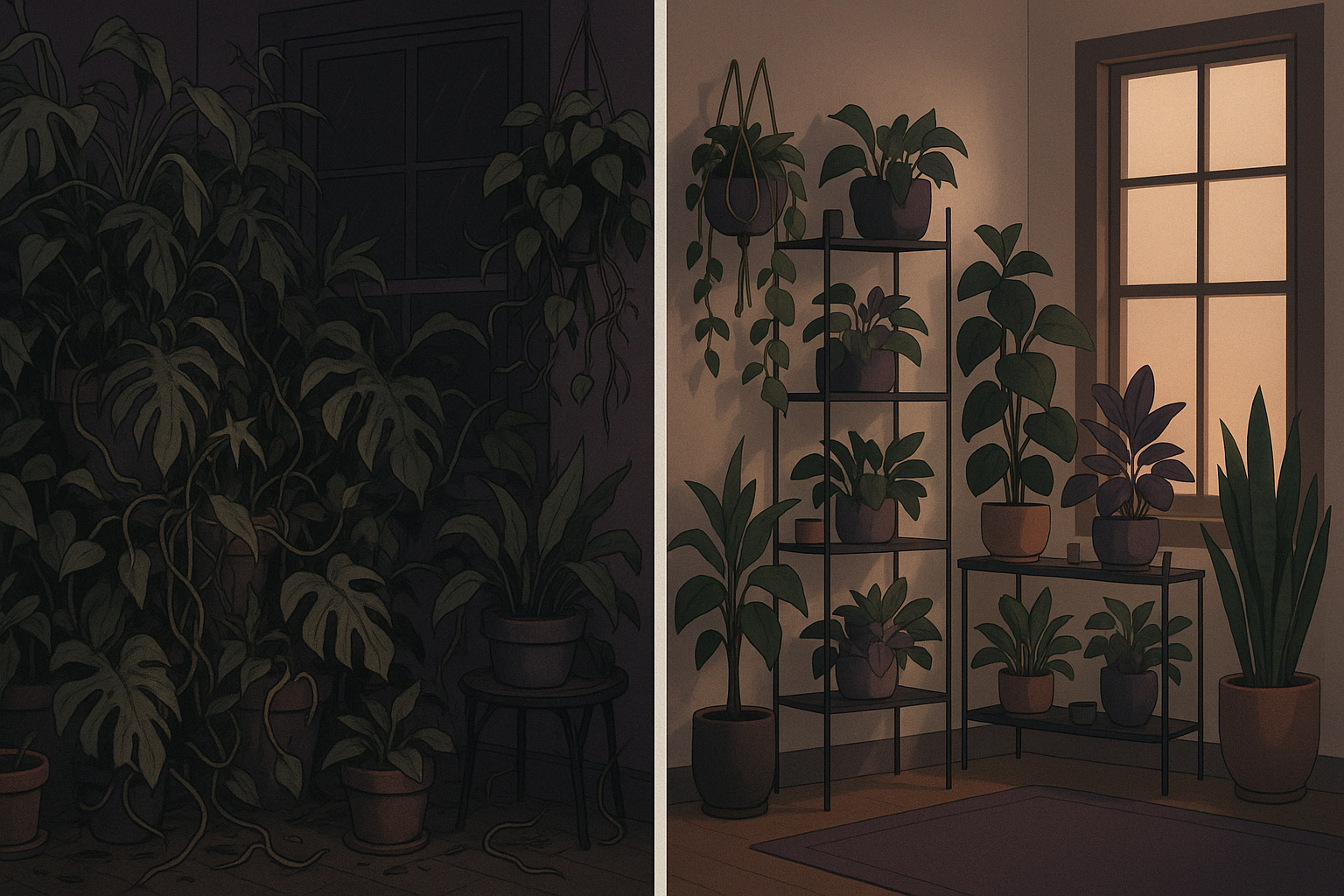
Do You Have a Plant Hoarding Problem?
Let's be honest. You probably already know the answer.
If you find yourself saying things like "I have too many plants" or "I should probably stop buying plants" but you keep buying plants, congratulations — you're a candidate for intervention.
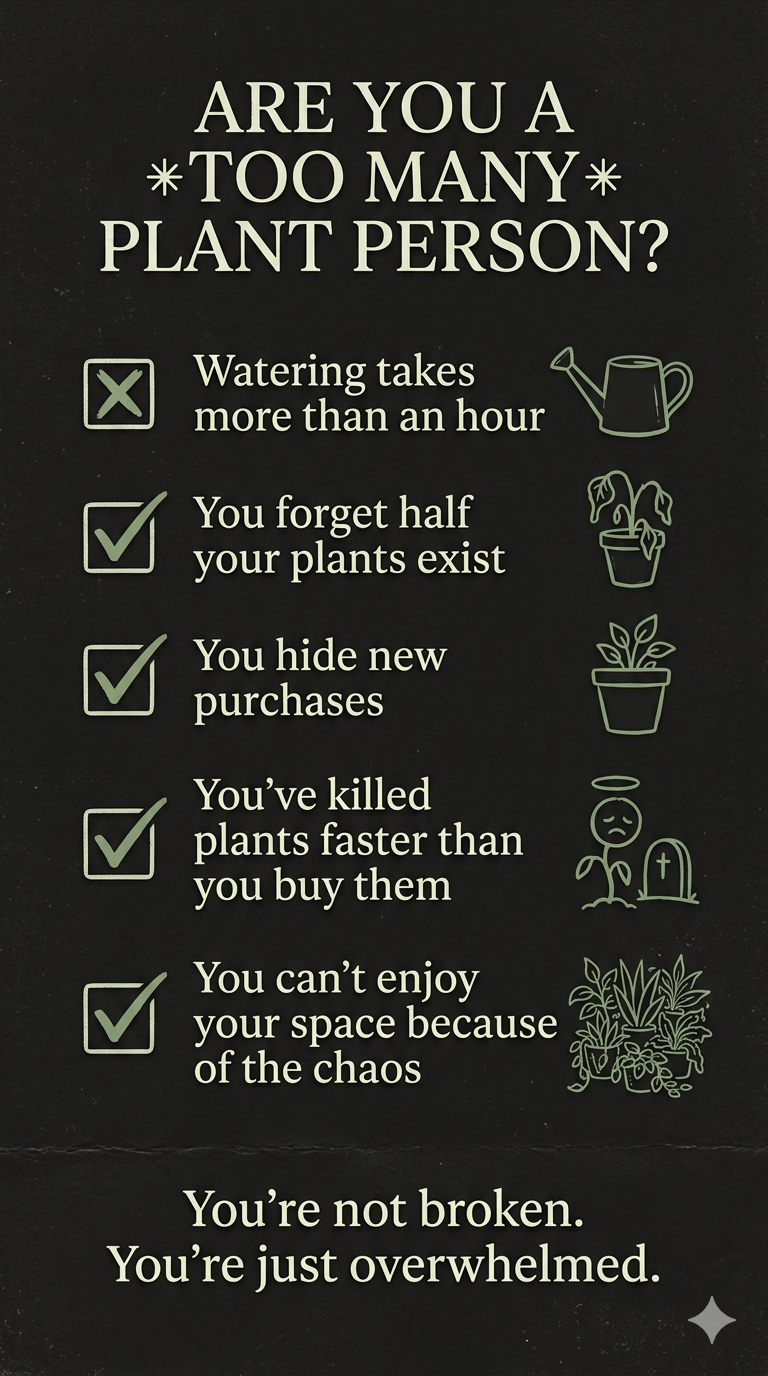
The Warning Signs of Plant Hoarding
Check yourself:
- Watering takes more than an hour — and you still miss plants
- You forget half your plants exist — until you find a crispy corpse behind the couch
- You hide new purchases — from your partner, your roommate, yourself
- You've killed plants faster than you buy them — and somehow the count keeps going up
- You can't enjoy your space because of the chaos
- You have plants in every room — including rooms that make no sense for plants
- You said "I'll put it in my cart and wait a week" and then forgot about it for three weeks and now it's arriving tomorrow
Sound familiar? Yeah. We've all been there.
Why We Keep Buying Plants
Here's the thing nobody talks about: buying a new plant feels like hope.
It's that moment of "this one will be different. I'll keep this one alive. This will be the one that finally makes me a plant person."
Except you already have forty-seven plant people living in your house.
The "one more plant" lie is a trap. The new plant high fades fast — within a week it's just another plant on the shelf, silently judging you for the watering schedule you've already abandoned.
The buying cycle goes like this:
- You feel guilty about your collection → "I need to do better"
- You see a plant that feels like hope → "This one I'll keep alive"
- You buy it → temporary satisfaction
- Repeat
The fix isn't more plants. It's a better system for the ones you already have.
Step 1: The Triage — Which Plants Stay
The first step is admitting you have a problem and doing something about it. That means making hard decisions about your existing collection.
This is where people freeze up. "But I can't get rid of my plants!" Yes, you can. And you should.
We need to talk about the Keep / Rehab / Rehome / Compost framework.
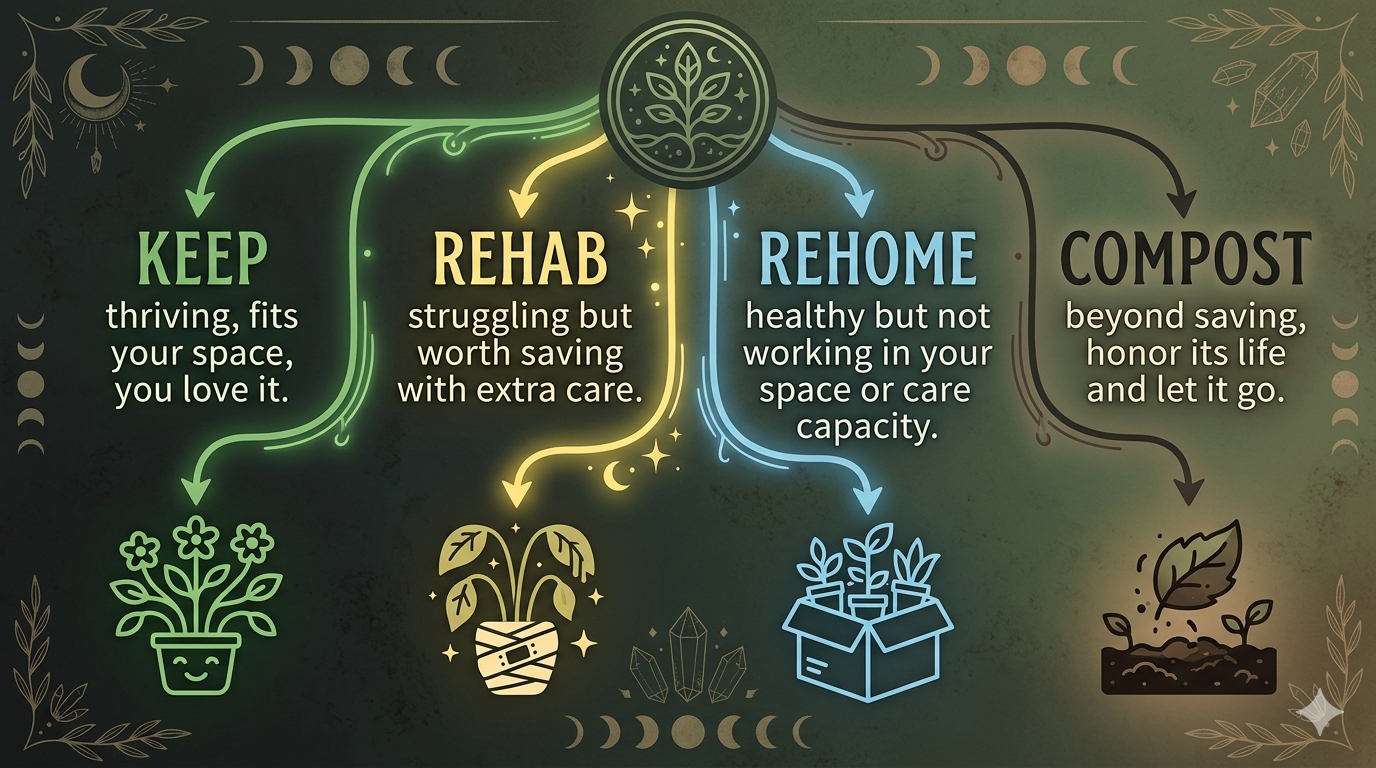
The Keep/Rehab/Rehome/Compost Framework
KEEP — The plant is thriving, fits your space, and you actually enjoy caring for it. These are your keepers. Protect these relationships.
REHAB — The plant is struggling but worth saving. Maybe it's just root-bound, or needs more light, or got hit by a pest. If you have the energy to nurse it back, go for it. But be honest about whether you will.
REHOME — The plant is healthy but doesn't fit your life. Maybe you got it as a gift and you hate it. Maybe it needs humidity you can't provide. Maybe it was impulse and you never bonded. That's okay. Finding it a new home isn't failure — it's maturity.
COMPOST — The plant is beyond saving. Here's the thing nobody tells you: plants die. It's not a moral failing. It's just nature's clearance rack. Let it go with gratitude, not guilt.
How to Actually Do the Triage
Go through each plant and ask:
- Is this plant thriving? (Keep)
- Can this plant be saved with reasonable effort? (Rehab)
- Is this plant healthy but not working in my space/life? (Rehome)
- Is this plant basically a crispy corpse at this point? (Compost)
Be brutal. The goal is a collection you actually enjoy, not a number.
Step 2: The Care Audit — Managing What Remains
Once you've triaged, you're left with what you actually want to keep. Now the question is: can you actually manage it?
A plant collection should enhance your life, not consume it.
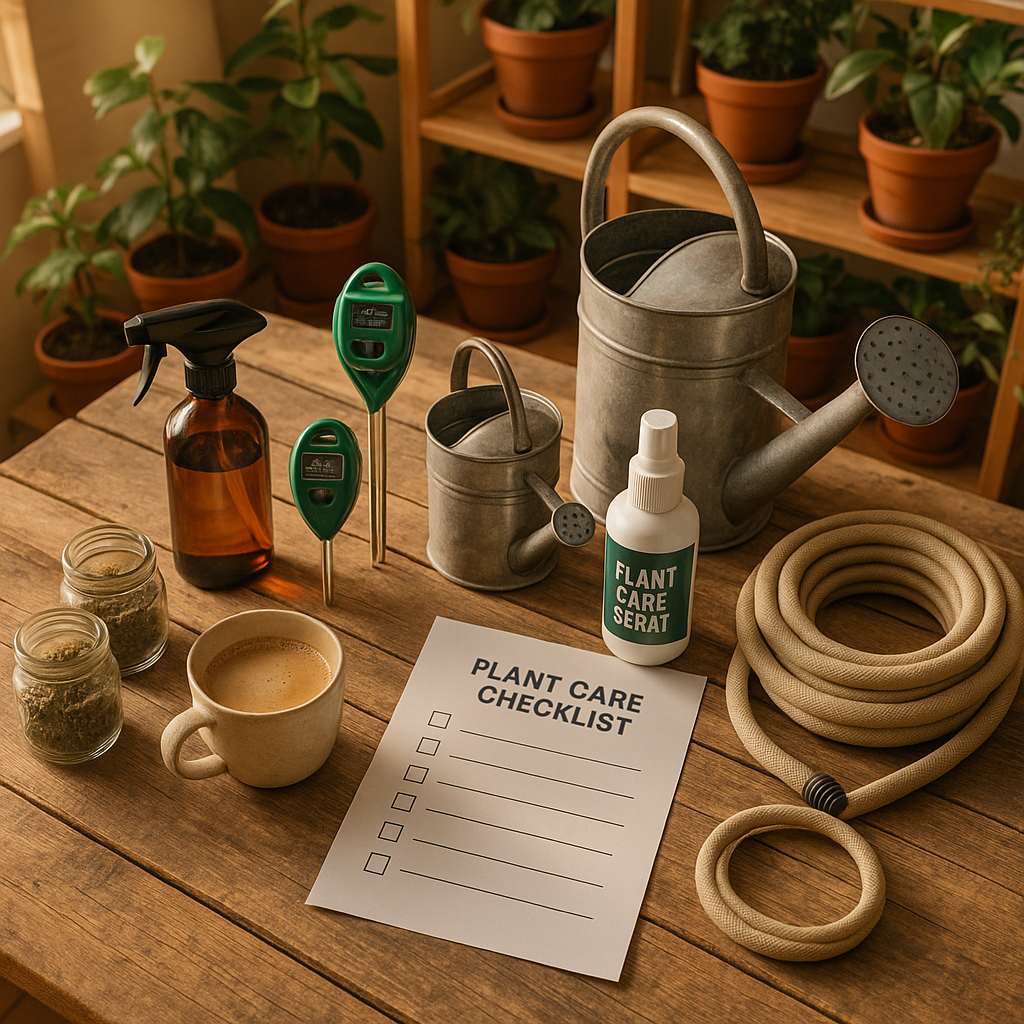
How to Batch Water 50+ Plants in 90 Minutes
The secret to managing a large collection is batching. Instead of watering randomly throughout the week, do it all at once.
Here's the system:
- Group plants by water needs — succulents together, tropicals together, moisture-loving plants together
- Do a moisture check — not every plant needs water every week, even if they're in the same group
- Water day is one day — pick a day (Saturday works) and do it all then
- Use the same route — same order every time, you'll develop a rhythm
With practice, I water my whole collection in about 90 minutes. The key is having everything organized so you're not running around looking for plants.
Tools That Save Hours Every Week
You don't need to buy a bunch of stuff. But if you're going to buy anything for your plant care routine, these actually save time:
Moisture meters let you check soil moisture on 20 plants in 10 minutes. No guessing, no finger-testing that gets old fast. Get the XLUX Moisture Meter — it's the one I use and it hasn't let me down.
Self-watering pots are great for plants that need consistent moisture. They buy you time between waterings and reduce the mental load of managing high-maintenance plants.
Bottom watering trays let you water multiple plants at once by setting them in a tray of water. Great for a batch approach.
Step 3: The Buying Freeze — How to Actually Stop
Now for the hard part: stopping the inflow.
The goal isn't to never buy plants again. The goal is to buy intentionally, not impulsively.
The 24-Hour Rule
Before buying any plant, wait 24 hours.
Not "put it in your cart." Actually wait a day. Most of the time, the impulse fades. If you still want it after 24 hours, you can get it.
Here's what usually happens: you see a plant at the store, you're excited, you buy it on impulse. But if you sleep on it, you realize you don't have space for it, you don't have a spot for it, and honestly you already have three of these.
The 24-hour rule works because it separates impulse from intention.
Remove the Triggers
Unfollow plant shops on Instagram. Leave plant Facebook groups. Stop going to Home Depot on Saturdays "just to look."
This sounds extreme, but hear me out: you don't need to be exposed to new plants all the time. The plants you already have are the plants you have. You already have enough.
Propagate Instead of Buy
Here's where it gets fun.
Instead of buying a new plant, make more of the plants you already have. Propagation scratches the "new plant" itch without adding to your collection.
Get a propagation station, grab some mason jars and rooting hormone, and start making babies of your existing plants. You can trade them, give them as gifts, or just enjoy the process.
Propagating gives you the dopamine hit of "new plant" without the chaos of one more plant to manage.
Step 4: Building a Sustainable Plant Care Routine
You have a triaged collection. You have a batching system. You have a buying freeze. Now you need to make it automatic.
The Weekly vs Monthly Task Breakdown
Daily (30 seconds):
- Quick scan for obvious problems (wilting, pests visible)
- Just look at them — noticing problems early saves time
Weekly (90 minutes):
- Water day (batch as described above)
- Quick pest check on new growth
- Rotate plants if you're obsessive about even light (I am, don't judge)
Monthly (2-3 hours):
- Fertilize (if it's growing season)
- Inspect for pests more thoroughly
- Clean leaves (dust reduces photosynthesis)
- Check for plants that need repotting
Seasonal (4x per year):
- Repotting (spring is usually best)
- Deep clean the area
- Reassess: is this plant still working?
Use a Tracking System
With a large collection, memory doesn't cut it. You need a system.
Greg.app is my go-to for tracking the whole collection. You log your plants, set watering reminders, and get notifications so nothing slips through the cracks. It's basically a to-do list for your plant obsession.
Or keep it analog with a plant care journal — some people prefer the physical act of writing it down.
The system doesn't matter. The tracking does.
The New Relationship with Plants
Here's the reframe: this isn't about deprivation. It's about building a relationship with your collection that actually works.
You don't have to love every plant you own. You don't have to keep everything you've ever bought. You don't have to maintain a collection that makes you feel overwhelmed.
The goal is a collection you actually enjoy.
Fewer plants, better care, more joy. That's the whole thing.
When you stop trying to keep 47 plants alive and focus on 15 that you actually connect with, something shifts. The care becomes sustainable. The plants thrive. You enjoy your space again.
You're not a bad plant parent for setting boundaries. You're a smart one.
Want to learn more about caring for what you have? Check out our plant health triage guide for diagnosing problems, or our batch watering strategy for making care faster.
Our Favorite Plant Care Tools
We use these products ourselves: