Plant ER — Diagnose What's Killing Your Houseplant
Because your plant is trying to tell you something. Learn to speak plant.
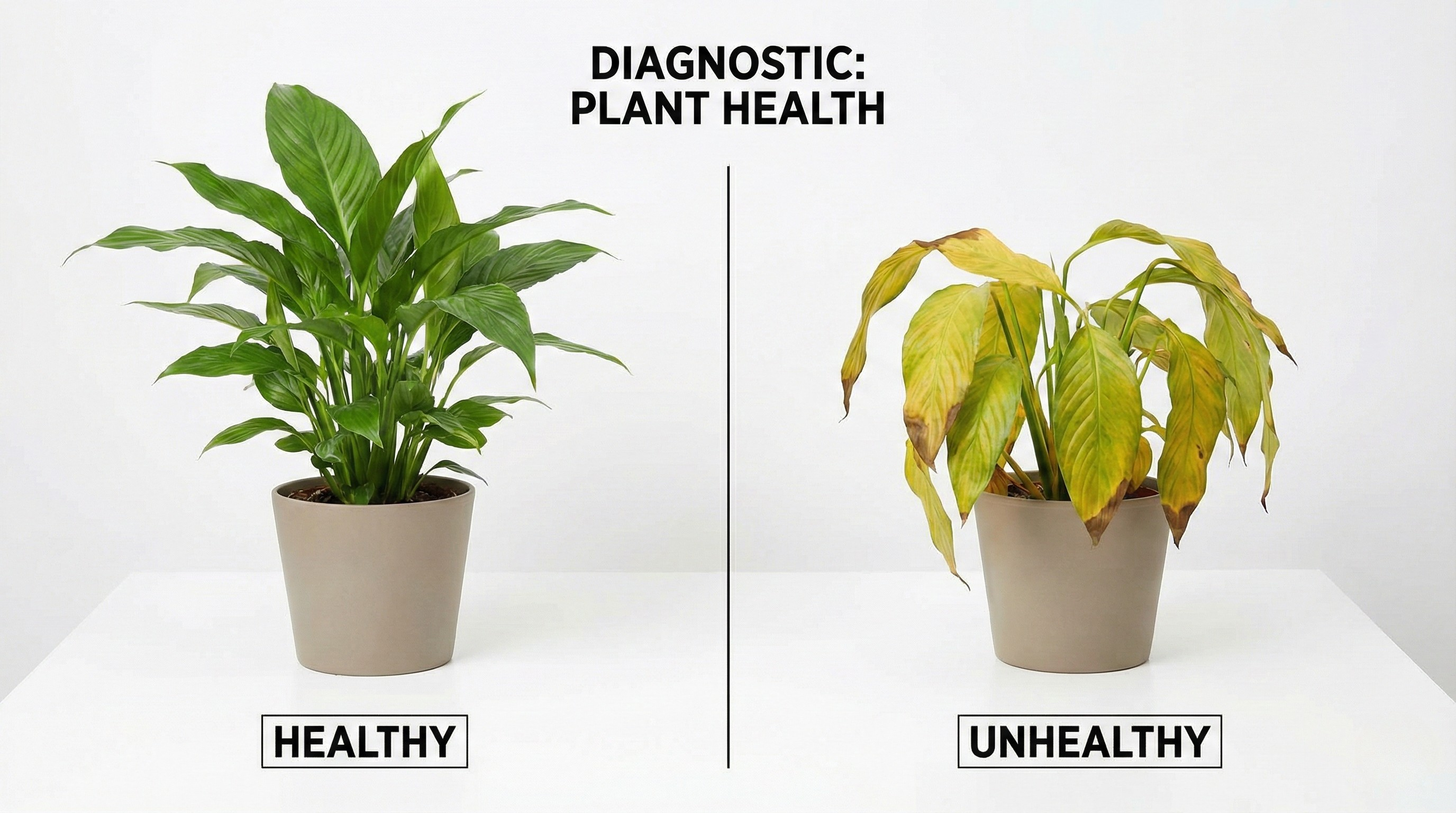
How to Diagnose Your Plant
Plants communicate through their leaves. The trick is knowing what they're saying.
Ask these questions in order:
- When did the problem start? (Yesterday? Last week? Since you repotted?)
- What changed recently? (New location? Different watering schedule? Temperature change?)
- Which leaves are affected? (New growth? Old leaves? All over?)
- What's the pattern? (Tips only? Edges? Spots? Uniform yellowing?)
Common Problems and Solutions
Yellow Leaves
Possible Causes:
Overwatering (Most common)
- Signs: Yellowing starts on lower/older leaves, soil is wet/moist
- Fix: Let soil dry out completely. Check for root rot.
Underwatering
- Signs: Dry soil, crispy leaves, plant droops but recovers after watering
- Fix: Water thoroughly, establish consistent schedule.
Natural aging
- Signs: One or two old leaves turning yellow, new growth healthy
- Fix: Nothing. Plants shed old leaves. Remove yellow leaf.
Nutrient deficiency
- Signs: Overall yellowing, especially new growth
- Fix: Fertilize (but rule out water issues first).
Brown Leaf Tips
Possible Causes:
Low humidity
- Signs: Tips dry and crispy, edges brown
- Fix: Increase humidity (pebble tray, humidifier, group plants).
🌫️ Give Your Calathea the Humidity It Craves
Want to give your calathea the humidity it craves? Here are our tested humidifiers that keep tropical plants happy:
*As an Amazon Associate, we earn from qualifying purchases.
Fertilizer burn
- Signs: White crust on soil, brown tips, history of heavy fertilizing
- Fix: Flush soil with plain water. Reduce fertilizer frequency.
Water quality
- Signs: Brown tips despite good humidity, sensitive plants (calathea, ferns)
- Fix: Use filtered or distilled water. Let tap water sit 24 hours.
Root bound
- Signs: Water runs through pot immediately, roots circling pot
- Fix: Repot into larger container.
Drooping/Wilting
Possible Causes:
Underwatered
- Signs: Dry soil, leaves perk up after watering
- Fix: Water thoroughly, check if pot has drainage.
Overwatered (Root rot)
- Signs: Wet soil, mushy stems, smell from soil
- Fix: Check roots. If black/mushy, trim and repot in fresh soil.
Temperature shock
- Signs: Drooping after being near cold draft or heat vent
- Fix: Move to stable temperature location. Give time to recover.
Transplant shock
- Signs: Drooping after repotting
- Fix: Keep conditions stable, avoid fertilizing for 2-4 weeks.
Brown Spots on Leaves
Possible Causes:
Fungal infection
- Signs: Brown spots with yellow halos, spreading pattern
- Fix: Remove affected leaves, improve air circulation, apply fungicide.
Pest damage
- Signs: Small dots, webbing (spider mites), visible insects
- Fix: Identify pest, treat with appropriate method (neem oil, insecticidal soap).
Sunburn
- Signs: Bleached or brown patches on side facing sun
- Fix: Move to filtered light, acclimate gradually.
Water droplets in sun
- Signs: Small burned spots (lens effect from water droplets)
- Fix: Water at soil level, avoid getting leaves wet in direct sun.
Leggy Growth
Possible Causes:
Not enough light
- Signs: Long stems, widely spaced leaves, stretching toward light
- Fix: Move closer to window or add grow light.
Normal vining behavior
- Signs: Pothos, philodendron, ivy naturally trail
- Fix: This is normal. Prune to encourage fullness.
No New Growth
Possible Causes:
Dormant season
- Signs: Slow growth in fall/winter, healthy otherwise
- Fix: Normal. Resume feeding in spring.
Root bound
- Signs: Roots circling, water runs through, stunted growth
- Fix: Repot into larger container.
Lack of nutrients
- Signs: Pale color, no new leaves, general decline
- Fix: Fertilize during growing season.
Incorrect light
- Signs: Plant isn't growing but not dying
- Fix: Adjust light exposure.
Quick Diagnosis Chart
| Symptom | Most Likely Cause | Check First |
|---|---|---|
| Yellow lower leaves | Overwatering | Soil moisture |
| Yellow new leaves | Nutrient deficiency | Fertilizer schedule |
| Brown crispy tips | Low humidity OR water quality | Environment |
| Wilting + wet soil | Root rot | Roots |
| Wilting + dry soil | Underwatering | Soil |
| Brown spots with halo | Fungus | Pattern spread |
| Leggy/stretching | Not enough light | Distance from window |
| No growth (winter) | Normal dormancy | Season |
| No growth (spring) | Root bound or nutrients | Pot size |
The Most Important Rule
Fix one thing at a time.
If you change watering, light, AND fertilizer simultaneously, you'll never know what worked.
The process:
- Identify the most likely cause
- Make one change
- Wait 1-2 weeks
- If no improvement, try the next likely cause
When to Give Up
Sometimes a plant is too far gone. Here's when to cut your losses:
- All roots are mushy/black — root rot is total
- Stem is mushy from base up — plant is gone
- Virus/fungal infection has spread everywhere — quarantine first, toss if needed
What to do:
- Take cuttings from healthy parts (propagate)
- Start fresh with new plant
- Learn from what went wrong (light? watering? pests?)
Prevention Is Easier Than Cure
| Habit | Prevents |
|---|---|
| Consistent watering schedule | Most issues |
| Regular pest checks | Infestations |
| Proper light placement | Leggy growth, etiolation |
| Good drainage | Root rot |
| Quarantine new plants | Pest introduction |
| Humidity management | Brown tips, crispy edges |
Tools You Need for Diagnosis
- Moisture meter — removes the guessing from watering
- Magnifying glass — helps spot tiny pests
- Pruning shears — for removing damaged growth
- Neem oil — treatment for most pests
- Insecticidal soap — softer pest treatment
The Bottom Line
Plants tell you when something's wrong. You just have to pay attention.
Start with the most common causes first:
- Overwatering (most common mistake)
- Light issues
- Humidity
- Pests
- Nutrient deficiencies
Fix one thing at a time. Be patient. Most plants recover if caught early.
Need help identifying specific pests? Check our Pest ID Guide. Confused about watering? See the Watering Guide.