Water Propagation vs Soil Propagation
Two methods. Same goal. Different trade-offs. Here's the honest comparison.
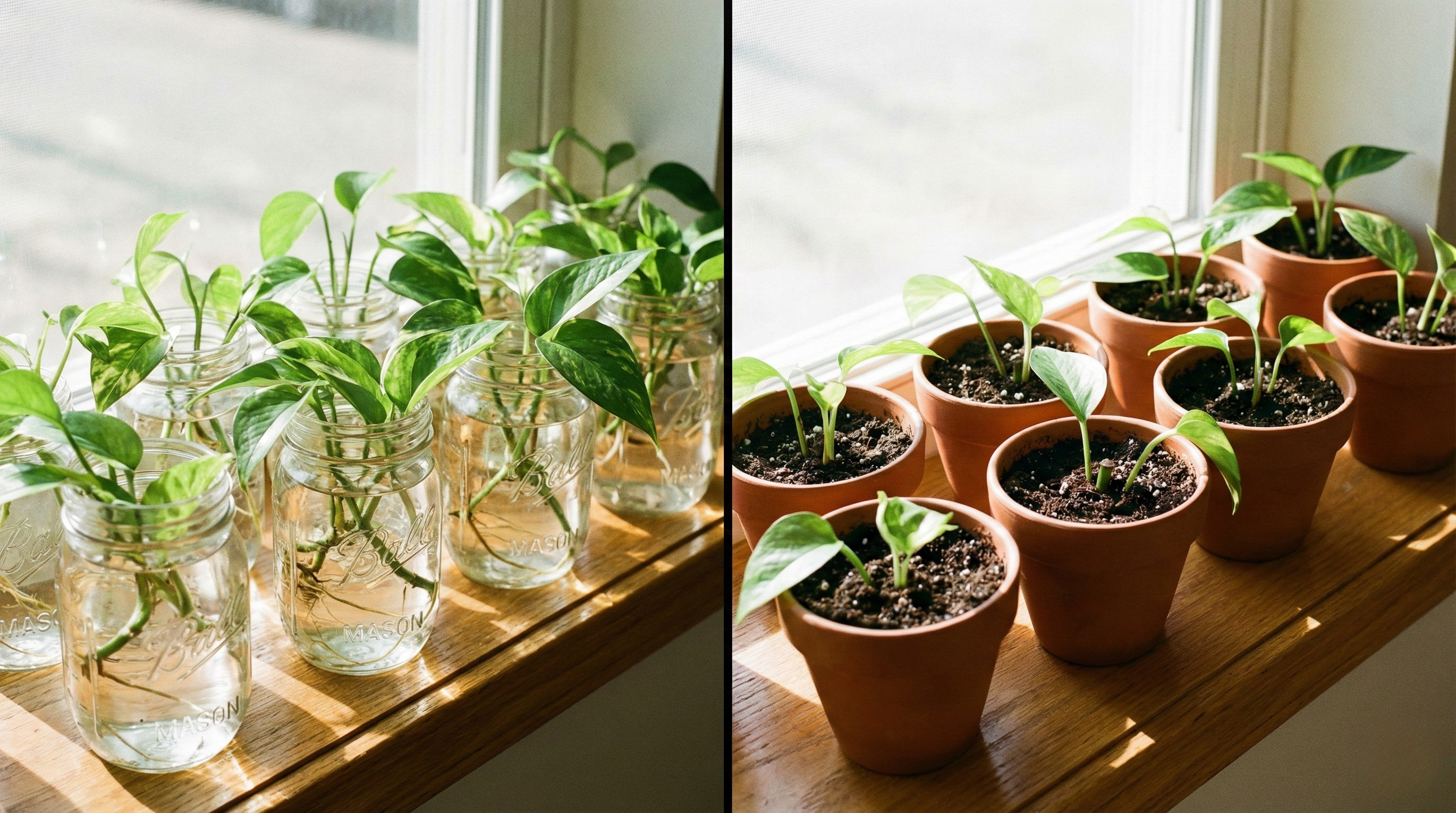
Quick Comparison
| Factor | Water | Soil |
|---|---|---|
| Ease of use | Easier | More steps |
| Root visibility | Visible (fun!) | Hidden |
| Transfer shock | More (potting established roots) | None (already in soil) |
| Time to roots | 2-4 weeks | 3-6 weeks |
| Success rate | Higher for beginners | Slightly lower |
| Mess | None | Some dirt |
Water Propagation
How It Works
Place a cutting in water. Roots grow in the water. Once roots are 2-3 inches long, transfer to soil.
Best Plants for Water Propagation
- Pothos
- Philodendron
- Spider plants
- Begonias
- Mint and herbs
- African violets
Step-by-Step
What you need:
- Clean glass jar or vase
- Room temperature water
- Healthy cutting with node
- Scissors or pruning shears
The process:
-
Take the cutting
- Find a healthy stem with at least one node (the bump where leaves attach)
- Cut 4-6 inches below the node
- Remove lower leaves (anything below the waterline)
-
Place in water
- Fill jar with room temperature water
- Submerge the node, not the leaves
- Place in bright indirect light
-
Change water regularly
- Every 3-5 days
- Fresh water prevents bacteria
- Keep water level consistent
-
Wait for roots
- Most plants root in 2-4 weeks
- Some (like monsteras) take longer
- Patience is key
-
Transfer to soil
- Wait until roots are 2-3 inches long
- Plant in well-draining potting mix
- Water thoroughly after potting
Pros
- You can see the roots — satisfying and educational
- Easy to monitor — spot problems early
- No mess — no dirt involved
- Instagram-worthy — jars look cool
Cons
- Transfer shock — plants need to adjust to soil
- Roots may be fragile — handle gently when potting
- Slower initial growth — roots adapted to water first
Soil Propagation
How It Works
Plant a cutting directly into soil. Roots grow in the soil from day one.
Best Plants for Soil Propagation
- Monsteras
- Snake plants
- ZZ plants
- Succulents
- Most houseplants
🌱 Set Your Plants Up for Success
Great plants start with great soil. Here are our go-to mixes and amendments:
*As an Amazon Associate, we earn from qualifying purchases.
Step-by-Step
What you need:
- Small pot with drainage
- Well-draining potting mix
- Rooting hormone (optional)
- Water
The process:
-
Take the cutting
- Same as water propagation
- Node must be buried in soil
-
Prepare the pot
- Fill pot with moist (not wet) potting mix
- Make a hole in the center
-
Plant the cutting
- Place node in the hole
- Bury node with soil
- Firm soil gently around stem
-
Create humidity (optional)
- Cover with plastic bag
- Use propagation chamber
- Mist regularly
-
Wait for roots
- 3-6 weeks typically
- Tug gently — resistance means roots
- No visible signs until new growth
Pros
- No transfer shock — roots grow in final medium
- Hardier plants — soil roots are stronger
- Faster established plants — no adjustment period
- One step — no repotting needed
Cons
- Can't see roots — guessing game
- Harder to monitor — problems hidden
- Messy — involves dirt
- Needs humidity — many cuttings dry out
Which Method Should You Choose?
Choose Water If:
- You're a beginner
- You want to watch roots grow
- You don't mind the transfer step
- You have patience for the two-step process
Choose Soil If:
- You want a single-step process
- You don't want to deal with transfer shock
- You're propagating monsteras or succulents
- You prefer "set and forget"
Rooting Hormone: Do You Need It?
Short answer: No, but it helps.
What it does:
- Speeds up root development
- Increases success rate
- Produces more robust roots
When to use it:
- Propagating difficult plants
- Taking cuttings from stressed plants
- Propagating in winter (slower growth)
How to use it:
- Dip cut end in powder or gel
- Don't overapply
- Tap off excess before planting
Troubleshooting
Water Propagation Problems
| Problem | Cause | Solution |
|---|---|---|
| Water turns cloudy | Bacteria | Change water more frequently |
| No roots after 4 weeks | Cutting has no node | Start over with proper cutting |
| Leaves turning yellow | Stress or old water | Change water, check for rot |
| Mold on cutting | Contaminated water | Start over, use fresh water |
Soil Propagation Problems
| Problem | Cause | Solution |
|---|---|---|
| Cutting shrivels | Too dry | Water more, add humidity |
| Cutting rots | Too wet | Let soil dry, use less water |
| No growth | No roots yet or died | Check for roots, start over |
| Leaves drop | Shock | Normal, keep caring |
The Verdict
Water propagation is more beginner-friendly and educational. You'll see the roots grow and learn how plants develop.
Soil propagation is more efficient for experienced growers who know what they're doing.
Best approach: Start with water propagation to learn. Graduate to soil propagation as you gain confidence.
Quick Reference
| Plant | Best Method | Notes |
|---|---|---|
| Pothos | Water | Roots extremely reliably in water |
| Philodendron | Water | Same as pothos |
| Monstera | Soil | Roots better in soil, hates transfer |
| Snake plant | Soil | Succulent, prefers soil |
| Spider plant | Water | Easy, produces babies quickly |
| Succulents | Soil | Hate being wet, soil is better |
Ready to propagate? Check our Propagation Guide for more details.