Syngonium Care Guide — Arrowhead Vines for Every Style
Arrowhead vines are the low-fuss aroid you'll want in every room. Here's how to keep them alive — and looking good.
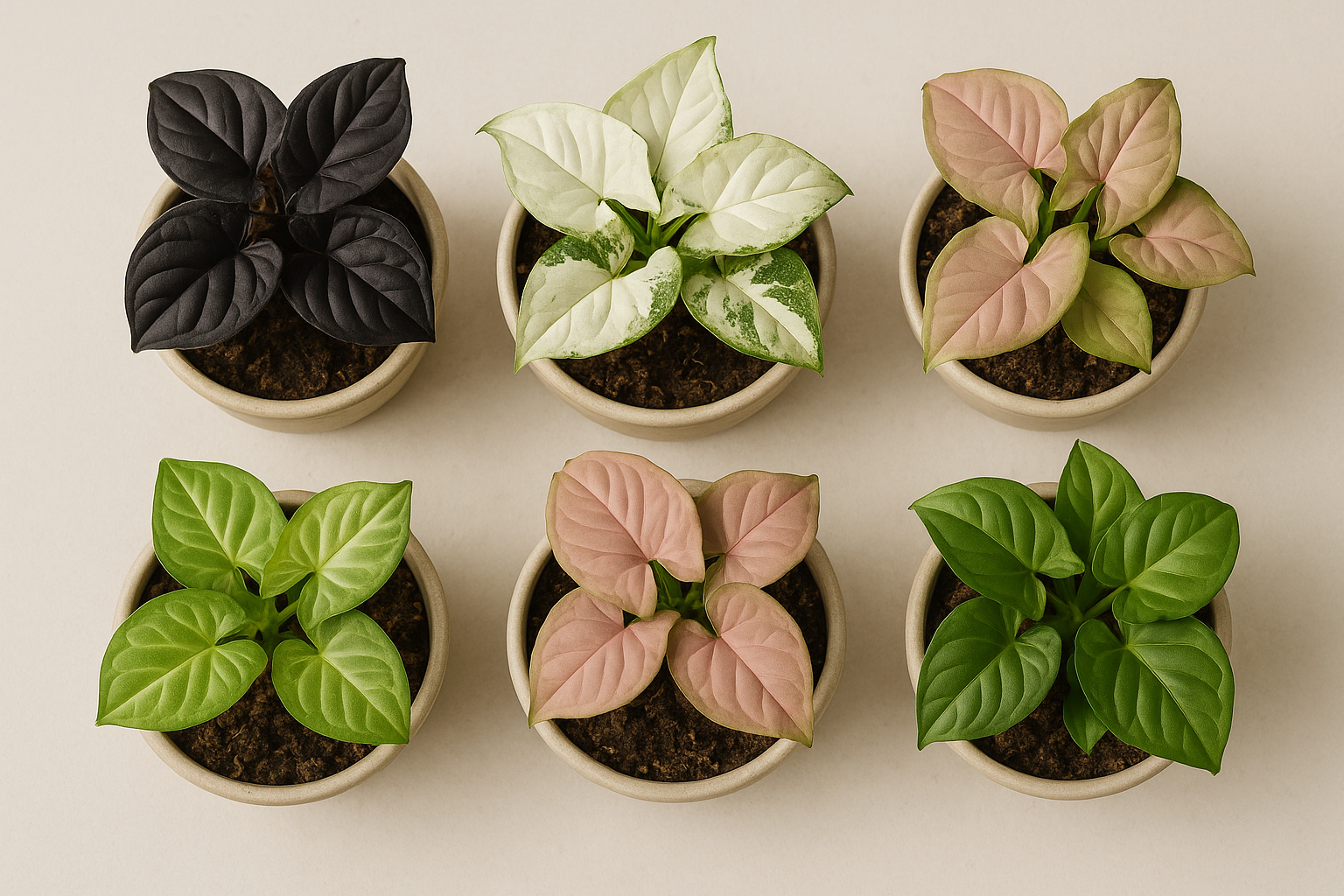
What Is a Syngonium?
Syngonium — formally Syngonium podophyllum — goes by a few names: arrowhead plant, arrowhead vine, goosefoot plant. The name comes from the shape of its juvenile leaves, which start out as, well, arrowheads.
It's a member of the Araceae family, making it a cousin to the monstera, philodendron, and pothos. What sets it apart? It's one of the more forgiving aroids. It tolerates lower light better than most, bounces back from watering mistakes, and grows fast enough that any mistake you make will be covered by new growth in a few weeks.
The "podophyllum" part means "foot of a duck" in Latin, which... sure. You can see it in the leaf shape if you squint.
Why Syngonium Is the Best Beginner Aroid
Let me make the case plainly: if you want an aroid that won't humiliate you, syngonium is it.
Most aroids are dramatic. Miss a watering? Droops like it's dying. Too much sun? Burns instantly. Wrong humidity? Brown tips for days.
Syngonium is more... chill. It tolerates inconsistent watering better than pothos (looking at you, half the readers who killed their first marble queen). It handles lower light without turning into a leggy mess overnight. It grows fast, which means any care mistakes you make get buried under new growth quickly.
It's also endlessly interesting. The leaf shape changes as the plant matures — what starts as a neat arrowhead can become a deeply lobed, almost monstera-like leaf if you give it something to climb. You get two plants in one, effectively.
If you've been burned by finicky houseplants before, syngonium is your reconciliation arc.
The Varieties: Syngonium by Aesthetic
Here's where this guide is different. Instead of listing every syngonium variety alphabetically, let's talk about which one fits your space.
Dark & Moody — The Witchy Collection
If your aesthetic skews gothic, boho-dark, or just aggressively cozy, these are your plants:
- Syngonium 'Black Velvet' — near-black leaves with contrasting light veins. The most dramatically dark of the bunch.
- Syngonium 'Maria' — deep green so dark it reads as black in low light, compact growth habit.
- Syngonium 'Batik' — dark green with cream and silver variegation patterns that look almost tie-dyed.
These varieties are forgiving with light — the darker the leaves, the more shade-tolerant the plant tends to be.
Clean & Bright — The Modern Minimalist
For bright, airy spaces that need a plant that won't compete with the vibe:
- Syngonium 'White Butterfly' — white and pale green variegated leaves, clean and architectural.
- Syngonium 'Albolineata' — cream-white margins on green leaves, striking contrast.
- Syngonium 'Neon Robusta' — solid pinkish-bronze new growth that lightens to a soft green. Surprisingly easy.
These varieties need more light to maintain their variegation. Put them near a window, but not in direct sun.
Warm & Textured — The Boho Tropical
For warm-toned spaces, terracotta pots, and layered textures:
- Syngonium 'Pink Allusion' — soft pink veins on a pale green leaf, the classic "pink syngonium."
- Syngonium 'Neon Pink' — vibrant neon pink that pops against dark foliage. More light = more pink.
- Syngonium 'Berry Allusion' — dusky pink and green with a muted, earthy quality.
Pink variegation is light-dependent. More bright indirect light = more pink. In low light, these tend to fade to green.
All Green, All Classic — The Trusty Standby
Don't underestimate the solid green syngonium. These are the hardest to kill and the fastest growers:
- Syngonium 'Emerald Gem' — deep green, arrow-shaped leaves, bulletproof.
- Syngonium 'Green Gold' — gold-green variegation that reads as mostly green from a distance.
Low light tolerance is highest in this group. These are the ones for offices, bathrooms, and corners that don't get much natural light.
Syngonium Care: The Basics
Light Requirements
Syngonium does best in bright indirect light — think the space two feet from a south- or east-facing window, not in the window itself.
Direct sun will scorch the leaves, leaving brown crispy patches. Too dark and the plant will become leggy (long stems with wide gaps between leaves), reaching for whatever light it can find.
Variegated varieties (white, pink, or peach) need more light than solid green ones to maintain their patterns. If your variegated syngonium is reverting to all-green leaves, it's probably not getting enough light.
The good news: syngonium tolerates lower light better than most aroids. It won't thrive in a north-facing room with no windows, but it will survive.
Watering Schedule
The golden rule: water when the top 1-2 inches of soil are dry.
Stick your finger in the soil. If it feels dry up to your first knuckle, water. If it still feels moist, wait.
In summer (active growing season), this might be weekly. In winter, it could be every 2-3 weeks. The size of the pot, the material it's made of, and your home's humidity all affect this.
Signs of overwatering: yellow leaves, especially lower/mature leaves first. The soil stays wet for more than a week after watering. A musty smell from the pot (root rot beginning).
Signs of underwatering: the whole plant droops, leaves look somewhat limp or papery. Usually bounces back quickly once watered.
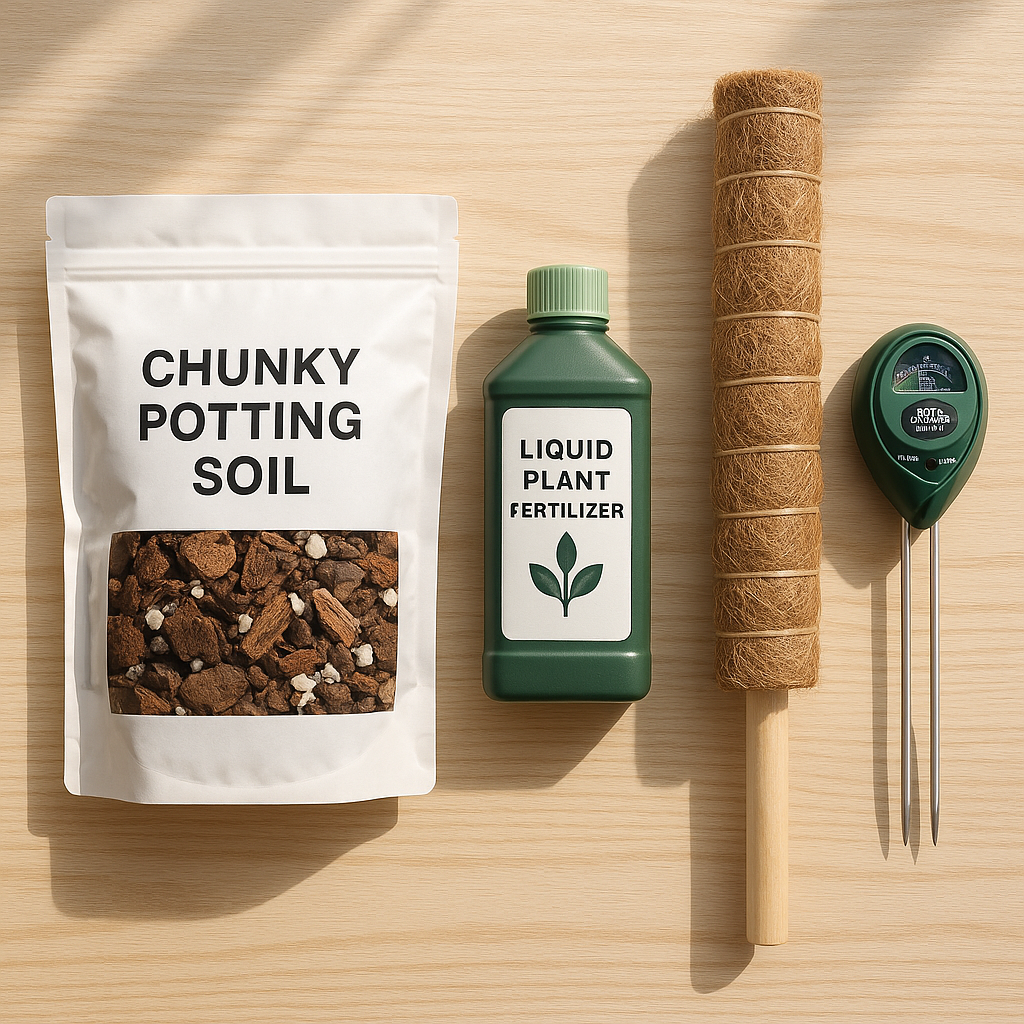
Pro tip: A moisture meter takes the guesswork out of this entirely. Under $15 and it removes all ambiguity.
Soil Mix
Syngonium is an aroid, and aroids want chunky, fast-draining soil. This is non-negotiable if you want to avoid root rot.
A good aroid mix: roughly 40% orchid bark (or chunky perlite), 30% coco coir or peat, and 30% perlite or pumice. The chunkiness is what you're after — water should flow through quickly, not sit.
See on Amazon — FoxFarm Ocean Forest
A good aroid mix is chunky and fast-draining — try FoxFarm Ocean Forest (available on Amazon) or mix your own with orchid bark, perlite, and coco coir.
If you prefer a pre-made chunky mix, Better-Gro Phalaenopsis Orchid Mix is a solid option — it's got the bark, perlite, and charcoal balance that works well for syngonium.
Humidity & Temperature
Syngonium is a tropical plant, so it appreciates 60%+ humidity, but it's not a diva about it. It will survive at average household humidity (30-40%), though you might see occasional brown leaf tips.
If you live in a dry climate — or run heat in the winter — a humidifier helps. The Levoit Classic 300S is a solid pick for a small room. Quiet, reliable, and covered under Feral Foliage's affiliate.
Temperature-wise, 65-85°F is the sweet spot. Keep it away from cold drafts in winter — syngonium does not tolerate frost or extended temperatures below 50°F.
Fertilizer Schedule
Syngonium is a fast grower, and fast growers need to eat. Feed monthly during spring and summer with a balanced liquid fertilizer diluted to half strength.
See on Amazon — FoxFarm Tiger Bloom
Feed monthly during spring and summer with a balanced liquid fertilizer like FoxFarm Tiger Bloom — it's what most serious plant people use and it's readily available on Amazon.
Skip feeding in fall and winter when growth naturally slows. Overfeeding is worse than underfeeding — it causes salt buildup in the soil and can burn roots.
The Vining vs. Bushy Question: Choosing Your Plant's Look
This is the decision that trips up a lot of syngonium owners, so let's be clear about what you actually want.
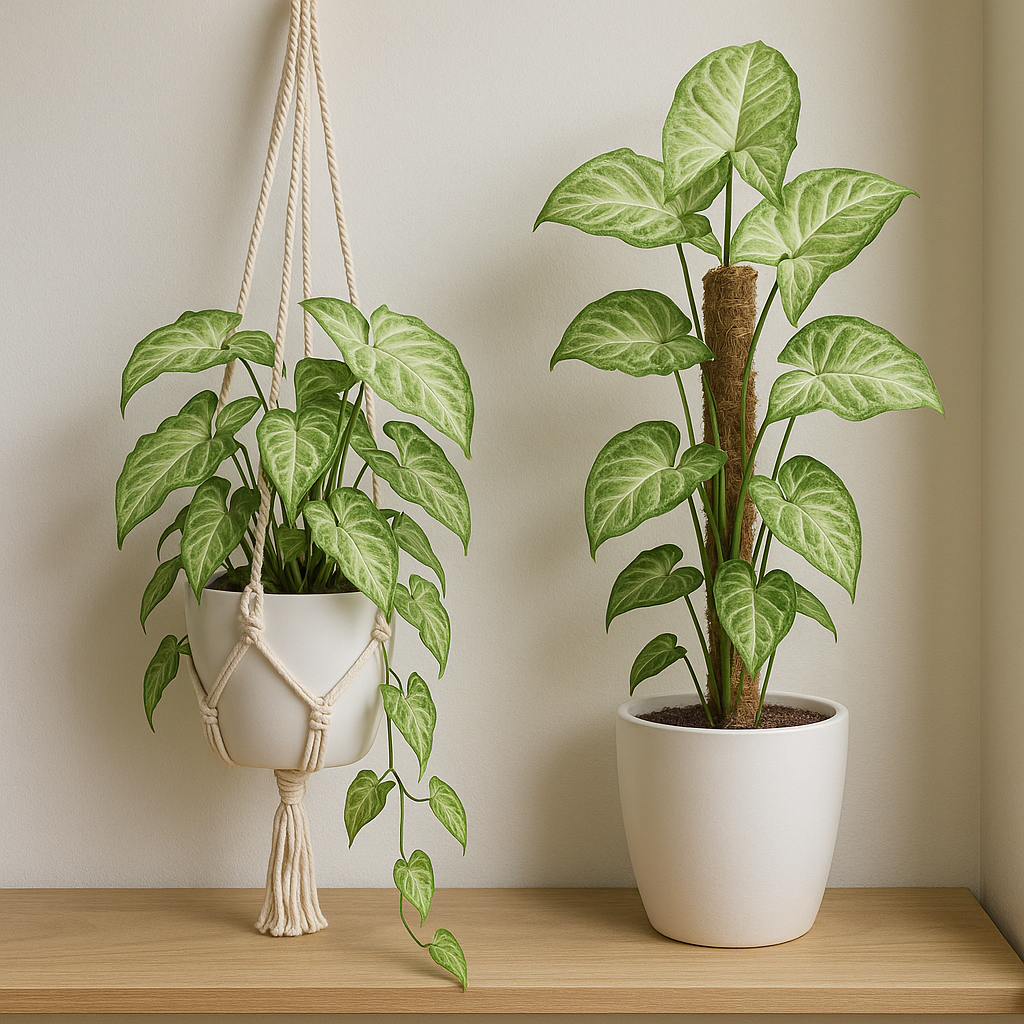
Let It Trail
The easiest option: put your syngonium on a high shelf or in a hanging basket and let the vines cascade down. No stakes, no pruning, just gravity doing the work.
This works well for any variety. The plant stays in its juvenile leaf form indefinitely.
Stake It for the Vining Look
If you want syngonium to show its adult form — larger leaves, sometimes with lobes — give it something to climb. A moss pole, coco pole, or wooden stake does the trick.
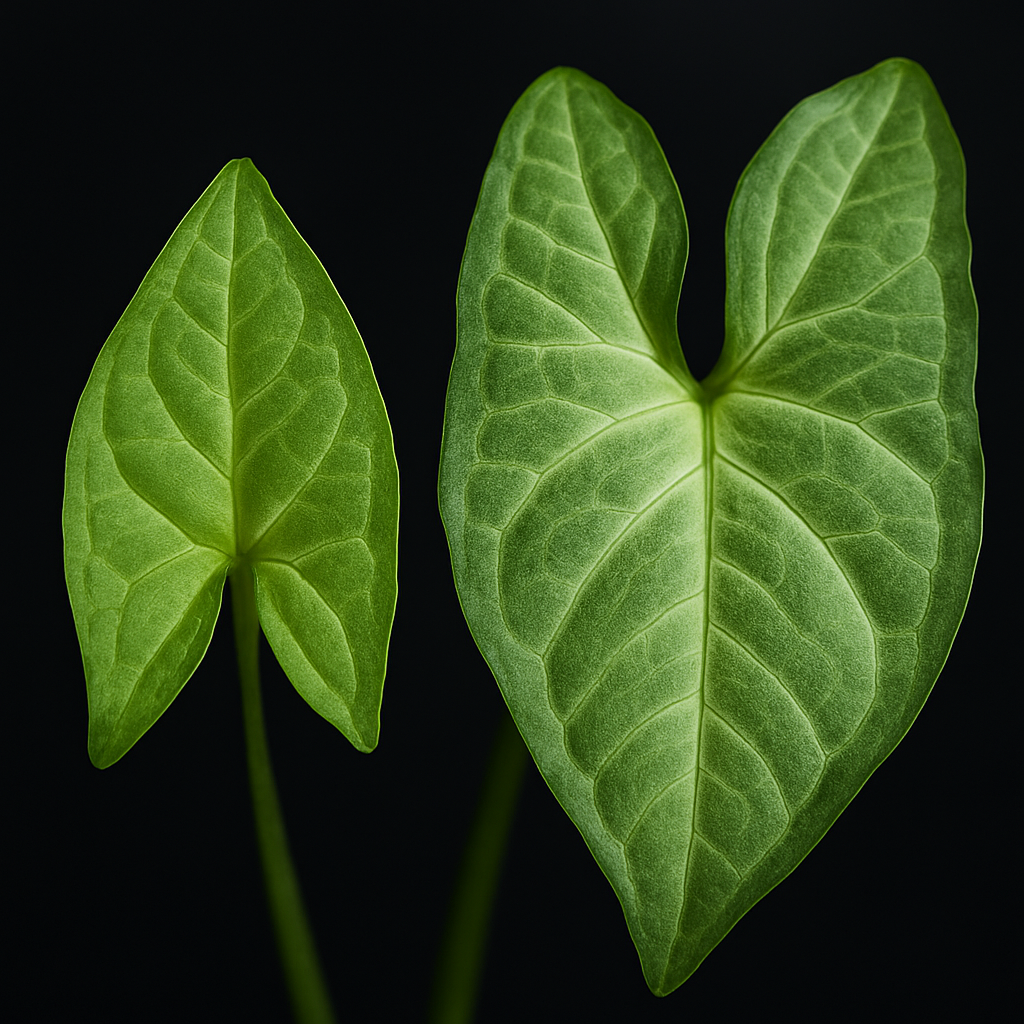
To get the big mature leaves with deep lobes, give your syngonium something to climb. An extendable moss pole (like this Highland Moss pole on Amazon) works well — just mist it and watch the aerial roots grab on.
Syngonium naturally produces aerial roots — those white or brown wiry things growing from the stem. These aren't a problem. They're how the plant attaches to trees in the wild. You can tuck them into the soil or wrap them around a moss pole. Don't cut them off unless they're dead (crispy and dry).
Prune for Bushy Growth
If your syngonium has gotten leggy — long stems with sparse leaves — you can fix it. How to prune leggy plants is a skill, but the basic move is:
Cut each stem just above a node (the point where a leaf attaches). The node will then produce two new growth points, making the plant branch and fill out.
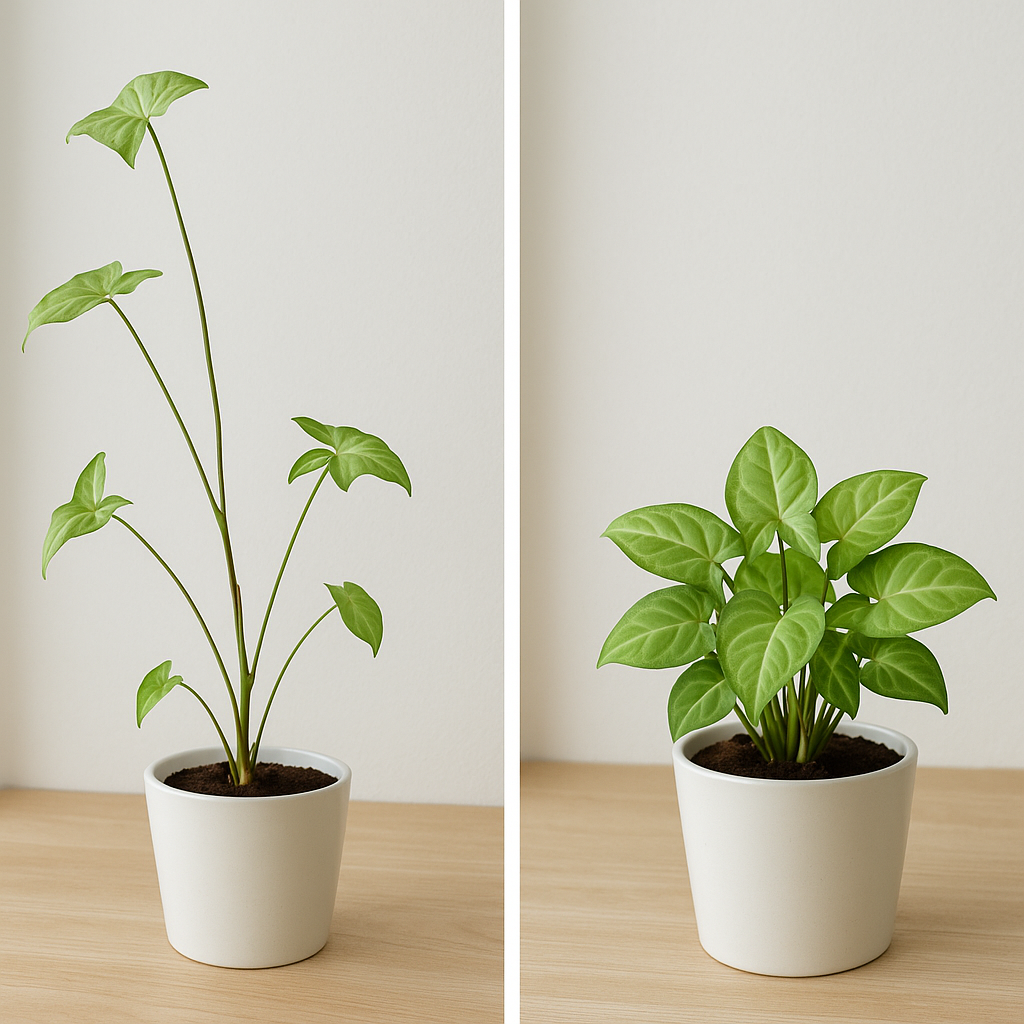
The cuttings you take can be propagated — see the propagation section below.
Why Did My Syngonium Change Leaf Shape?
This is the question I see most on plant forums: "Why did my syngonium's arrowhead leaves change into something completely different?"
The answer is normal plant development. Syngonium has two distinct leaf forms:
- Juvenile leaves: Arrowhead-shaped (hence the common name). This is what the plant looks like when young.
- Adult leaves: Often deeply lobed, larger, sometimes almost fenestrated like a small monstera.
When a syngonium reaches maturity — which happens faster when it has something to climb — it starts producing adult leaves. The juvenile leaves you bought it with won't come back.
This is not a problem. This is your plant thriving.
If you want to keep the arrowhead shape: keep the plant in a hanging basket or pinch off the climbing stems to encourage branching. The juvenile form persists indefinitely if the plant never climbs.
If you want the adult form: add a moss pole and let it climb. Mist the pole to encourage aerial roots to attach. The more climbing, the more dramatic the adult foliage.
Syngonium Problems and How to Fix Them
Yellow Leaves
Yellow leaves on syngonium usually mean overwatering. Check the soil — if it's wet and has been wet for more than a week, you've got a problem.
Fix: Let the soil dry out completely before watering again. If the soil stays wet for more than 10 days after watering, you need better drainage — add more perlite or bark to the mix, or switch to a terracotta pot (which evaporates moisture faster than plastic).
One yellow leaf that appears occasionally (especially a lower/mature leaf) is normal — plants shed old leaves. Multiple yellow leaves appearing at once = cut back on water.
Drooping or Wilting
Two possible causes:
- Underwatering — the soil is dry and the plant is thirsty. Solution: water it.
- Root rot — the roots are damaged and can't absorb water even though the soil is wet. Solution: unpot, trim any black/mushy roots, repot in fresh dry mix, water lightly.
If you're not sure which it is, check the soil. Dry = water. Wet = root rot.
Leggy or Spindly Growth
This is a light problem. Your syngonium is reaching for more light, stretching the stems as it goes.
Fix: Move to a brighter spot. If that's not possible, consider a grow light. Then prune back the leggy stems (see the pruning section above) to encourage bushier regrowth.
Root Rot
The result of chronic overwatering and/or poor drainage. Signs: yellowing across the whole plant, mushy stems at the base, a sour smell from the soil.
Fix: Remove the plant from the pot, shake off all soil, and inspect the roots. Healthy roots are white and firm. Dead/rotten roots are black, brown, or mushy. Cut away everything that's not healthy. Repot in fresh aroid mix in a clean pot (or scrub your existing pot). Water lightly and let it dry out more than you have been.
Pests
Syngonium is occasionally targeted by spider mites and mealybugs — check out FF's pest identification guide for help telling them apart.
Spider mites show up as tiny dots on the underside of leaves and fine webbing between stems. Mealybugs look like small cotton fluff masses in the leaf joints.
Fix: Wipe the leaves down with a damp cloth, then spray with neem oil or insecticidal soap. Increase humidity — spider mites hate moisture. Treat weekly until the problem is gone.
How to Propagate Syngonium in Water
Syngonium is one of the easiest plants to propagate, and water propagation is the most satisfying way to do it — you get to watch the roots grow.
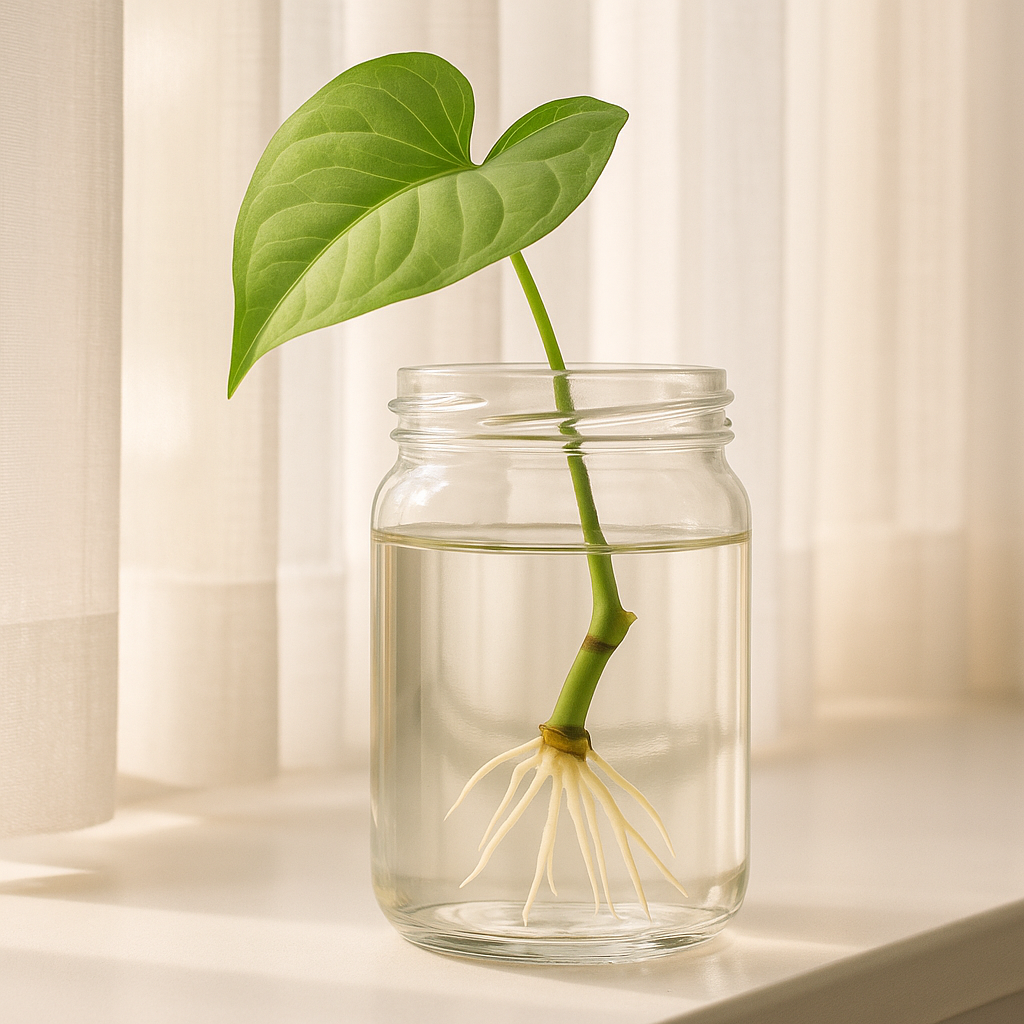
What you need:
- A stem cutting with at least one node (the bumpy part where a leaf or aerial root attaches — this is non-negotiable, nodes are where roots grow from)
- A clear glass jar
- Room-temperature water
Steps:
- Cut below a node — the node should be the lowest point on your cutting, submerged in water
- Remove any leaves that would sit below the waterline (they'll rot)
- Place in a clear jar of water on a bright windowsill (no direct sun)
- Change the water every few days to keep it fresh
- Wait 2-4 weeks for roots to appear (1-2 inches is a good target before potting)
- Pot in aroid mix when roots are about 2 inches long
FAQ: Can you propagate syngonium in soil? Yes — the same stem cutting can go directly into moist aroid mix. Success rate is slightly lower for beginners since you can't see the roots. For more on propagation in general, see FF's houseplant propagation guide.
Toxicity: Keep Syngonium Away from Pets
Warning: Syngonium is toxic to cats and dogs.
Like most aroids, syngonium contains calcium oxalate crystals — tiny needle-like structures that cause irritation and swelling in the mouth, tongue, and GI tract if ingested.
Symptoms include drooling, pawing at the mouth, vomiting, and difficulty swallowing. It's not usually fatal, but it's deeply unpleasant for your pet and stressful for everyone.
If you have curious pets who chew on plants, keep syngonium on a high shelf or in a room they can't access. For pet-safe alternatives, see FF's guide to pet-safe houseplants.
Syngonium Quick-Care Cheat Sheet
- Light: Bright indirect — tolerates lower light better than most aroids
- Water: When top 1-2 inches of soil are dry; yellow leaves = overwatering
- Soil: Chunky aroid mix with perlite and bark for drainage
- Humidity: Prefers 60%+ but survives average household humidity
- Temperature: 65-85°F — keep away from cold drafts
- Fertilizer: Monthly liquid feed spring/summer, none in fall/winter
- Growth: Fast — juvenile arrowhead leaves or adult lobed leaves depending on climbing
- Toxicity: Toxic to cats and dogs — keep out of reach
Products We Love
We use these ourselves:
- FoxFarm Ocean Forest Potting Soil — our go-to aroid base
- Better-Gro Orchid Mix — chunky bark alternative for syngonium soil
- FoxFarm Tiger Bloom — the liquid fertilizer we reach for most
- Highland Moss Extendable Pole — for climbing syngonium
- Levoit Classic 300S Humidifier — for dry rooms and winter months
Ready to add more beginner-friendly aroids to your collection? Start with FF's easiest houseplants guide — same no-nonsense approach, zero gatekeeping.