String of Pearls Care Guide: How to Grow, Propagate & Not Kill Them
These gorgeous trailing succulents have a secret: they're surprisingly easy to kill — not because they're delicate, but because their watering needs are counterintuitive. Here's everything you need to keep your peas plump and happy.
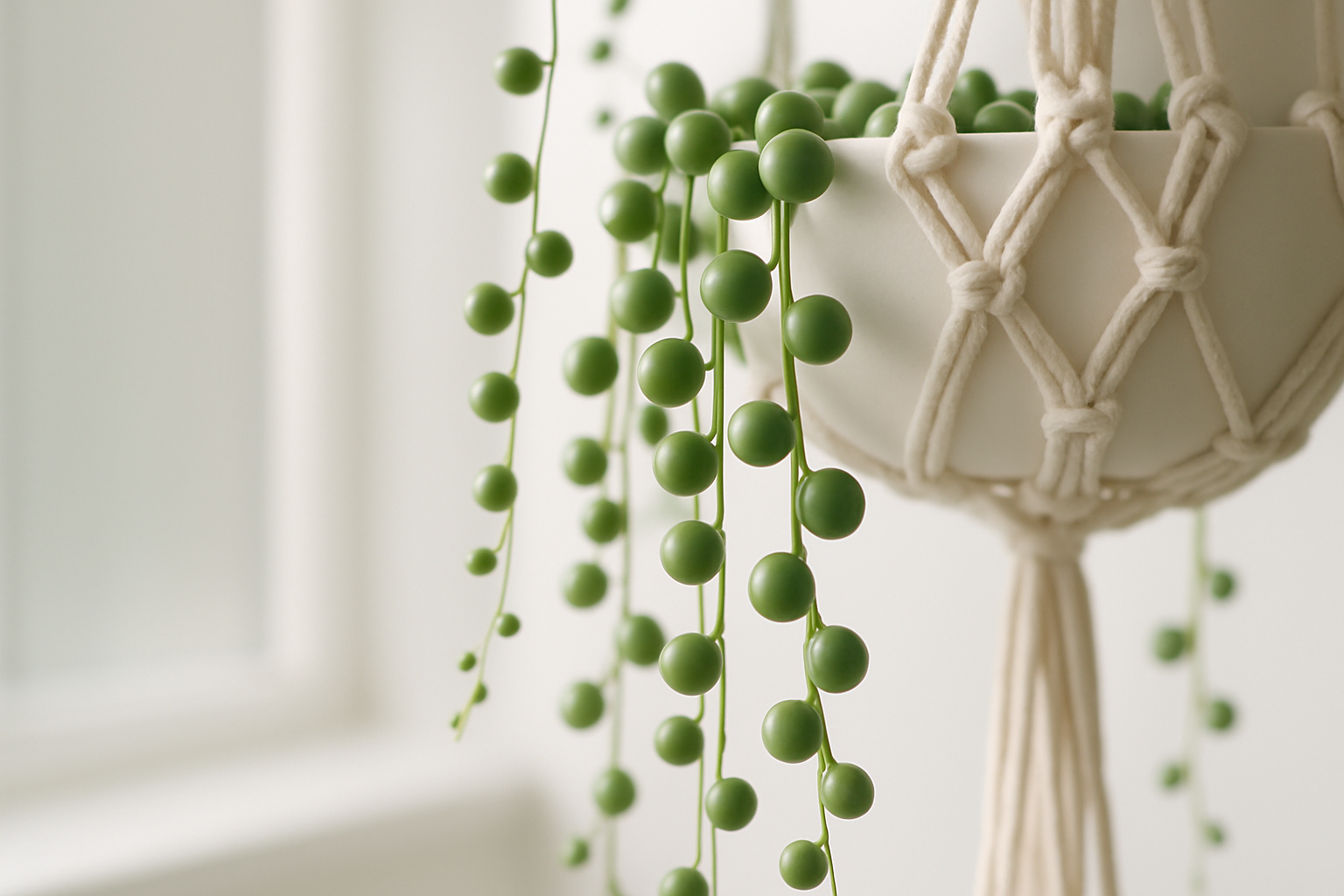
Meet Your String of Pearls (And Why They Have a Reputation)
Senecio rowleyanus — String of Pearls, or SOP if you're into acronyms — is a trailing succulent native to Southwest Africa. Those round, pea-like leaves aren't just adorable; they're water-storage organs designed to survive long dry spells between rare rainfalls. Which brings us to the problem.
Most people water their SOP the same way they water their pothos or philodendron: a little splash here, a little splash there, whenever the top inch of soil feels dry. This will kill your String of Pearls. Not eventually — quickly. And if you're looking for the perfect vessel to show off those cascading strands, a macramé hanger is the classic display choice for String of Pearls →
The shallow root system (more on that in a moment) combined with those water-storing peas means SOP is uniquely intolerant of excess moisture. But it's also uniquely intolerant of being ignored. The window between "too dry" and "too wet" is narrower than most houseplants, and the signs of distress can look similar to untrained eyes.
That's why the pearl-reading diagnostic system below is worth learning. Your plant is telling you exactly what it needs — if you know how to listen.
Read Your Pearls: What Shape, Color & Texture Mean
This is the FF signature section — a visual diagnostic system that no other plant site has properly nailed. Before you panic about your SOP, look at the peas.
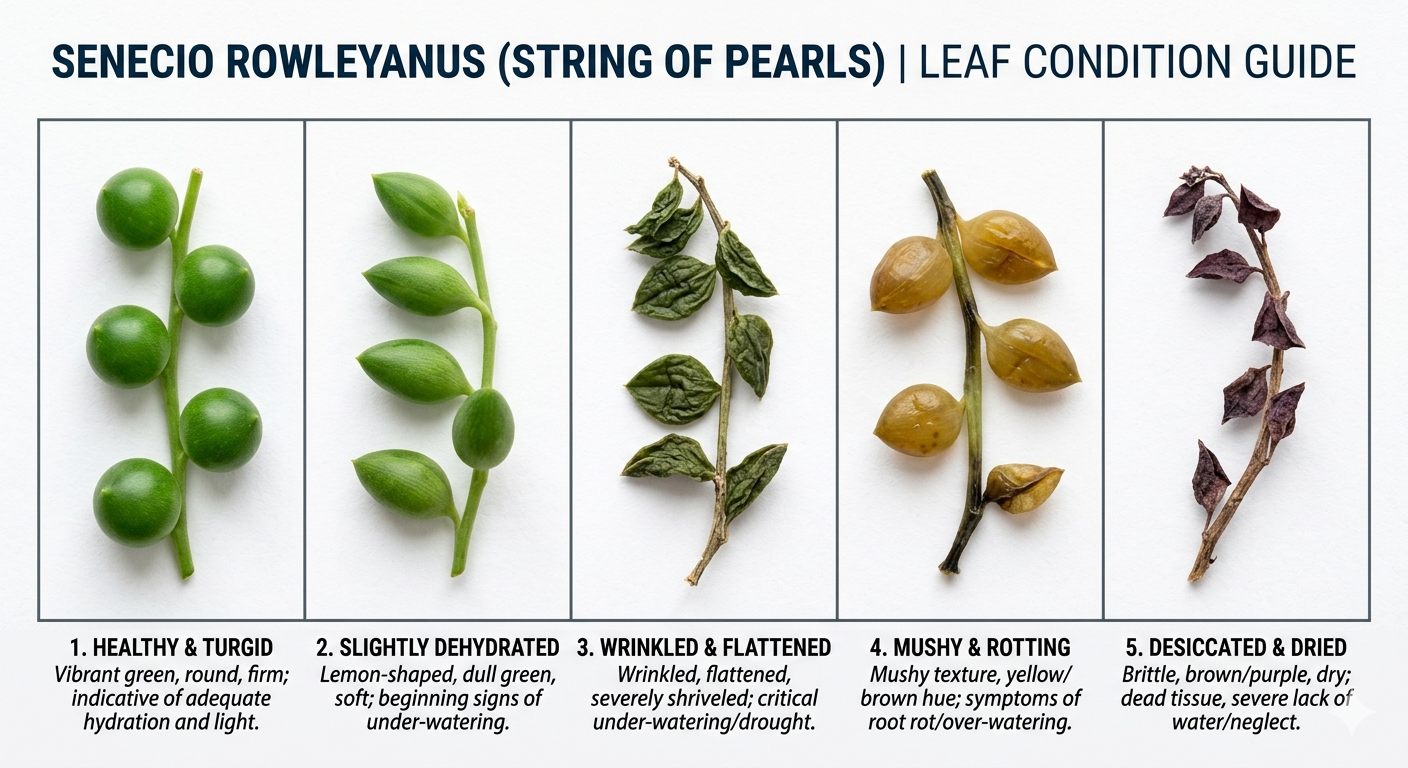
Round & Plump = Happy
If your pearls are perfectly round, firm to the touch, and have a slight sheen, your plant is happy. Full stop. Don't adjust anything.
Lemon-Shaped = Thirsty
If the peas are slightly deflated and shaped more like small lemons than perfect spheres, your SOP is telling you it's thirsty. This is the early stage of underwatering — an easy fix. Give it a good soak (see the watering section below) and the peas will plump back up within 24-48 hours.
Wrinkled or Flat = Severely Underwatered
Wrinkled, shriveled peas mean you've waited too long. The water reserves in the leaves are depleted. This can happen if you've been too conservative with watering, if the plant is root-bound, or if it's in a very hot/dry environment. A thorough soak can usually rescue these plants, but repeated cycles of severe underwatering will weaken the plant permanently.
Mushy or Yellow = Overwatered
Soft, squishy peas that feel mushy to the touch — or worse, yellowing — mean you've gone too far with the watering can. This is the most dangerous state because overwatering leads to root rot fast. If the stems are also mushy, you may be dealing with full rot (see the Rescue section below). Stop watering immediately. Let the soil dry completely. If the pot doesn't drain, repot into something with drainage holes and fast-draining soil.
Bald Stems = Light Problem
If your SOP is dropping peas and leaving bare, stringy stems behind, it's almost certainly a light problem. String of Pearls needs significantly more light than most houseplant advice suggests. "Bright indirect" is not enough — these are full-sun plants that have just been baby-sat in low-light apartments. See the light section below for what they actually need.
Light: Why "Bright Indirect" Is Wrong for String of Pearls
Here's a sentence that will make every plant expert you've ever argued with uncomfortable: String of Pearls needs direct sun indoors. Not "bright indirect." Not "lots of light." Direct sun. At least 4 hours of it.
Outdoors, String of Pearls grows in full sun in its native African habitat. The "bright indirect" advice exists because most people treat SOP like a tropical houseplant, put it across the room from a window, watch it slowly decline, and then blame themselves. The plant isn't dying because you're a bad plant parent — it's dying because it literally cannot photosynthesize enough in the light you're giving it.
What works: A south-facing or west-facing window where the plant sits directly in the sunbeam. Morning sun is gentler and still effective. East-facing windows work well too.
What doesn't work: North-facing windows. Rooms with no direct sun. "Near" a bright window but not in it. If you can read comfortably in the corner of the room, your SOP will not be happy there.
Grow lights work too. If you don't have a sunny window, a full-spectrum LED grow light on for 10-12 hours can substitute. Clip-on LED grow lights positioned 6-12 inches above the plant work well.
Watering String of Pearls: Not Too Much, Not Too Little
Watering is the hardest part of SOP care, and the part where most people fail. Not because it's complicated — but because it requires resisting your instincts.
Check soil moisture with a no-battery moisture meter before you water →
The Soak-and-Dry Method
String of Pearls should be watered using the soak-and-dry method:
- Check the soil. Not the top inch — the soil at the bottom of the pot. SOP's shallow roots mean the top dries out fast but the bottom can still be wet. Use a chopstick, a moisture meter, or lift the pot to gauge weight.
- When the soil is completely dry (and I mean completely — not "mostly dry" — dry), water thoroughly.
- Water until it drains out the bottom. This is not a "splash a little water on top" situation. Soak it.
- Empty the drainage tray immediately. SOP cannot sit in standing water. Root rot happens fast if the roots sit in water.
- Do not water again until the soil is bone dry.
Seasonal Watering Schedule
There is no universal "water every X days" schedule that works. Here's what actually works:
- Summer (active growth): Every 7-10 days, depending on heat and pot size. Smaller pots dry faster. Terra cotta dries faster than plastic.
- Winter (dormant): Every 2-3 weeks. SOP slows significantly in cooler, lower-light conditions. Overwatering in winter is the most common killer.
- Signals to watch: Lemon-shaped peas = thirsty. Mushy peas = overwatered. Adjust accordingly.
The Shallow Root Problem
SOP has a shallow, spreading root system — not a deep taproot. This means:
- It dries out faster than you'd expect from a succulent
- Moisture meters are your best friend — the top soil can be dry while the root zone is still damp
- Deep pots hold too much moisture at the bottom; shallow, wide pots are better
If you're unsure whether to water, see our root rot treatment guide for what happens when you get this wrong and how to recover.
The Right Soil Mix (And Why Your Pot Shape Matters)
Regular potting soil is death for String of Pearls. It retains too much moisture and doesn't drain fast enough. You need a fast-draining, gritty mix that dries quickly and doesn't compact around the roots.
DIY recipe: Mix standard succulent/cactus potting soil with perlite in a 2:1 ratio. The perlite creates air pockets and speeds drainage. You can also add coarse sand or pumice for extra grit.
Or just get the right stuff:
rePotme String of Pearls Imperial Succulent Mix — the blend this plant actually needs →
Whatever you use, it should drain in seconds, not minutes. If water pools on top of your soil instead of running through immediately, your mix is too dense.
Pot Shape and Drainage
Shallow and wide beats tall and deep. SOP's roots spread horizontally, not vertically. A 4-6 inch shallow pot with a wide opening is ideal. Tall pots hold too much excess soil at the bottom that stays wet too long.
Drainage holes are non-negotiable. No exceptions. If your decorative pot doesn't have a drainage hole, either drill one or use it as a cache pot — put the plant in a plastic nursery pot with drainage and set it inside the decorative one. Take it out to water, let it drain, then return it to the decorative pot.
Happy Environment: Warm, Dry, Out of Drafts
String of Pearls is a desert plant masquerading as a houseplant. It wants warmth, low humidity, and absolutely no cold drafts.
- Temperature: Above 20°C (68°F) is ideal. It can tolerate down to 10°C (50°F) in winter with significantly reduced water. Below that, damage starts happening.
- Humidity: Low. Do not mist SOP. Do not put it in your bathroom (contrary to Pinterest advice). Do not group it with humidity-loving tropicals. It wants dry air.
- Drafts: Keep away from air conditioning vents, heating vents, drafty windows, and exterior doors. Cold air hitting SOP causes stress and can trigger leaf drop.
- Outdoor summer care: SOP can live outdoors in temperate climates during summer, as long as it's in a shaded or part-sun location (not scorching midday sun) and brought inside when temperatures drop below 10°C.
Feed Your Peas: Yes, They Need Food
Succulents get a reputation for not needing fertilizer, and while it's true that they're more forgiving than heavy feeders, SOP will perform noticeably better with occasional feeding.
- Use a succulent or cactus fertilizer at half the recommended strength during the growing season (spring and summer).
- The "weakly weekly" method: Feed weakly, weekly — a diluted dose every week during active growth is better than a full dose once a month.
- Stop feeding in fall and winter when growth slows or stops.
- Signs of nutrient deficiency: Small, stunted, or deformed peas. The plant is too depleted to produce normal-sized leaves.
Schultz Succulent Plant Food — easy to use liquid fertilizer for your peas →
Propagate String of Pearls: 2 Methods That Work
String of Pearls is one of the easiest succulents to propagate, and you should be doing it regularly — both to expand your collection and to have backups in case the main plant goes sideways. Win-win.
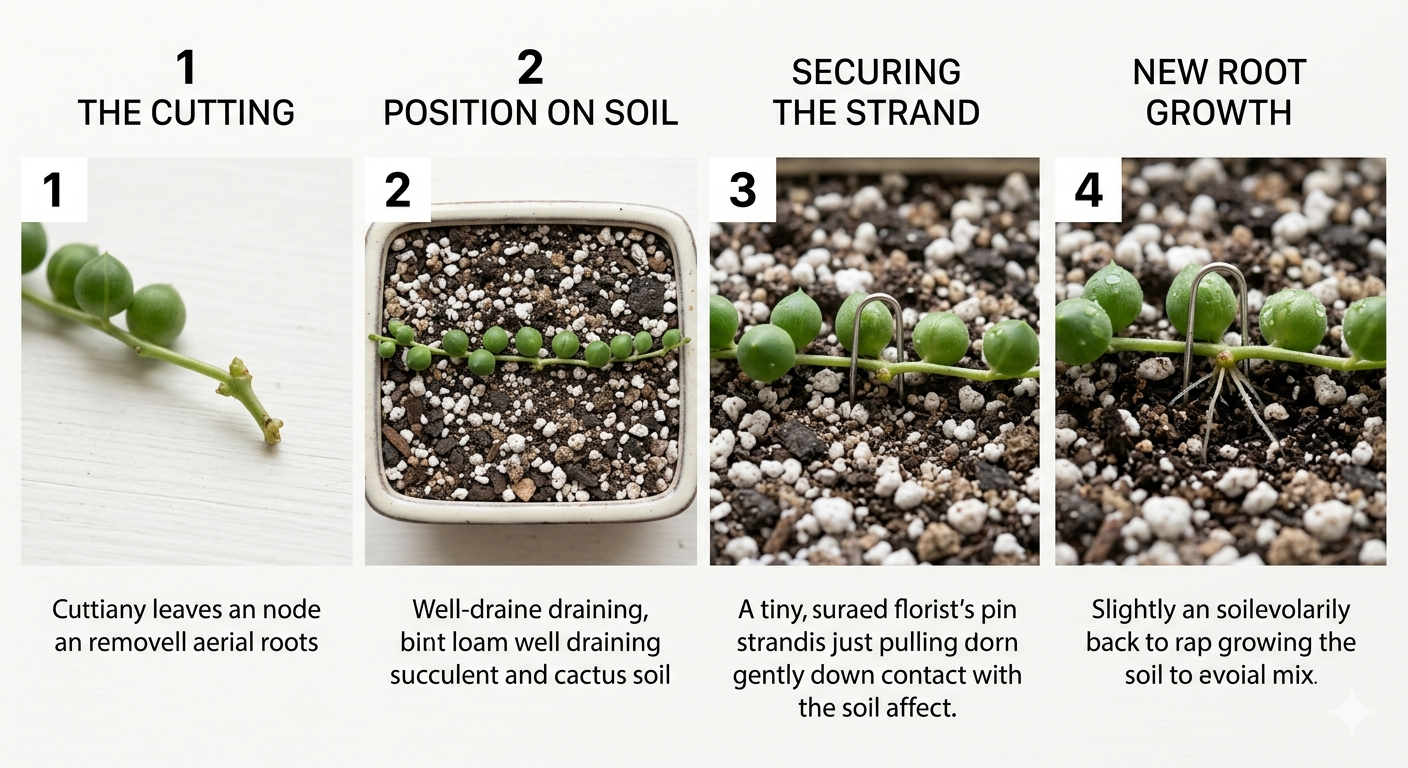
Method 1: Soil Layering (Easiest)
This is the method so easy it feels like cheating:
- Identify a healthy, long strand on your existing plant.
- Lay the strand directly on top of moist succulent soil in a new pot.
- Use u-shaped plant pins to gently hold the strand in contact with the soil at 2-3 points along its length. This keeps the nodes in contact with moisture so they can root.
- Keep the soil lightly moist (not soaking) for 2-4 weeks.
- After 4 weeks, give the strand a very gentle tug. If you feel resistance, roots have formed.
- Stop misting and treat like a normal SOP.
The parent plant will continue growing from the original strand — you've just added a second plant without cutting anything.
Method 2: Stem Cuttings in Soil
If you want to propagate multiple plants from one strand, or if a strand breaks off naturally:
- Cut a 4-6 inch section of healthy strand with clean, sharp scissors just below a node (where a leaf meets the stem — that's where roots will emerge).
- Let the cutting callous over for 24 hours. This is optional but reduces rot risk.
- Stick the cut end into succulent soil, burying the node.
- Keep lightly moist until roots form (2-4 weeks).
- Treat as normal once rooted.
Water Propagation: Worth the Risk?
You can root SOP in water, and roots do appear faster. But transferring a water-rooted succulent to soil is stressful and many plants don't survive the transition. If you want to water propagate, keep the roots very short (1/2 inch max) and move to soil immediately. See our general propagation guide for more detail.
Pruning for Fullness (Be Mean!)
Pruning String of Pearls sounds scary — those long, flowing strands are the whole point, right? But strategic pruning is what makes SOP look full and lush instead of long and lanky.
How to prune: Using clean, sharp scissors, cut a strand just above a node (where a leaf attaches). This signals the plant to branch from that point, creating two growing tips instead of one. More tips = fuller plant = more strands cascading over the pot edge.
What to do with the cuttings: Propagate them! Lay them back on the soil in the same pot or start new pots. This is how you go from one sad strand to a lush, full plant over time.
Leggy strands: If a strand has lost most of its peas and is just a bare string, it's not going to recover. Cut it off and propagate the healthy sections. Let the bare sections go.
When Your String of Pearls is Dying: Save vs Start Over
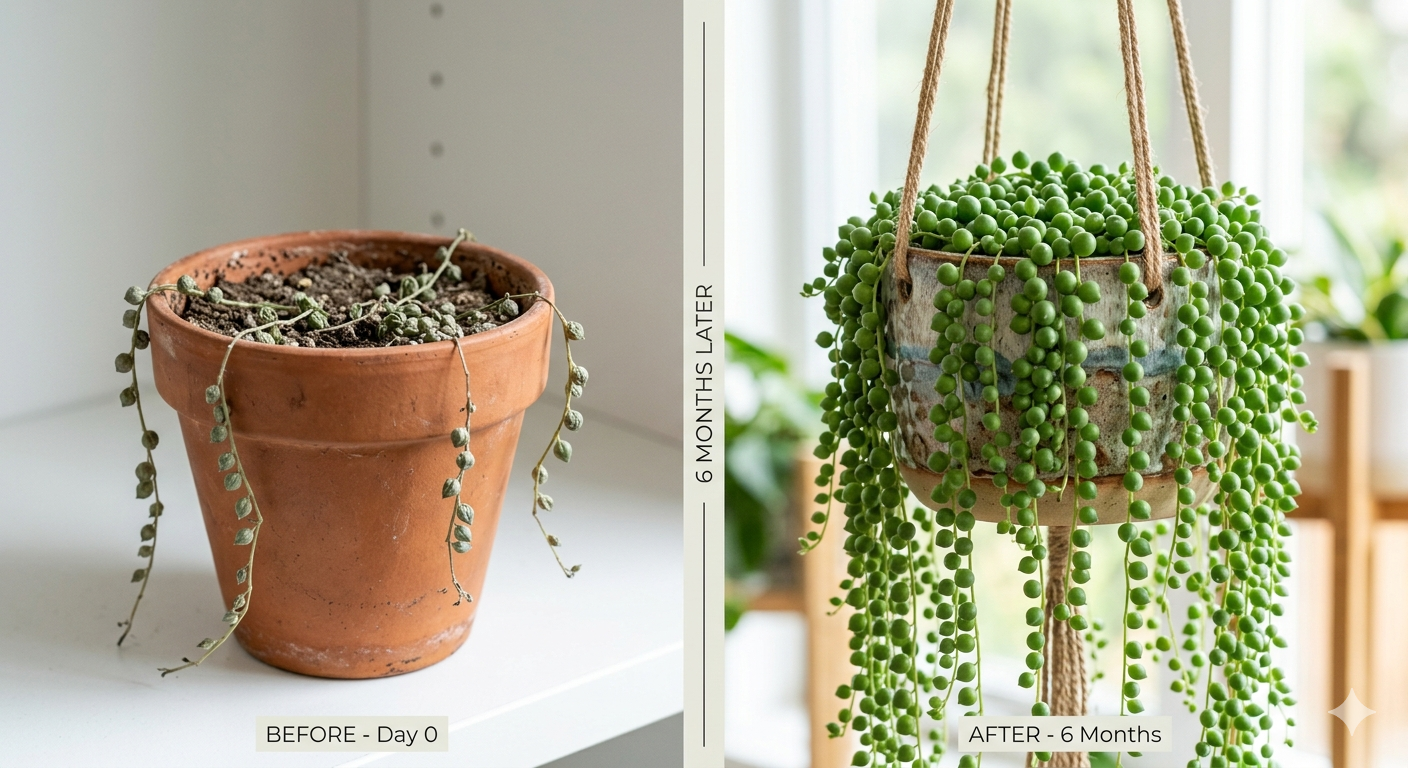
String of Pearls is dramatic. It goes downhill fast and it can come back from near-death just as quickly. Here's how to decide if it's worth saving.
Can This Plant Be Saved? (Decision Tree)
- Are the roots white/tan and firm? → Healthy roots. The plant can be saved.
- Are the roots black, brown, mushy, or slimy? → Root rot. Treat immediately or propagate what you can.
- Are any strands still plump and firm? → You can propagate from the healthy sections even if the main plant is a loss.
- Are all the peas mushy and all the stems brown/slimy? → Probably too late. But check for any remaining firm strands before you throw it out.
Step-by-Step Rescue Protocol
- Remove the plant from its pot. Gently shake off the soil and examine the roots.
- Trim away all rotted roots with clean scissors. Rotted roots are brown/black and mushy. Healthy roots are white or tan and firm.
- Cut away any dead strands. If a strand is mushy throughout, remove it entirely. If only part is affected, cut below the affected area.
- Repot in fresh, dry succulent soil in a clean pot with drainage. Do not water immediately — wait 3-5 days to let the cut roots callous.
- Water sparingly after the waiting period, using the soak-and-dry method.
- Place in bright direct light. Recovery requires good light.
When to Give Up and Propagate What's Left
If the root system is completely gone but you have firm, healthy strands remaining: don't throw the plant out. Cut the healthy strands, propagate them in fresh soil, and start over. This is not a loss — you just turned one dying plant into multiple new ones.
For detailed root rot recovery steps, see our root rot treatment guide.
⚠️ Is String of Pearls Toxic to Pets?
Yes. String of Pearls is toxic to cats and dogs if ingested.
Senecio rowleyanus contains compounds that can cause gastrointestinal irritation, vomiting, diarrhea, drooling, and lethargy in pets who chew or ingest any part of the plant. If you suspect your pet has eaten SOP, contact your vet immediately.
This is not a plant to keep if you have curious pets who chew on plants. If that's your situation, consider String of Hearts — a non-toxic trailing plant with a similar aesthetic. Less dramatic-looking than SOP, but your pet won't need emergency care if they decide to sample it.
String of Pearls Cheat Sheet
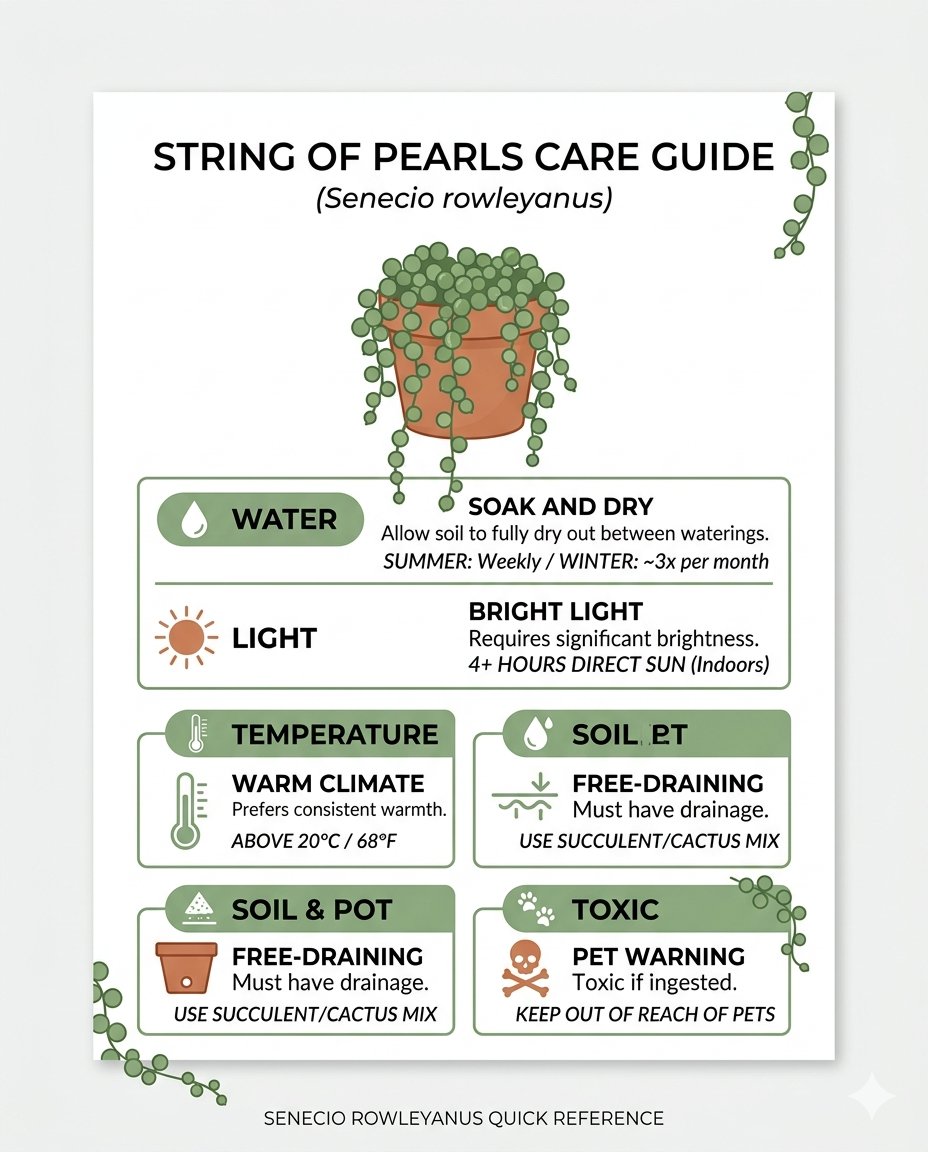
| Light | 4+ hours direct sun indoors. Morning sun ideal. |
| Water | Soak and dry. Every 7-10 days summer, every 2-3 weeks winter. |
| Soil | Fast-draining succulent mix with perlite. |
| Pot | Shallow, wide, with drainage holes. |
| Temperature | Above 20°C (68°F). No drafts. |
| Humidity | Low. Don't mist. Keep dry. |
| Fertilizer | Succulent fertilizer, half-strength, spring-summer only. |
| Toxicity | ⚠️ Toxic to cats and dogs. Keep out of reach. |
| Propagation | Soil layering or stem cuttings. Easiest method: lay on soil and pin. |
Our Favorite String of Pearls Products
We use and recommend these products for SOP care:
| Product | Why We Like It |
|---|---|
| rePotme String of Pearls Imperial Succulent Mix | Specifically formulated for SOP. No guesswork. |
| Sustee Moisture Meter | No batteries needed. Color-coded. Perfect for checking soil before watering. |
| Schultz Succulent Plant Food | Easy liquid fertilizer. Works for all succulents. |