String of Pearls Care: The Complete Senecio Rowleyanus Guide
Your String of Pearls is a desert plant dressed up in pearls. Treat it like a tropical and it will rot. Here's everything you need to keep it alive.
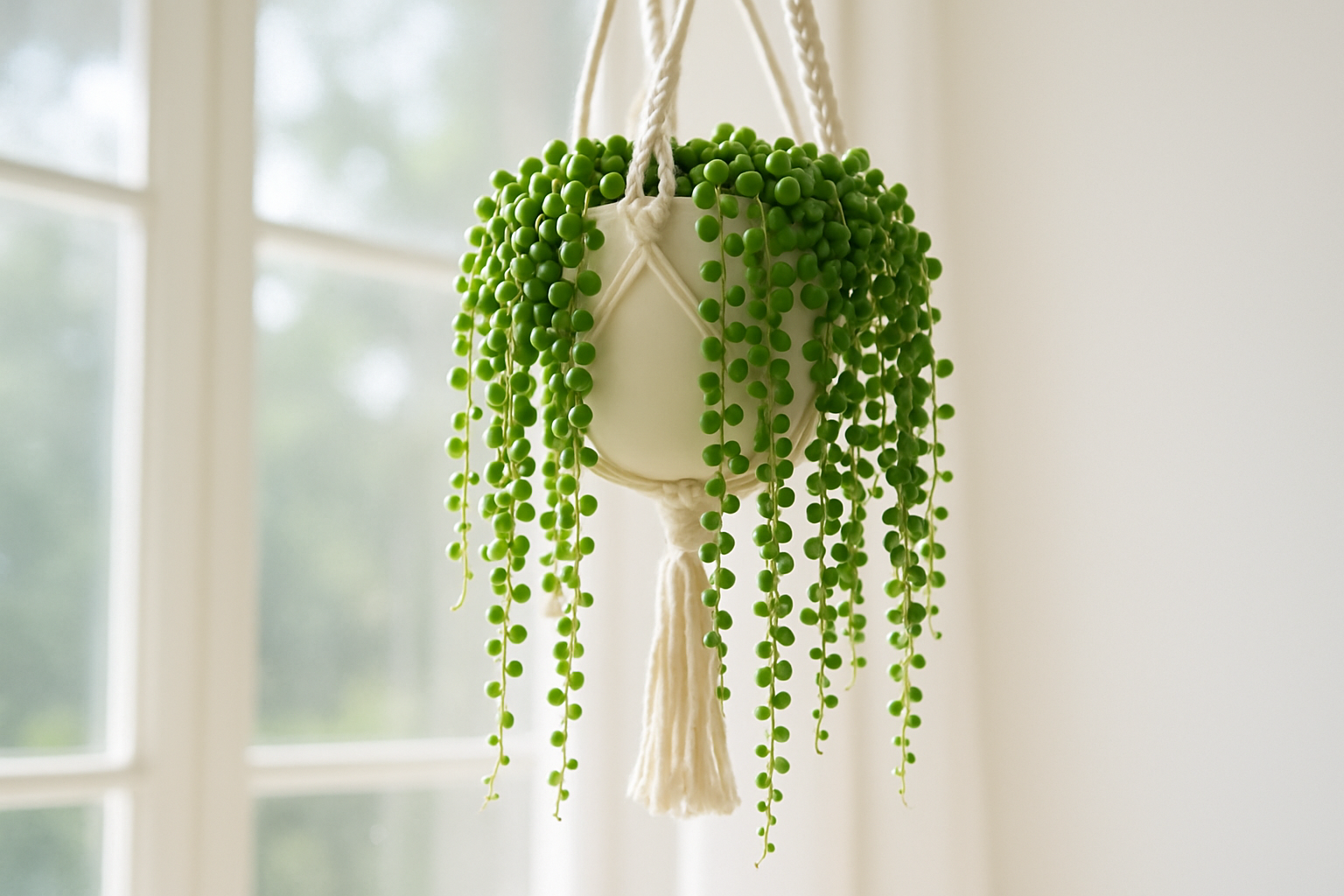
Meet Your String of Pearls (And Why Everyone Kills Theirs)
Senecio rowleyanus — the plant that looks like a string of绿绿的 peas dangling from a jewelry box. It's a succulent. From the Cape of Good Hope. That matters because succulents from arid regions have zero tolerance for sitting in wet soil, and "bright indirect light" is about the worst advice you can follow for this particular plant.
Most people kill their String of Pearls (SOP) by treating it like a tropical hanging plant. It is not a pothos. It does not want humidity. It does not want to be misted. It wants sun, drought, and excellent drainage.
The good news: once you understand what it actually is, SOP is genuinely easy. This guide covers every angle — diagnostics, watering, light, soil, propagation, rescue, toxicity, and the variegated version everyone keeps asking about. Read the whole thing or jump to what you need.
Read Your Pearls: A Visual Diagnostic Guide
Your SOP's pearls are a status report. Learn to read them and you'll know exactly what's wrong — no guessing required.
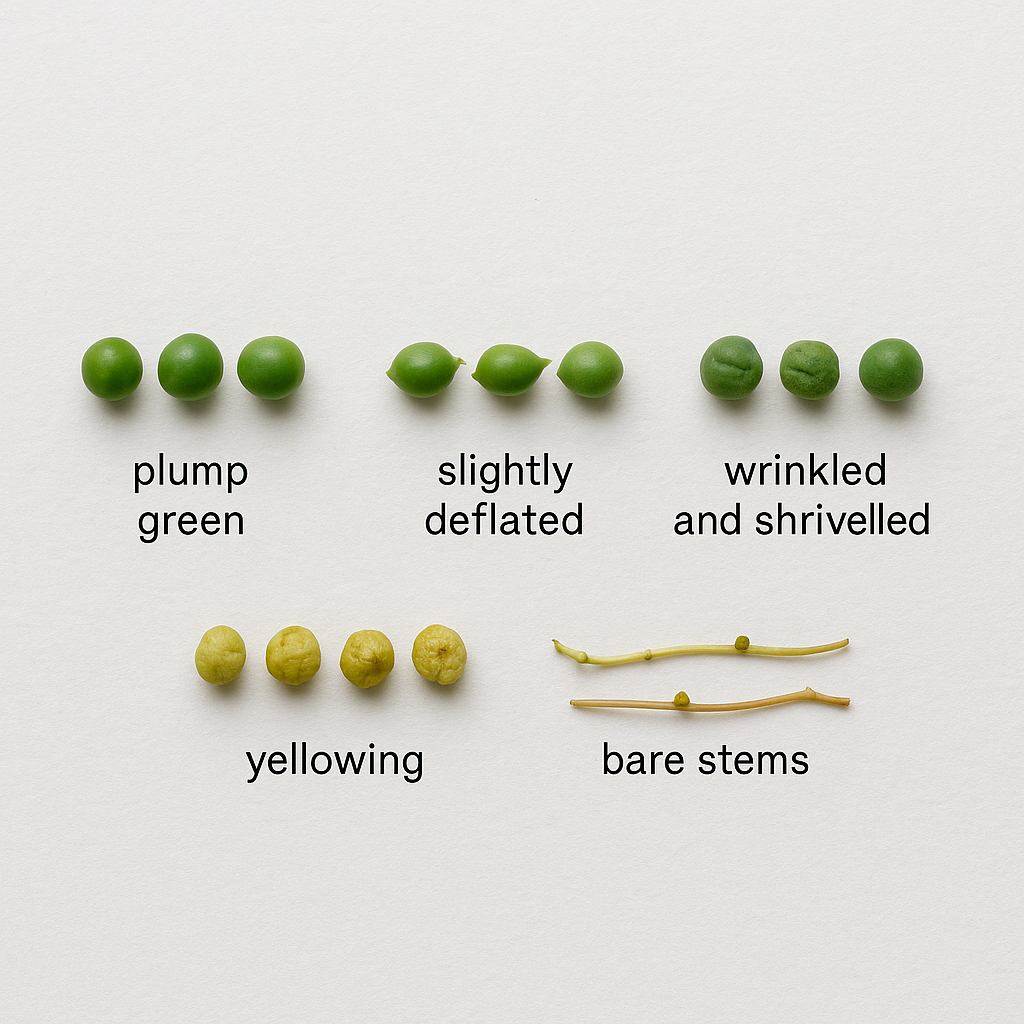
Here's what your pearls are telling you:
1. Plump and perfectly round → Happy plant. Consistent soak-and-dry watering, good light. Keep doing exactly what you're doing.
2. Lemon-shaped (slightly deflated, narrower in the middle) → Mild underwatering. The pearls are using stored water. Soak the pot for 30 minutes, let it drain fully, and check your watering schedule.
3. Wrinkled and shrivelled → Significant underwatering or prolonged drought. If the soil is bone dry and the pearls look like raisins, soak the pot for 30–60 minutes. In the future, water more frequently — but only when the soil is dry.
4. Mushy, soft, and yellowing → Overwatering or root rot. Stop watering immediately. This is the number one killer of SOP. If the roots smell bad or look brown and mushy, you've got root rot — trim the affected roots, spray with diluted hydrogen peroxide, and repot in fresh dry gritty mix. See the root rot treatment guide for the full protocol.
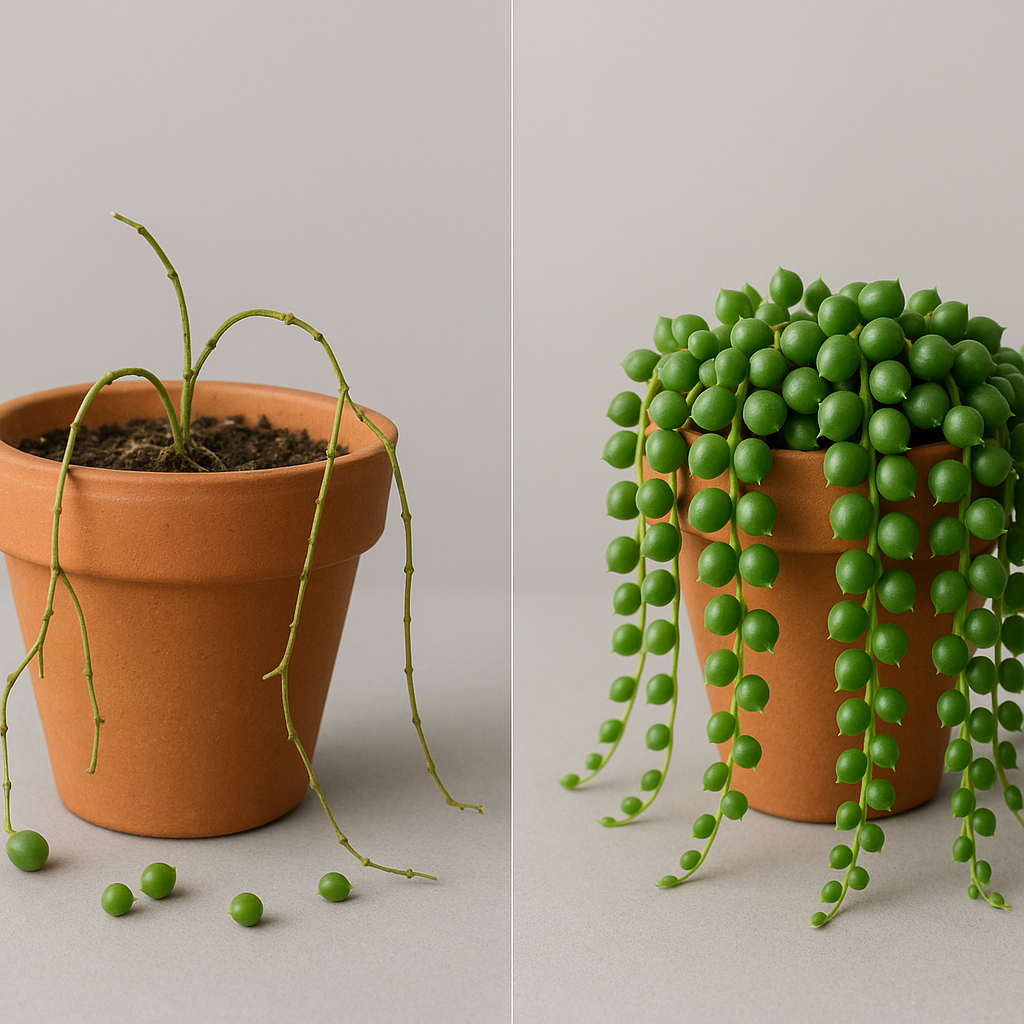
5. Bare stems with fallen pearl nodes → Too far gone to easily rescue. This happens after prolonged neglect or root rot. If you still have any healthy-looking strands, propagate those immediately (see below). The bare stems won't regrow pearls.
If your plant has serious symptoms beyond what these pearls show, check the Plant ER for more advanced triage.
Why "Bright Indirect" Is Wrong for String of Pearls
Here's the counterintuitive truth: String of Pearls wants direct sun. Not "bright indirect." Not "some morning sun." Direct.
In its native habitat, Senecio rowleyanus grows in full sun conditions. The "bright indirect" advice floating around the internet is generic tropical plant advice that does not apply to this plant. If your SOP is sitting 3 feet back from a north-facing window, it's slowly etiolating — stretching out, getting leggy, losing its compact round pearl shape.
What SOP actually needs:
- 4–6 hours of direct sunlight daily
- East or west-facing windows are ideal (morning or afternoon sun)
- South-facing with a sheer curtain works perfectly
- A few hours of direct afternoon sun is fine — it's not as fragile as the internet suggests
What if you don't have a sunny window?
If you're in a dim apartment (we've all been there), a grow light is genuinely the right call here. A clip-on LED grow light is the easiest solution — it sits on a shelf or windowsill and gives your SOP the light it actually needs. Full spectrum is best. Run it 8–10 hours a day if natural light is minimal.
Signs your SOP needs more light:
- Leggy, stretched growth with widely spaced pearls
- Pale green rather than deep green
- Strands reaching toward the light source
Watering String of Pearls: The Soak-and-Dry Method
Watering is where most people fail with SOP. This plant is a desert succulent — its roots are adapted to periods of drought followed by brief saturation. Not constant moderate moisture.
The method:
- Check that the soil is completely dry (use a finger or, better, a moisture meter — SOP's roots are shallow, so the top drying out doesn't mean the bottom is)
- Water thoroughly until it drains freely from the bottom
- Let it drain fully — never let the pot sit in standing water
- Don't water again until the soil is bone dry
Seasonal frequencies:
- Summer (active growth): Every 7–10 days, depending on heat and light
- Winter (dormant): Every 2–3 weeks, sometimes longer
- Key rule: When in doubt, wait another few days. SOP can handle drought far better than overwatering.
The shallow root problem:
SOP has shallow, wide-spreading roots — not deep taproots. A standard finger test won't tell you the whole story. The top inch might be dry while the root zone below is still damp. A moisture meter removes the guesswork. Push it to about 2 inches deep — if it reads dry at that depth, water. See the best moisture meters for more options.
Never water-propagate a mature SOP. It's fine for rooting cuttings (see propagation below), but a mature SOP in water will rot within weeks. Soil only for the grown plant.
The Right Soil Mix and Why Your Pot Shape Matters
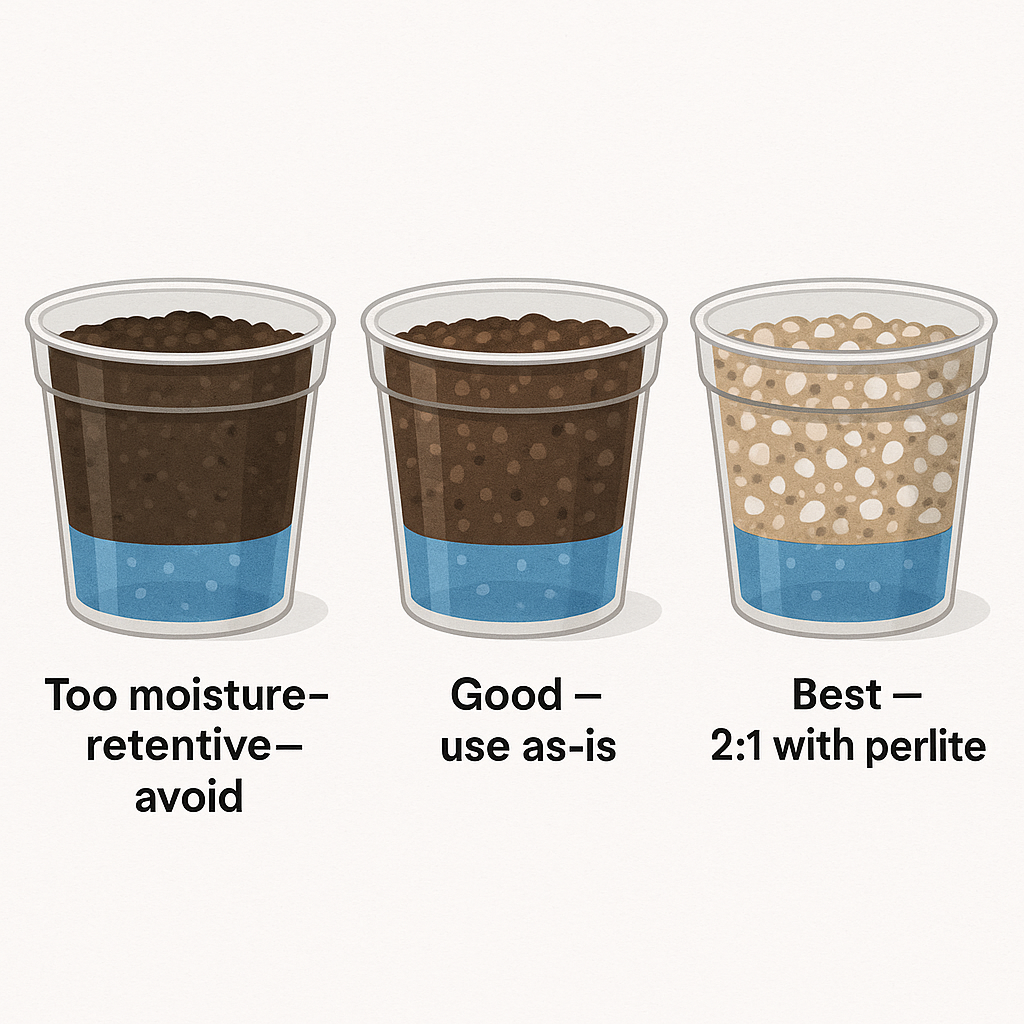
Standard potting soil is the enemy of SOP. It retains too much moisture, and SOP roots hate sitting wet. You need a fast-draining, gritty, airy mix.
The DIY mix:
- 2 parts succulent or cactus mix
- 1 part perlite
- Optional: a handful of coarse sand for extra drainage
This mix drains fast, dries evenly, and gives the roots the oxygen they need. If you want to skip the mixing, rePotme's String of Pearls Imperial Succulent Mix is specifically formulated for this plant — it's what we use and recommend.
The pot shape matters more than you think:
SOP roots spread wide, not deep. A shallow wide pot lets the entire root zone dry evenly. A tall narrow pot leaves the bottom perpetually damp — and damp = root rot.
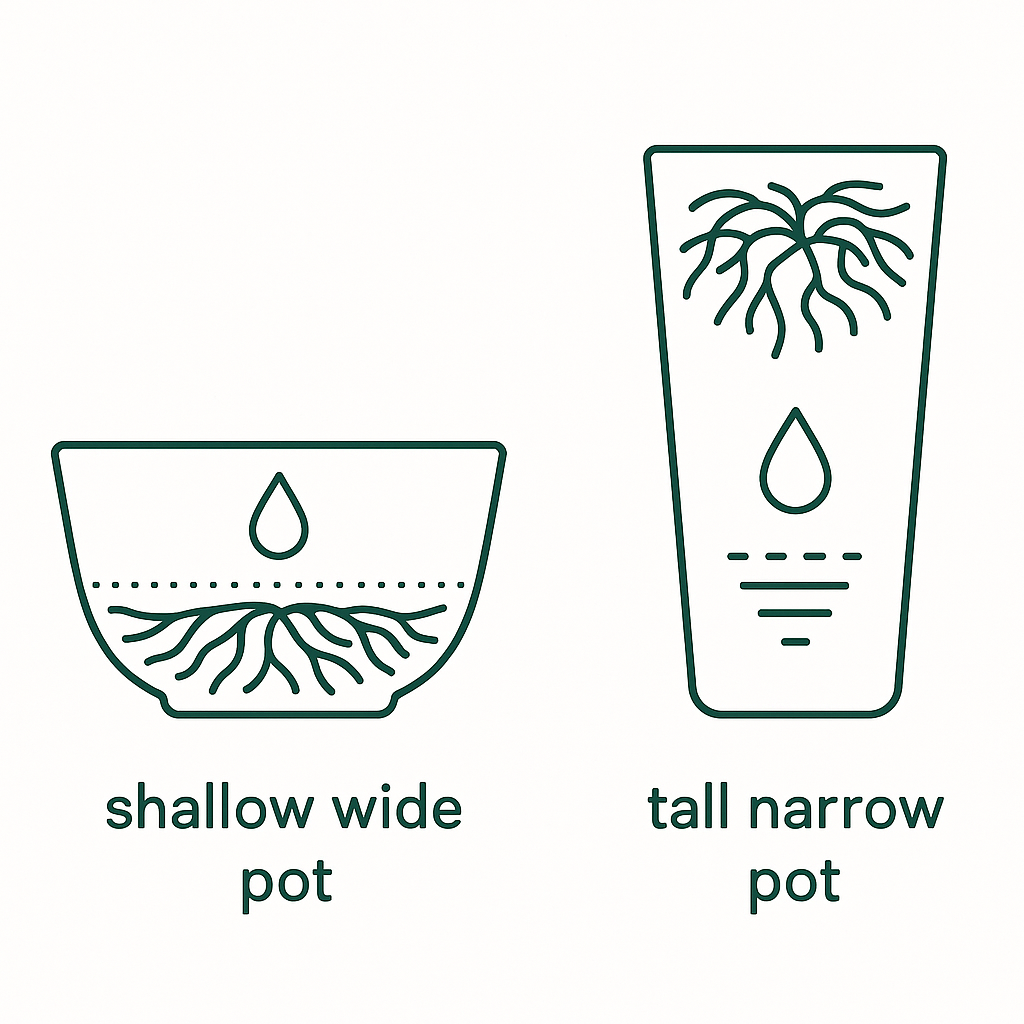
Always use a pot with drainage holes. No exceptions. Cache pots (decorative outer pots) are fine — just make sure the inner pot drains freely and you don't let water collect at the bottom. See best pots for succulents for shallow pot recommendations.
Happy Environment: Warm, Dry, No Drafts
SOP is not complicated about its environment:
- Temperature: Above 68°F (20°C). It can handle brief dips, but sustained cold will damage it. Bring it inside when temps drop below 50°F.
- Humidity: Low. This is a desert plant. It does not want a humid bathroom or a kitchen windowsill above a kettle. High humidity promotes the fungal issues that kill SOP.
- Drafts: Keep it away from heating vents, air conditioners, and drafty doorways.
- Outdoor summer care: SOP loves being outside in warm months — just ease it into direct sun gradually to avoid sunburn (a few hours of morning sun, then shade for a week, then full sun).
Feed Your Peas: Yes, They Need Food Too
Succulents get a reputation for not needing fertilizer, but SOP grows actively in summer and will look better with light feeding.
- Use a succulent or cactus fertilizer at half the recommended strength
- Feed every 2–3 weeks during the growing season (spring and summer)
- Stop feeding entirely in fall and winter when growth slows
- Schultz Succulent Plant Food is a liquid formula — easy to dilute to half strength without precise measuring
The weakly-weekly method works well: dilute fertilizer to quarter or half strength and feed every time you water during active growth. Skip it entirely in winter.
Propagate String of Pearls: Soil Layering and Stem Cuttings
SOP propagates reliably from cuttings, and there are two methods depending on how much you want to fiddle with it.
Method 1: Soil Layering (easiest)
This is the method with the highest success rate because the strand stays attached to the mother plant while it roots.
- Select a healthy strand at least 4–6 inches long with plump, round pearls
- Lay the strand flat on top of pre-moistened gritty succulent soil
- Pin the strand to the soil surface at 2–3 points using bent floral pins or small stones
- Keep the soil lightly moist (not wet) for 2–4 weeks
- Once you feel resistance when you gently tug the strand, roots have formed
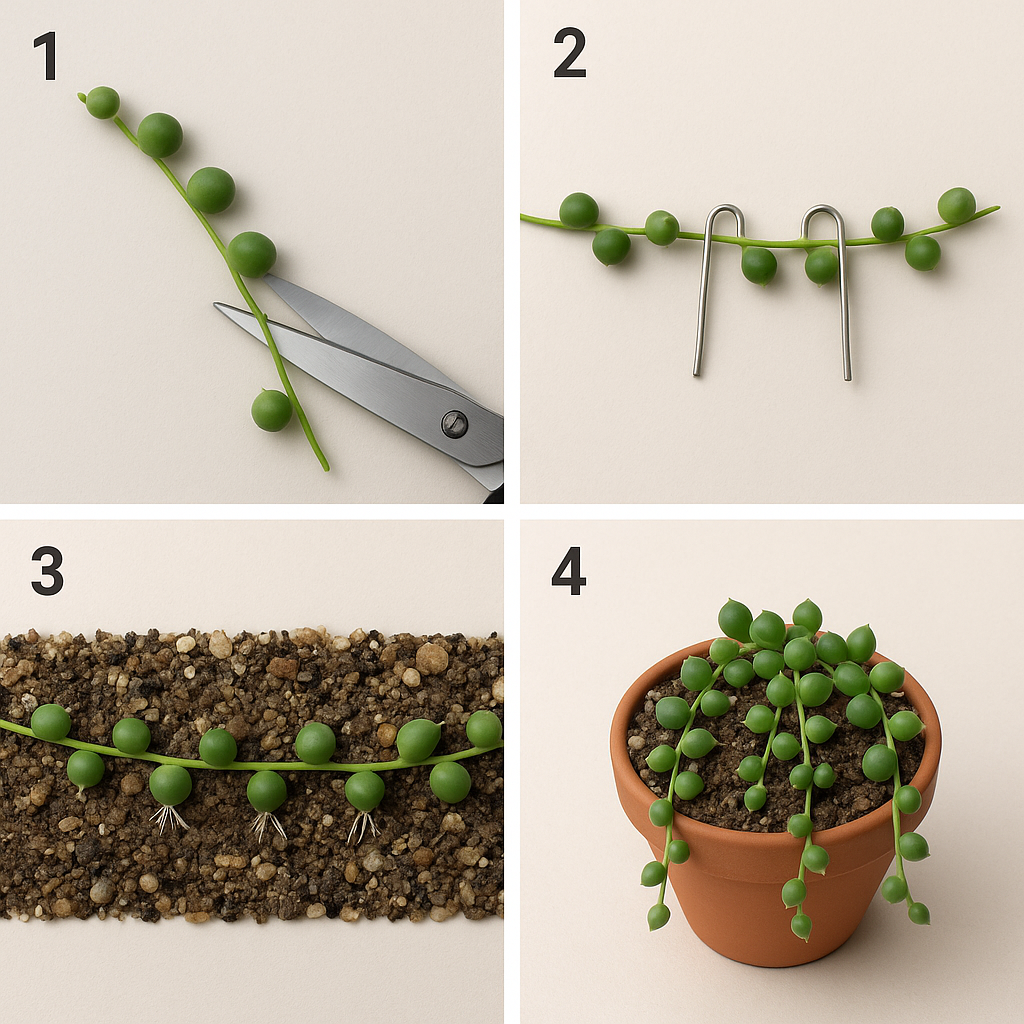
Method 2: Stem Cuttings
- Cut a healthy strand 4–6 inches long with clean scissors
- Let the cut end callous over for 24 hours (this prevents rot)
- Plant the calloused end in dry gritty mix
- Keep lightly moist until roots form (2–4 weeks), then transition to normal SOP watering
Water propagation warning: You can root SOP cuttings in water, but transferring a water-rooted cutting to soil is a common failure point. The roots formed in water are different from soil roots, and the transition shocks many cuttings. Soil propagation (either method above) has a much higher success rate for mature plants.
For more on propagation tradeoffs, see the Propagation Guide.
Pruning for Fullness: Be Mean to Your Plant
Strategic pruning is not abuse — it's how you get a fuller, bushier SOP. When you cut a strand, it branches from the cut point. Two strands become four. Four become eight.
When to prune:
- Leggy, bare-stem sections with gaps between pearls
- Strands that have gotten too long and sparse
- Any dead or dried-out sections
How to prune:
- Cut with clean scissors just above a pearl node
- The node will branch into 2–3 new strands
- Don't throw the cuttings — propagate them (see above)
Pruning is also your chance to propagate any healthy strands you've cut and fill in bare spots or start a new plant. See the Propagation Guide for step-by-step instructions.
When Your String of Pearls Is Dying: Save vs. Start Over
Here's the honest triage decision tree:
Step 1: Inspect the roots Pull the plant out of the pot and look. Healthy SOP roots are white and firm. Brown, mushy, or smelly roots = root rot.
Step 2: If it's root rot
- Trim all affected roots with clean scissors
- Spray surviving roots with diluted hydrogen peroxide (1:1 with water)
- Repot in fresh, completely dry, gritty mix
- Wait 3–5 days before watering
- See the root rot treatment guide for the full protocol
Step 3: If it's not root rot but the plant looks terrible
- Check light — is it getting enough sun?
- Check watering — too much or too little?
- SOP is remarkably resilient. Address the issue, give it 4–6 weeks, and see if it bounces back
Step 4: If the damage is too severe
- Identify any remaining healthy strands
- Propagate those strands (see propagation section)
- Let the mother plant go
- Start fresh with better conditions
If you need more general plant triage, see the Plant ER.
Is String of Pearls Toxic to Pets?
Yes. Full stop. Senecio rowleyanus is toxic to both cats and dogs.
The plant contains pyrrolizidine alkaloids, which can cause liver damage in pets if ingested in sufficient quantities. Most pets won't eat it — the pearls look enticing but taste bad — but accidents happen.
Symptoms of ingestion:
- Drooling
- Vomiting
- Lethargy
- Loss of appetite
- Diarrhea
What to do:
- Remove any plant material from your pet's mouth
- Call your vet immediately — don't wait for symptoms to worsen
- Note how much was eaten and when
- Bring a photo of the plant to help your vet identify it
There is no safe dosage here. Keep SOP well out of reach of any pet with a history of eating plants. If you want a trailing plant that's genuinely pet-safe, the String of Hearts (Ceropegia woodii) is non-toxic and equally gorgeous. See our pet-safe trailing plants list for more options.
String of Pearls Through the Year
Spring (wake-up season)
- Resume watering as growth picks up
- Start fertilizing every 2–3 weeks
- Check for new strands — this is a good time to propagate cuttings
- Gradually increase light exposure
Summer (peak growth)
- Water every 7–10 days
- Fertilize every 2–3 weeks
- Watch for sunburn if moving outdoors — ease into it
- SOP grows fastest now; prune to encourage fullness
Fall (wind-down)
- Reduce watering frequency
- Stop fertilizing
- Prepare to bring indoors if temps will drop below 50°F
- Check for pests before bringing inside
Winter (dormancy)
- Water every 2–3 weeks — let it get almost completely dry between waterings
- No fertilizer
- Keep above 68°F
- Growth slows significantly; this is normal
- Leggy growth in winter usually means insufficient light — consider a grow light
For the broader seasonal context, see the Seasonal Care Calendar.
Variegated String of Pearls: Same Rules, More Light
Variegated String of Pearls (Senecio rowleyanus f. variegata) has cream and pink striping instead of solid green. It's the same plant with one key difference: it needs more light to maintain the variegation.
In low light, the variegated sections (which have less chlorophyll) can't photosynthesize efficiently, and the plant will push out more solid green growth to compensate. You end up losing the variegation.
Variegated SOP care adjustments:
- More direct sun than the standard green version — up to 6 hours of direct sun
- If growing indoors without a bright window, a grow light is effectively mandatory
- Same watering, soil, and temperature requirements as standard SOP
- Slower growing than the standard green (less chlorophyll = less energy)
The variegated version is less common and slightly more demanding, but if you can give it the light it needs, it's a stunner.
Quick Cheat Sheet and Our Favorite Products
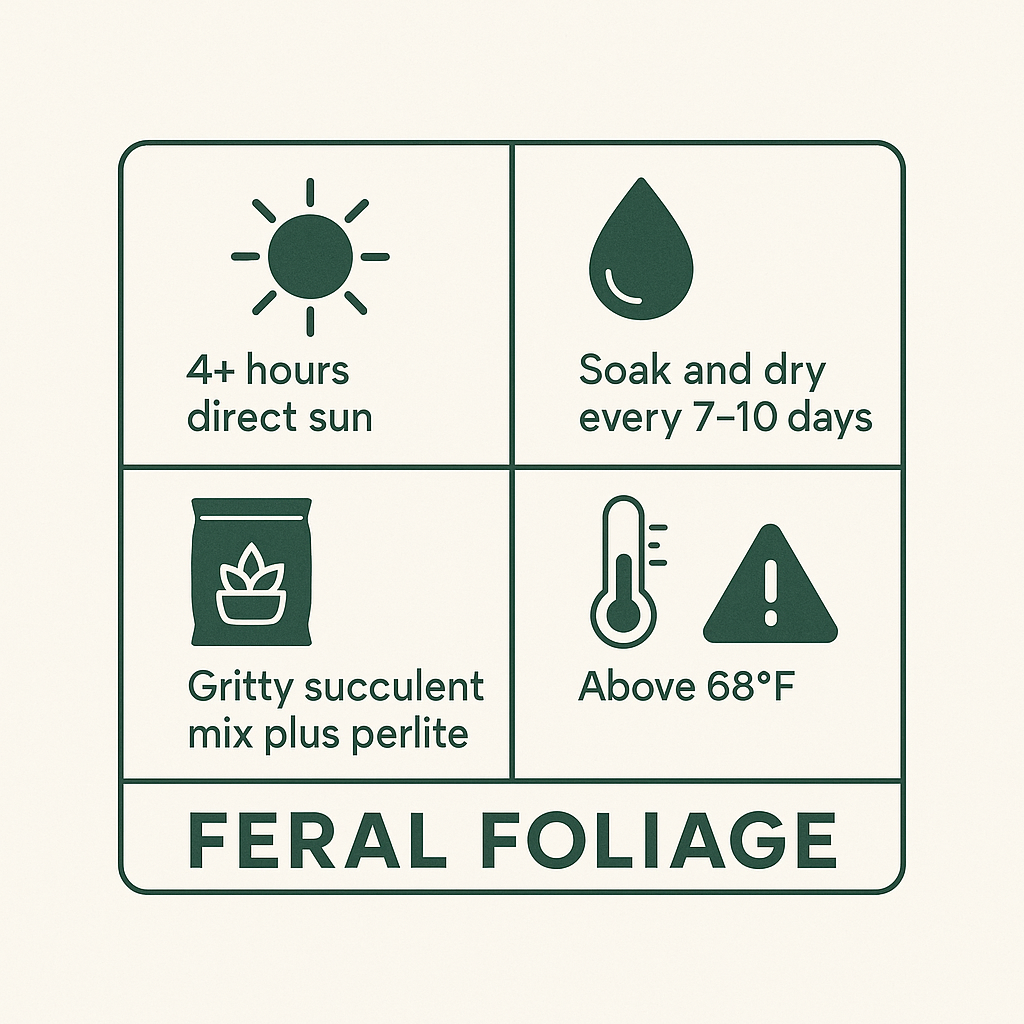
| Light | 4–6 hours direct sun (or grow light) |
| Water | Soak-and-dry; every 7–10 days summer, 2–3 weeks winter |
| Soil | Fast-draining gritty mix; 2:1 succulent soil + perlite |
| Temperature | Above 68°F; bring inside below 50°F |
| Humidity | Low — keep it dry |
| Fertilizer | Succulent fertilizer at half strength, spring–summer only |
| Toxicity | Toxic to cats and dogs |
| Propagation | Soil layering or stem cuttings |
Products We Love
We use these products ourselves:
- rePotme String of Pearls Imperial Succulent Mix — the ready-to-use option that actually works for SOP
- Sustee Moisture Meter — no battery, color-changing, and it actually helps you water SOP correctly
- Schultz Succulent Plant Food — liquid formula makes half-strength feeding easy
- Browse Macramé Plant Hangers on Amazon — the #1 display choice for cascading SOP
Want to diagnose what's actually killing your other plants? Check out the Plant ER for plant-specific triage guides.