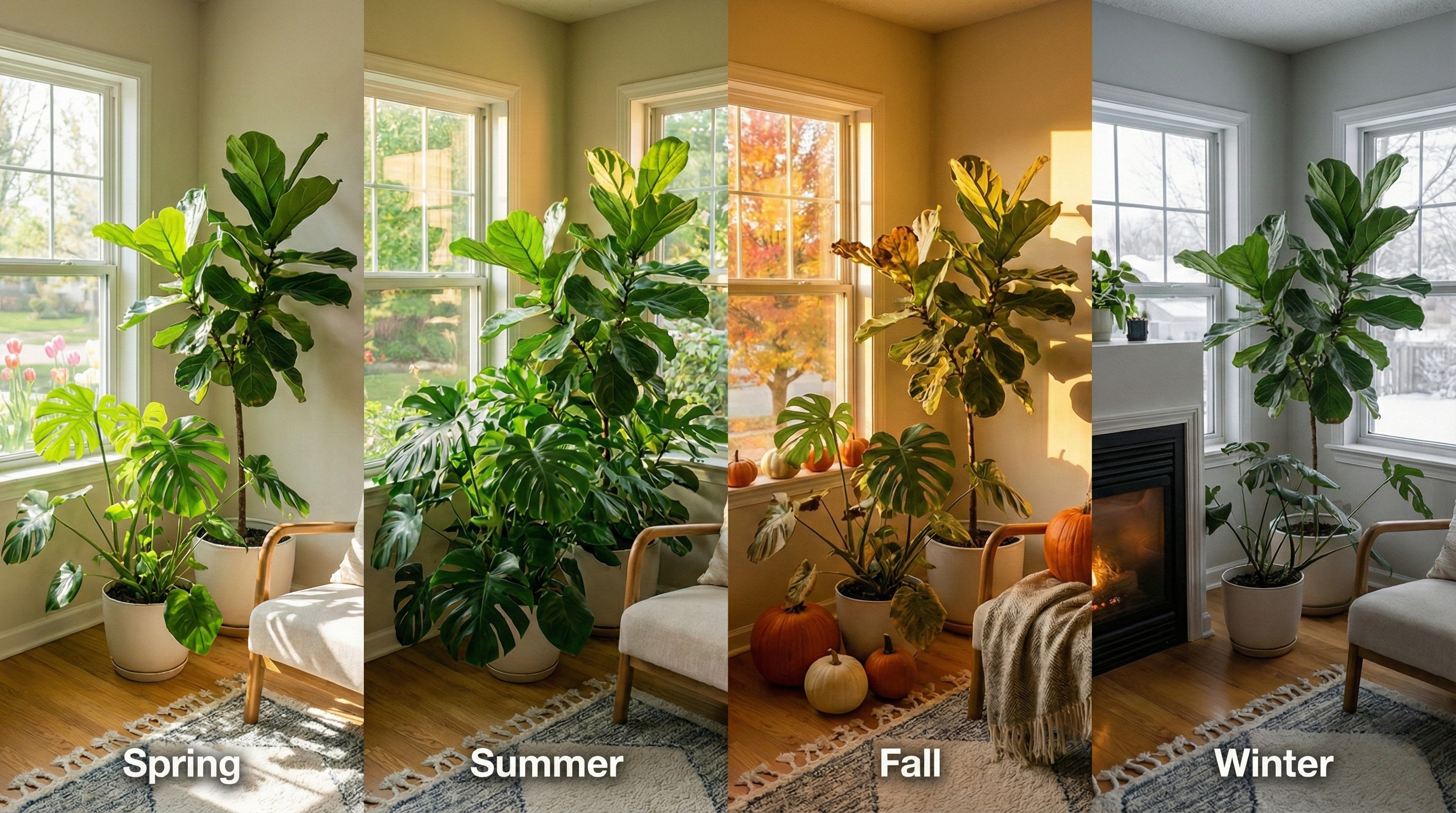
Seasonal Care Calendar
Because what your plants need in January is very different from July.
Disclosure: Some links on this page are affiliate links. As an Amazon Associate, we earn from qualifying purchases.
The secret: Most houseplant care is seasonal. Match your routine to what your plants are actually doing, and everything gets easier.
Understanding the Seasons
Growing season: Spring through early fall
- Plants are actively growing
- They need more water, fertilizer, and light
- This is when you repot, propagate, and fertilize
Dormant season: Late fall through winter
- Growth slows or stops
- Plants need less water, no fertilizer
- This is when you prune, plan, and resist the urge to buy more plants
Spring (March-May)
What Plants Need
- Water: Increase frequency as growth resumes
- Fertilizer: Start feeding again every 2-4 weeks
- Light: Move plants closer to windows as days lengthen
- Humidity: Still okay, but start monitoring as temps rise
Tasks to Do
- [ ] Repot — if roots are circling or growing slowly
- [ ] Propagate — take cuttings now for best success
- [ ] Fertilize — start at half-strength, build up to full
- [ ] Clean leaves — wipe dust off for max light absorption
- [ ] Check for pests — spring wakes bugs up too
- [ ] Move plants — gradually acclimate to brighter spots
- [ ] Calculate feed amounts — use our Fertilizer Calculator for precise dilution
Plants That Love Spring
- Monsteras, pothos, philodendrons (tropicals waking up)
- Any plant that produced no new growth in winter
- Plants you plan to propagate
Summer (June-August)
What Plants Need
- Water: Most plants need more frequent watering now
- Fertilizer: Full feeding schedule (every 2-4 weeks)
- Light: Protect from scorching midday sun
- Humidity: Monitor — AC can dry air out fast
Tasks to Do
- [ ] Water regularly — check pots weekly, not just on schedule
- [ ] Fertilize — peak feeding season
- [ ] Rotate pots — even quarter-turns prevent leaning
- [ ] Prune — shape leggy growth, propagate cuttings
- [ ] Increase humidity — pebble trays, humidifier, or grouping
- [ ] Monitor for pests — summer is bug season
Plants That Thrive in Summer
- Succulents and cacti (peak growing season)
- Tropical foliage (monstera, pothos, philodendron)
- Any plant you moved outside (acclimated first!)
Warning: Heat Stress
If temps regularly hit 85°F+:
- Move plants away from hot windows
- Water more frequently (containers heat up)
- Skip fertilizing (stressed plants can't use it)
- Expect some leaf drop — it's temporary
Fall (September-November)
What Plants Need
- Water: Begin reducing frequency
- Fertilizer: Stop by late October (or earlier in cold climates)
- Light: Days shorten — move plants closer to windows if needed
- Humidity: Heaters come on — monitor for crispy tips
Tasks to Do
- [ ] Reduce watering — let soil dry more between waterings
- [ ] Stop fertilizing — let plants rest
- [ ] Prepare for heaters — increase humidity
- [ ] Bring plants inside — if you moved any outside
- [ ] Quarantine new plants — check for pests before introducing
- [ ] Clean up — remove dead leaves, tidy up
Plants That Need Fall Prep
- Any plant that was outside
- New purchases going into the collection
- Plants that dropped leaves during transition
The Quarantine Rule
Always quarantine new plants for 2-3 weeks before adding to your collection.
Check under leaves, in leaf joints, and in soil. Most pests hide there.
Winter (December-February)
What Plants Need
- Water: Significantly less — most only need water every 2-4 weeks
- Fertilizer: Not needed (plants aren't growing)
- Light: Low light season — accept slower growth
- Humidity: Heaters are running — increase humidity
Tasks to Do
- [ ] Water sparingly — check soil before watering
- [ ] No fertilizer — until spring growth resumes
- [ ] Increase humidity — pebble trays, humidifier, or grouping
🌫️ Give Your Calathea the Humidity It Craves
Want to give your calathea the humidity it craves? Here are our tested humidifiers that keep tropical plants happy:
LEVOIT 6L Ultrasonic
Top Pick • Cool & Warm Mist • 60hr Runtime
View on Amazon →
MIRO NR08M Modular
Premium • Easiest to Clean • Code: OHIOTROPICS (15% off)
View on Amazon →
TaoTronics 4L Cool Mist
Budget Pick • LED Display • Great for Beginners
View on Amazon →
*As an Amazon Associate, we earn from qualifying purchases.
- [ ] Keep away from drafts — cold windows, heater vents
- [ ] Clean leaves — dust reduces light capture in low-light months
- [ ] Rotate occasionally — prevent uneven growth toward light
Plants That Handle Winter Best
- Snake plants (basically unkillable)
- ZZ plants (dormant and fine with neglect)
- Succulents (need almost no water)
Winter Warning Signs
- Yellow leaves — usually overwatering (most common winter mistake)
- Leggy growth — not enough light, normal in winter
- Brown tips — low humidity from heaters
- Drooping — check soil — could be underwatered OR overwatered
The golden winter rule: When in doubt, don't water.
Quick Reference: Monthly Checklist
| Month | Water | Fertilize | Special Tasks |
|---|---|---|---|
| January | Minimal | No | Monitor humidity, keep away from drafts |
| February | Minimal | No | Plan spring projects, order supplies |
| March | Increase | Start (half) | Repot if needed, start propagating |
| April | Regular | Yes | Full care routine begins |
| May | Regular | Yes | Last chance for major repotting |
| June | Frequent | Yes | Watch for pests, increase humidity |
| July | Frequent | Yes | Protect from heat, prune if needed |
| August | Regular | Yes | Continue feeding, plan fall transition |
| September | Reduce | Reduce | Bring plants inside if outside |
| October | Less | Stop | Quarantine new plants |
| November | Minimal | No | Increase humidity for heaters |
| December | Minimal | No | Avoid drafts, don't water out of habit |
Signs You're On Track
| Season | Healthy Signs | Warning Signs |
|---|---|---|
| Spring | New growth emerging | No new growth (needs light or repotting) |
| Summer | Active growth, vibrant color | Leggy stretching, pale color |
| Fall | Slowing growth, stable | Sudden leaf drop (transition stress) |
| Winter | No growth is normal | Yellow leaves (overwatering), crispy tips (low humidity) |
The Most Common Mistakes by Season
Spring
- Mistake: Fertilizing too early
- Fix: Wait until you see active new growth
Summer
- Mistake: Ignoring heat stress
- Fix: Move plants from hot windows, water more
Fall
- Mistake: Keeping summer watering schedule
- Fix: Reduce water as temperatures drop
Winter
- Mistake: Overwatering because "it feels like time"
- Fix: Check soil first — most plants are fine waiting
The Bottom Line
Match your care to the season, and you'll avoid 80% of houseplant problems.
Key takeaways:
- Spring: Resume feeding, repot, propagate
- Summer: Water more, fertilize regularly, watch for pests
- Fall: Reduce water, stop feeding, bring plants inside
- Winter: Water minimally, no fertilizer, increase humidity
Need help with specific problems year-round? Check our Plant ER for troubleshooting.