Rubber Plant Care: Ficus Elastica Varieties & Growing Guide
Your Ficus elastica questions, answered: varieties, care, troubleshooting, and how to make it actually bushy.
Introduction: Why the Rubber Plant Deserves a Second Look
The rubber plant — Ficus elastica — keeps getting overshadowed by its flashier cousins. Monstera stole the spotlight. Fiddleaf fig got the Instagram treatment. But Ficus elastica just sits there looking unreasonably chic, growing a couple feet a year, and asking for surprisingly little in return.
Here's the thing: the rubber plant is the easiest Ficus you're likely to encounter. It forgives inconsistent watering better than the fiddleaf. It tolerates lower light better than the fiddleaf. And unlike Monstera, it doesn't send you emergency texts via collapsed leaves every time you walk past it wrong.
This guide covers everything: the varieties worth knowing (there are more than you think), exactly how to care for them, the common problems and how to fix them, and — because we know you want a bushy plant, not a single sad stick — how to prune and propagate for maximum fullness.
If you're coming from our watering guide, a lot of this will feel familiar. The rubber plant's needs are pretty standard for a tropical houseplant. Let's get into it.
Meet the Family: Ficus Elastica Varieties
Ficus elastica has been a houseplant staple for decades, which means plant breeders have had plenty of time to tinker. The result: a surprisingly wide range of leaf colors, patterns, and growth habits — all from the same species.
Most people know the basic green rubber plant. Fewer know that "rubber plant" is actually a whole family with significant differences in care, difficulty, and light requirements.
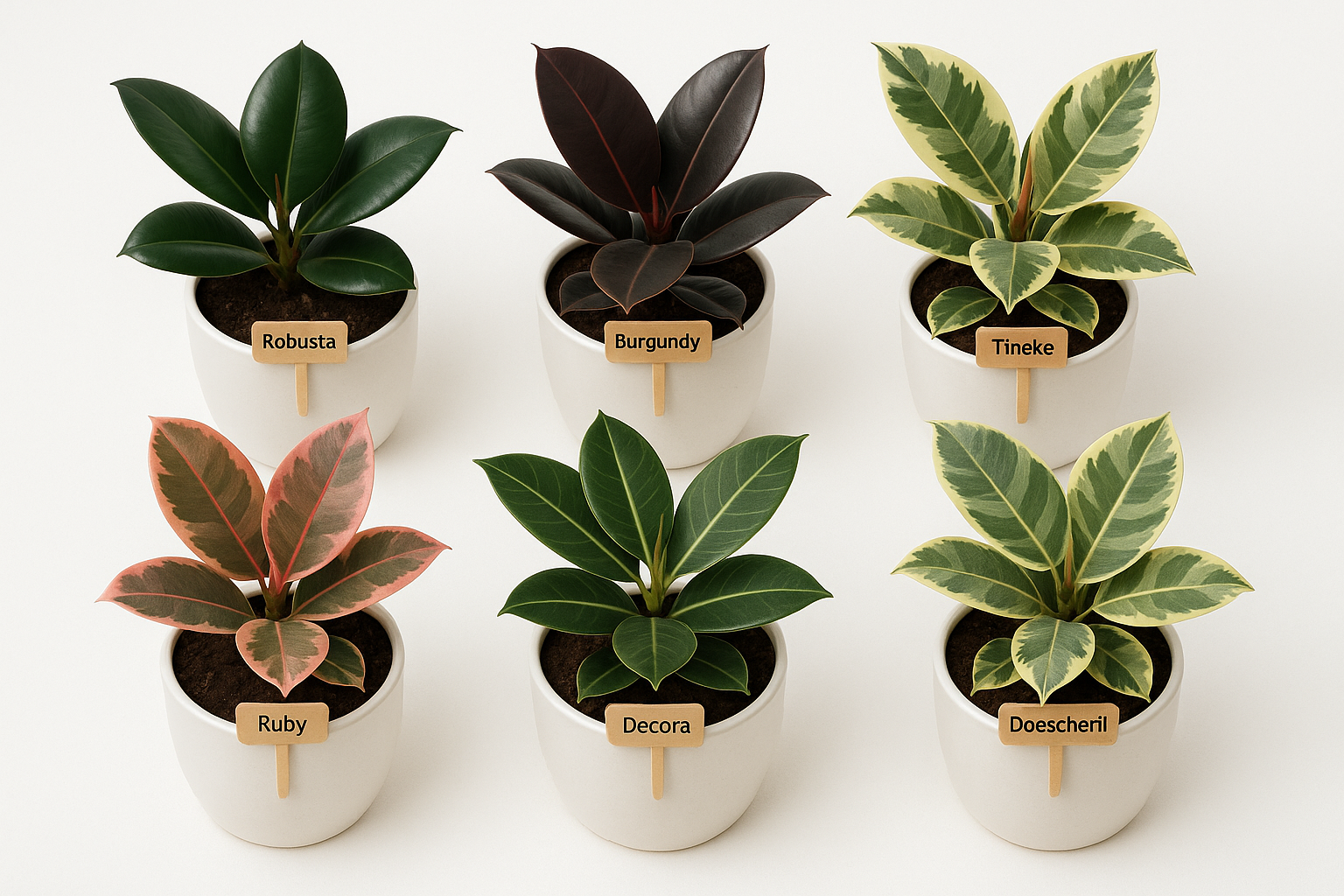
Green Varieties: Robusta, Decora, Burgundy, Melany
Robusta is the one you'll find at every garden center. Big, wide, paddle-shaped leaves, deep glossy green. It's the closest to the wild species and the easiest to keep happy. If you're new to Ficus elastica, start here.
Decora has narrower, more pointed leaves with distinctive white veining. Slightly more refined look than Robusta, similar care difficulty.
Burgundy (sometimes sold as Ficus elastica 'Burgundy' or 'Black Prince') is the dramatic one — leaves so dark they're nearly black, with red undersides. The dark pigment actually makes it slightly more tolerant of lower light than the green varieties (more leaf surface area to catch what little's there). It needs more light to maintain that deep color, though.
Melany is a compact, bushier variety with smaller leaves than Robusta. Good if you want something that stays more manageable in size.
Variegated Varieties: Tineke, Ruby, Doescherii, Belize
Here's where Ficus elastica gets genuinely interesting — and genuinely more demanding.
Tineke has green and cream variegation, usually in broad patches along the leaf edges. It's the most common variegated rubber plant and the easiest of the variegated bunch. That said, "easiest variegated" is still a higher bar than the green varieties. The variegated patches have less chlorophyll, which means less energy production. Tineke needs more light to maintain its variegation — put it in a dim corner and it'll revert to mostly green.
Ruby is the showboat: pink, cream, and green variegation that can be genuinely striking on a healthy plant. It's also the most finicky. Less light and it fades. More light and the pink burns. It's the diva of the rubber plant family and honestly, that's part of the appeal.
Doescherii (sometimes called 'Belize' or confused with it) has gray-green leaves with yellow-pink variegation. Less common in nurseries but worth seeking out if you want something different.
Belize — sometimes used interchangeably with Doescherii, sometimes a distinct cultivar — has similar pink and cream variegation on green leaves. The naming in the trade is genuinely messy here. If you find one you like, buy it and figure out exactly what you have later.
Shop live rubber plant varieties (Tineke, Ruby, Burgundy) online →
Variety Comparison Table
| Variety | Leaf Color | Light Needs | Difficulty | Growth Rate | Price Tier |
|---|---|---|---|---|---|
| Robusta | Deep green, glossy | Low–bright indirect | Easy | Fast | Budget |
| Decora | Green, white veins | Bright indirect | Easy | Moderate | Budget |
| Burgundy | Near-black green, red undersides | Bright indirect | Moderate | Moderate | Mid |
| Melany | Deep green, compact | Bright indirect | Moderate | Slow | Mid |
| Tineke | Green + cream variegation | Bright indirect, some direct | Moderate | Moderate | Mid–High |
| Ruby | Green + pink + cream | Bright indirect, no direct | High | Slow | High |
| Doescherii | Gray-green + yellow/pink | Bright indirect | Moderate–High | Moderate | High |
Light Requirements for Rubber Plants
The short version: bright indirect light is the sweet spot for most Ficus elastica varieties. Not direct sun, not a dark corner.
Direct sun — especially hot afternoon sun through glass — will scorch those big glossy leaves. You'll see brown crispy patches appear fast. Move it back from that south-facing window.
Low light is survivable for green varieties (especially Burgundy) but the plant will grow slowly, drop lower leaves to conserve energy, and generally look stringy and sad.
Variegated varieties are the exception. Tineke and Ruby need more light to maintain their variegation. If you want those pink patches on your Ruby to stay pink (not fade to cream), give it the brightest spot you have. Some direct morning sun is fine; watch for afternoon scorch.
The rule of thumb: if you're reading a book comfortably in that spot, your rubber plant can probably survive there. If you need a lamp, it's too dark for healthy growth.
Seasonal adjustment: Light levels change. A spot that's perfect in March may become too dark by November. Move your plant closer to the window as days shorten, or accept that winter growth will be slower.
Watering: The Most Important Thing to Get Right
Here's the uncomfortable truth about rubber plant care: overwatering is the #1 killer. Not underwatering, not pests — overwatering. Ficus elastica has thick, waxy leaves that retain moisture. It stores water in those leaves. It does not need to be kept consistently moist.
Let the top 2–3 inches of soil dry out completely between waterings. In summer, that's roughly every 7–10 days. In winter, cut that back to every 2–3 weeks.
How do you know when it's time? The finger test: stick your finger in the soil up to the second knuckle. If it comes out dry and clean, water. If it comes out with soil stuck to it, wait.
How to Check Soil Moisture the Right Way
The finger test works fine once you get used to it. But Ficus elastica roots go deep, and the top layer dries out faster than the root zone. A moisture meter gives you the full picture — especially useful for larger pots where the finger test only tells you about the top few inches.
Water thoroughly when you do water: pour until it flows freely out of the drainage hole, then stop. Don't let the plant sit in a saucer of standing water — that's an express lane to root rot.
Bottom watering is an option if your plant has been inconsistent. Set the pot in a tray of water for 20–30 minutes and let the soil absorb from below. It encourages deeper root growth. Just don't leave it sitting in water long-term.
Soil, Potting & Drainage
Rubber plants need fast-draining soil. This is not optional. A moisture-retaining potting mix that stays wet for days is the single fastest way to kill a Ficus elastica.
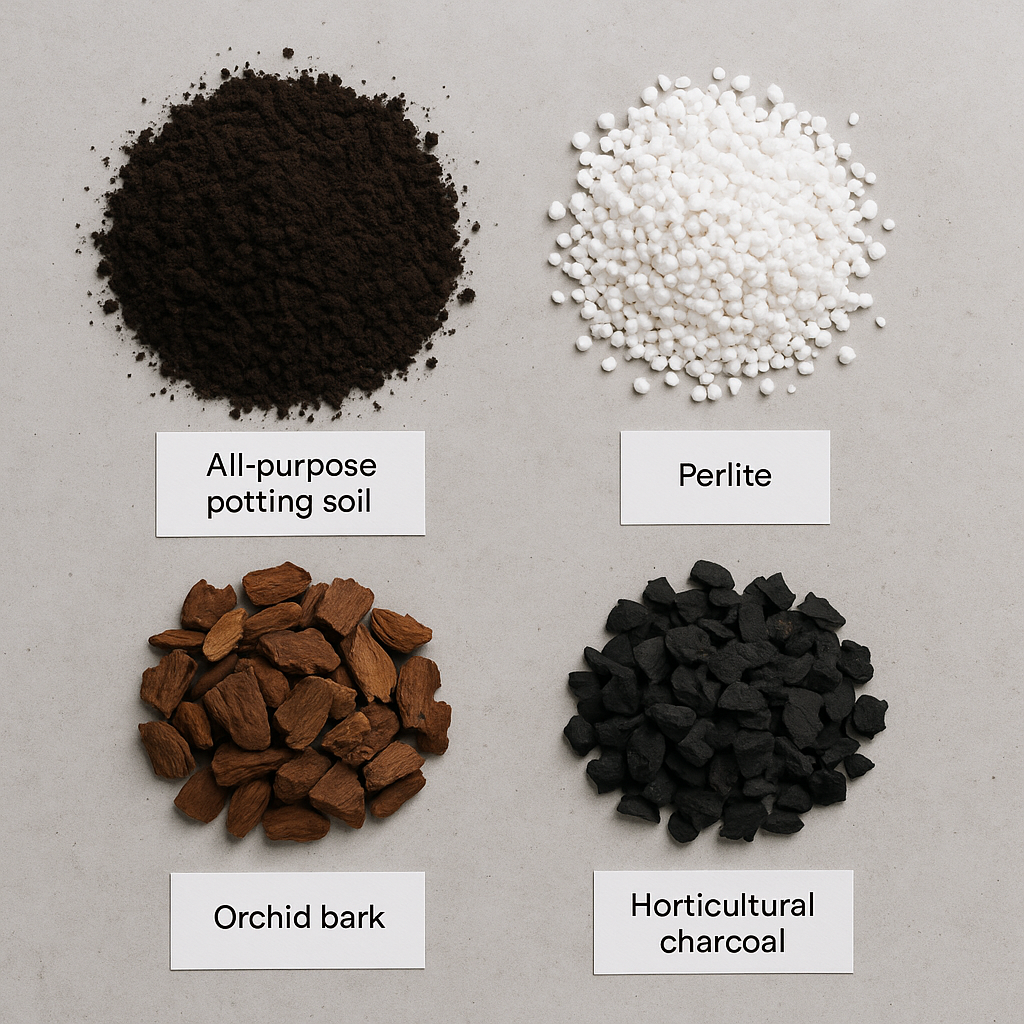
The ideal mix: an all-purpose potting soil as your base, amended with roughly 25% perlite for drainage and 15% orchid bark for aeration and structure. A handful of horticultural charcoal keeps things fresh and helps with drainage.
Pot size guidance: Rubber plants like to be somewhat root-bound. Go up only 1–2 inches in pot diameter when repotting. A pot that's too large holds too much moisture relative to the root mass, and you'll be dealing with wet soil for weeks.
Drainage is non-negotiable. Whatever pot you use — ceramic, terracotta, plastic — it needs at least one drainage hole. No exceptions. If the pot looks cute but has no hole, use it as a cache pot: keep the plant in a nursery pot with drainage holes, and set that inside the decorative pot. Remove the inner pot to water, then return it after drainage is complete.
Temperature, Humidity & the Environment
Temperature: Ficus elastica is comfortable in the same range you are: 65–85°F (18–29°C). It does not tolerate frost. If you have it on a patio in summer, bring it in when nighttime temps drop below 60°F. Cold drafts cause leaf drop fast.
Keep it away from cold drafts in winter: not near exterior doors that open frequently, not next to single-pane windows, not near air conditioning vents that blow cold air directly on the leaves.
Humidity: Rubber plants tolerate average household humidity just fine. They don't need a humidifier to survive. That said, they appreciate higher humidity — especially the variegated varieties — and you'll get bigger, more frequent new growth if you boost humidity to 50–60%.
If you're in a dry climate or running heat in winter, occasional misting or a humidity tray helps. Just don't mist and then put it in direct sun, because you'll get leaf burn from the water droplet magnifying effect.
Toxicity: Important — Ficus elastica is toxic to cats and dogs if ingested. The milky white sap that bleeds from cuts or damaged leaves contains compounds that cause oral irritation, drooling, vomiting, and skin irritation. If you have pets who chew on plants, keep the rubber plant on a high shelf or choose a pet-safe alternative. This is not a plant you want to leave within chewing range.
Fertilizer Schedule
Feed your rubber plant monthly during the growing season — March through September. Use a balanced liquid houseplant fertilizer diluted to half strength. "Balanced" means roughly equal nitrogen, phosphorus, and potassium (look for 10-10-10 or similar).
Stop fertilizing entirely in fall and winter. The plant's growth slows significantly and it won't use the extra nutrients — they'll just build up in the soil and can cause fertilizer burn.
Signs you're over-fertilizing: White crust on the soil surface, browning leaf tips, wilting despite moist soil. If this happens, flush the soil thoroughly with plain water to leach out the excess salts, and hold off on fertilizer for a few months.
Signs of under-fertilizing: slow growth, smaller new leaves than old, pale or yellowing leaves. If it's been more than a year since you repotted and you haven't been fertilizing, your plant may just be hungry.
Pruning & Shaping: How to Make Your Rubber Plant Bushy
This is the section you're here for. Nobody wants a single sad stick with three leaves at the top. You want a full, multi-branched plant that actually fills the corner it lives in.
Here's the uncomfortable part: Ficus elastica does not naturally branch much on its own. Left to its own devices, it'll grow upward as a single stem indefinitely, dropping lower leaves as it goes until you're left with a bare trunk and a pom-pom of leaves at the top. It's the plant equivalent of male pattern baldness, except it happens to trees.
The solution: you have to make it branch. And the way you do that is through pruning.
When to prune: Spring and early summer, when the plant is actively growing. This matters. Pruning in fall or winter when the plant is dormant means it won't produce new growth from the cut site — you'll just have a wounded stick that sits there.
How much to cut: Never remove more than 20–30% of the plant's foliage at once. Any more than that and the plant goes into shock, may drop leaves aggressively, and struggles to recover.
The Notch Method: Encouraging Branches
The classic Ficus trick. Instead of cutting straight across a stem, you make a small notch — about one-third through the stem — just above a node (the point where a leaf attaches).
Here's how:
- Identify a node on the main stem, roughly where you want branching to occur.
- With a clean, sharp blade, make a diagonal cut about 1/3 into the stem, just above the node. The notch should face toward the node.
- A milky sap will bleed out — wipe it away with a damp cloth.
- The plant responds by producing new growth hormones that concentrate below the notch, triggering branching from that node.
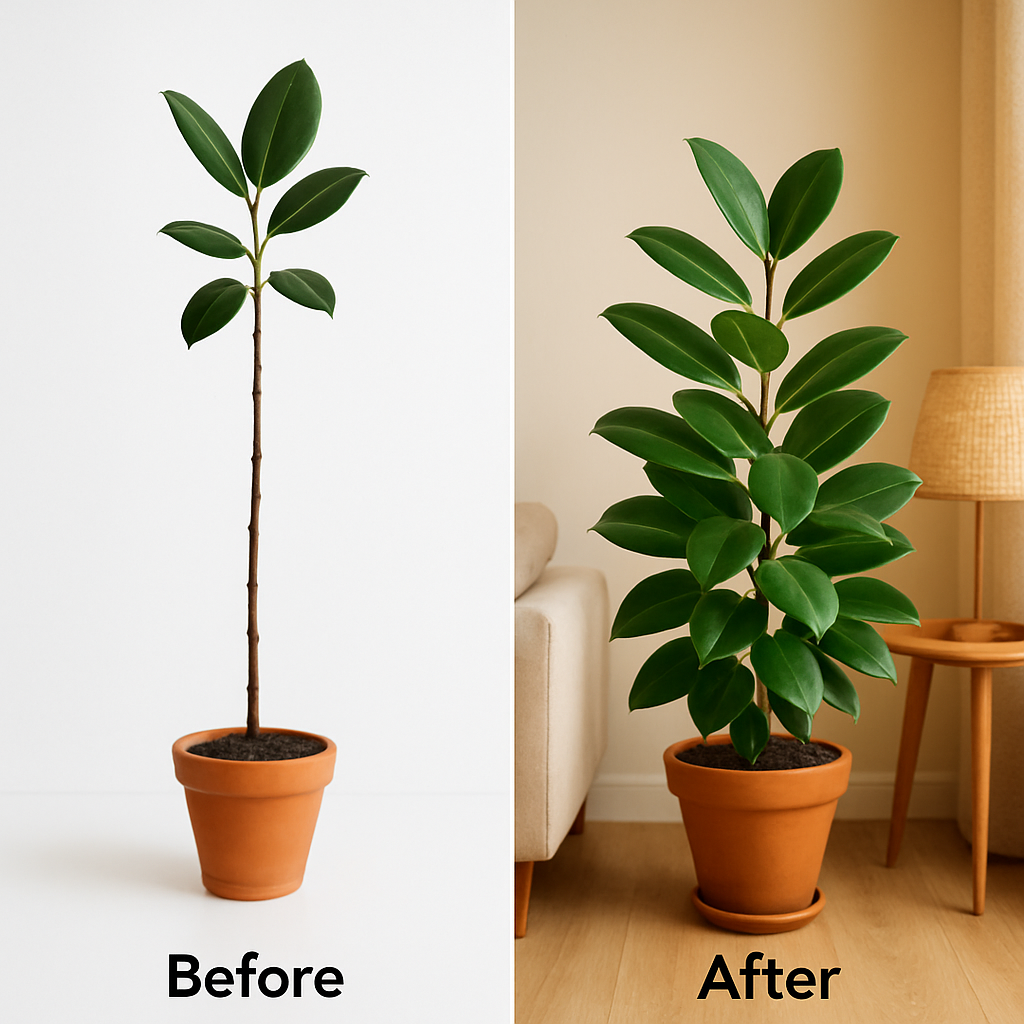
Topping is an alternative for very tall plants: cutting the main growing tip entirely off to force multiple branches below. It's more aggressive than notching and works best on plants that are already reasonably tall. Cut just above a node, same as above.
What to do with the cuttings: Don't throw them away. Rubber plant cuttings root easily (see Propagation section) and you'll have baby plants to keep, give away, or sell.
For more on general pruning technique, see our guide to pruning houseplants.
Propagation: Growing Your Collection for Free
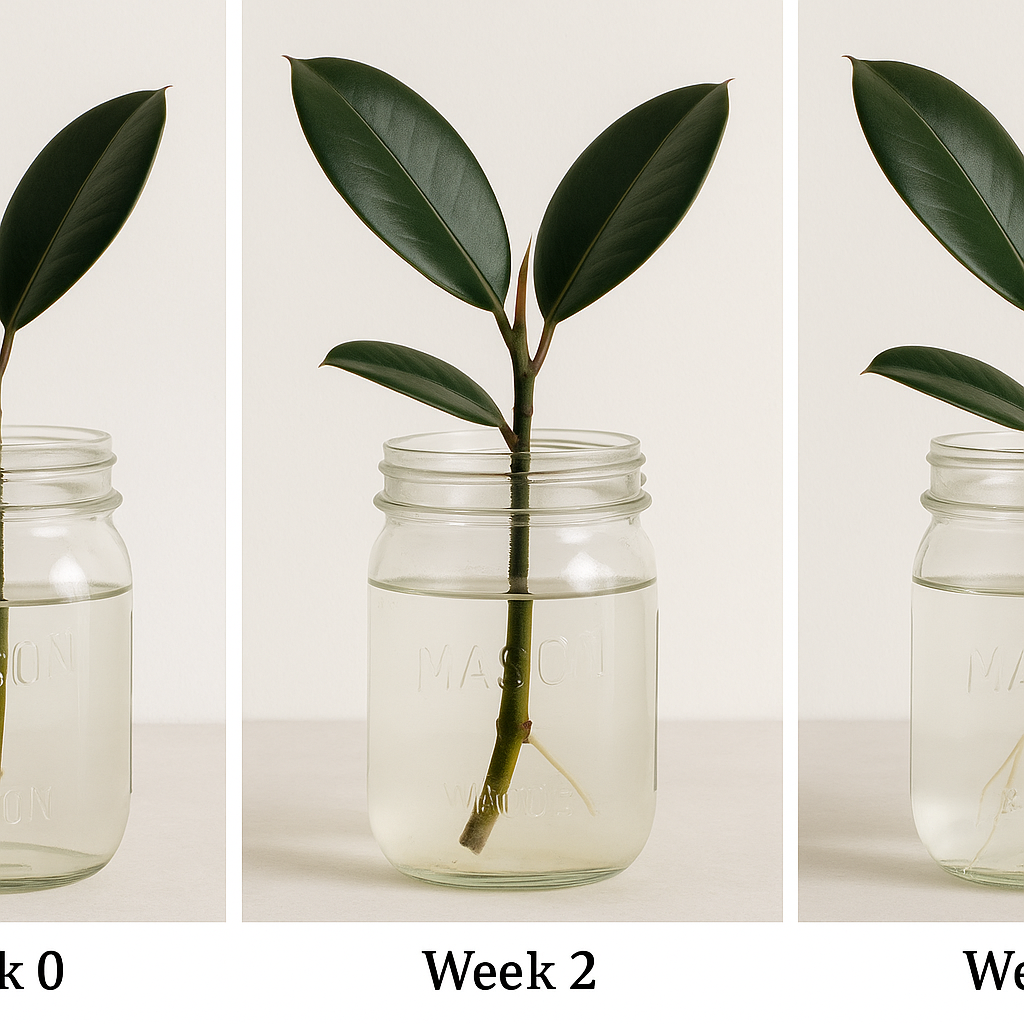
Rubber plant propagation is straightforward if you remember one critical rule: you need a stem cutting with nodes. A single leaf stuck in water will root — but it will never produce a new plant. It just sits there, looking alive but going nowhere, eventually dying. A stem cutting with 2–3 nodes will produce roots and, eventually, a new plant.
Method 1: Water propagation
- Take a stem cutting with 2–3 nodes using a clean, sharp blade. Cut just below a node.
- Remove the leaf or leaves from the bottom node(s) — those will be submerged. Leave the top 1–2 leaves.
- Place in a clear glass container with fresh water. The node(s) should be submerged; leaves should not.
- Change the water every 3–5 days to keep it clear and oxygenated.
- Roots appear in 2–4 weeks. Once roots are 2–3 inches long, pot in well-draining soil.
- Keep the new plant in bright indirect light and maintain slightly more consistent moisture than the parent plant while it establishes.
Method 2: Soil propagation
Some growers prefer to skip the water stage entirely and stick the cutting directly into moist soil. Use the same cutting, dip the cut end in rooting hormone powder (optional but improves success rate), and plant in a small pot of well-draining mix. Keep the soil moist (not wet) and the cutting in bright indirect light. The plant will establish roots in soil rather than water.
Air layering is an advanced technique for large, established rubber plants. It involves wounding a node on the main plant, wrapping it in moist sphagnum moss to encourage root growth before cutting — so the new plant is already rooted when you separate it from the parent. Useful if you don't want to risk losing a large, beautiful specimen.
For more on general propagation technique, see our propagation guide.
Repotting: When & How
Rubber plants don't need to be repotted frequently — every 2–3 years is typical for most specimens. They're actually happier slightly root-bound.
Signs it's time to repot:
- Roots growing out of the drainage hole
- The plant is growing significantly but you haven't repotted in 2+ years
- Water runs straight through the pot (soil is exhausted)
- The plant is top-heavy and tipping over
When to repot: Spring or early summer, when the plant is entering active growth. Never repot a stressed plant (just moved, dropping leaves, etc.) — wait until it's settled.
How to repot:
- Water the plant a day or two before to moisten the root ball — it makes everything easier.
- Gently remove the plant from its current pot. If it's stuck, run a knife around the edge.
- Inspect the roots. Healthy roots are white or tan and firm. Brown, mushy, smelly roots indicate root rot — trim those away with clean scissors before repotting.
- Place the root ball in the new pot (only 1–2 inches larger in diameter) with a layer of fresh, fast-draining soil mix beneath.
- Backfill around the edges, firming gently. Don't bury the plant deeper than it was originally.
- Water thoroughly and return to its spot.
After repotting: The plant may look stressed for a week or two — some leaf drop is normal. Keep it in bright indirect light and don't fertilize for at least a month, as the roots need time to settle into the new soil.
Rubber Plant Troubleshooting: What's Wrong With My Plant?
Rubber plants are dramatic. They will let you know when something is wrong. The trick is reading the signals correctly.
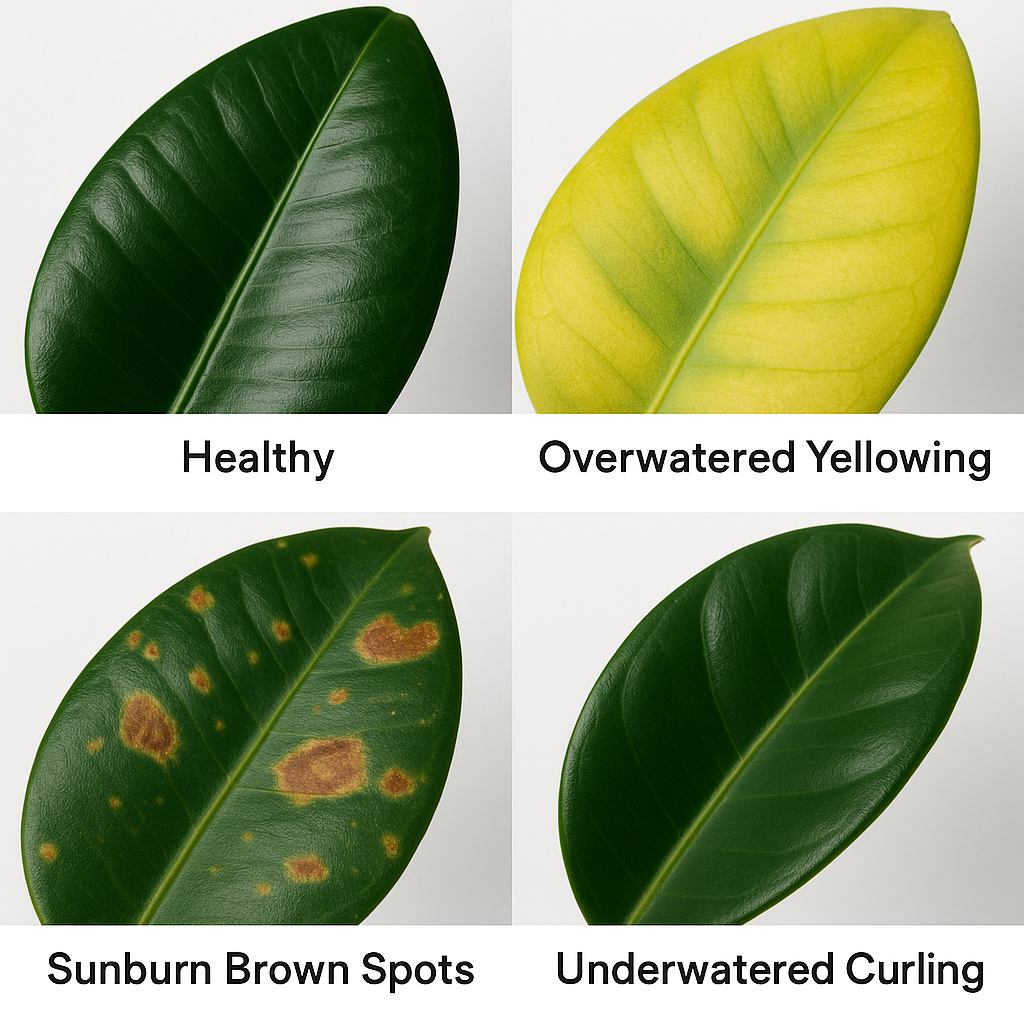
Yellow Leaves
Cause: Usually overwatering. The plant is sitting in soil that's too wet for too long, and the roots are struggling.
Fix: Check soil moisture immediately — if it's wet and it's been less than a week since you watered, you've found your culprit. Let it dry out completely. If the soil stays wet for more than 10 days after watering, you have a drainage problem: repot into faster-draining mix, check that the pot has drainage holes, or move to a smaller pot.
Occasional yellow lower leaves are normal (the plant shedding older growth). Widespread or rapid yellowing across the whole plant is a problem.
Dropping Leaves
Cause: Usually a sudden change in environment — cold draft, move to a new location, dry air from heating/cooling. Rubber plants hate change. They also drop leaves from overwatering or underwatering.
Fix: Work through the list: Is the soil soggy? Let it dry. Is the soil bone dry? Water thoroughly. Is there a cold draft or air vent nearby? Move the plant. If you just moved it, give it a few weeks to settle — rubber plants don't love change but they do adapt.
Brown Spots & Black Spots
Brown spots that are crispy and appear on sun-facing leaves = sunburn. Move the plant back from direct light.
Brown or black soft spots that spread = usually overwatering or a fungal issue. Check the soil. If it's wet, let it dry. If the spots are spreading fast, you may need to repot with fresh soil and trim any rotted roots.
Small brown dots on leaf undersides — check carefully for pests (spider mites leave tiny brown dots; scale appears as brown discs). More on this in the Pest section below.
Curling Leaves
Cause: Almost always underwatering. The plant is pulling water from its leaves to survive, causing them to curl inward.
Fix: Water thoroughly. Check the soil: if it repels water (hydrophobic soil), you may need to bottom-water to rehydrate it properly. Put the pot in a tray of water for 30 minutes, then let it drain.
Leaves that curl inward and go limp can also indicate the plant is too cold. Check for drafts.
Leggy or Stretched Growth
Cause: Not enough light. The plant is reaching toward whatever light source it can find, stretching its stem in the process.
Fix: Move to a brighter location gradually. The existing leggy growth won't shrink back, but new growth will be compact and healthy if the light is better. Once you have better light, you can prune back the leggy sections and the plant will branch from the cut points.
If you're unsure what's wrong with your rubber plant, our Plant ER has guides on specific symptoms and treatments. For root rot specifically, see our guide on how to treat root rot.
Pest & Disease Guide
Rubber plants are relatively pest-resistant when healthy, but they're not immune. The usual houseplant suspects apply.
Spider mites are the most common. They thrive in dry conditions and appear as tiny moving dots on leaf undersides, often with fine webbing between leaves. You'll also see the damage first: stippled, faded patches on leaves.
Scale appears as brown or tan discs attached to stems and leaf surfaces — they look almost like part of the plant at first glance. Wipe them off with a cotton ball dipped in rubbing alcohol. Repeat weekly until gone.
Mealybugs are the white cottony ones. They cluster in leaf joints and on stems, leaving sticky residue (honeydew) that can lead to sooty mold.
Treatment for all three:
- Isolate the affected plant immediately.
- Wipe leaves and stems down with neem oil spray or insecticidal soap, getting into crevices.
- Repeat every 5–7 days for at least three weeks to catch hatching eggs.
Root rot is the main disease concern and it's always caused by overwatering or poor drainage. Prevention is the cure: fast-draining soil, drainage holes, and letting the soil dry between waterings. If you catch it early (roots are brown but not completely mushy), trim the rotted roots, repot in fresh dry mix, and hold off on watering for a week or two.
Rubber Plant Styling: Where to Put It & What to Pair It With
Here's the part other plant guides skip: making your rubber plant actually look good in your space.
Ficus elastica is, fundamentally, an architectural plant. Those big, bold, glossy leaves make a statement. Treat it that way.
Placement: The rubber plant is a statement floor plant. It wants floor level, in a prominent spot where it can grow tall. Corners that need filling, beside sofas, next to shelving where it can rise above everything else. It's not a tabletop plant — the big varieties can hit 6–8 feet indoors.
Pot selection: A matte black, dark gray, or terracotta pot works with almost every interior style. The key is proportion: the pot should be about 1/3 the height of the plant (including the pot). Too small and the plant looks top-heavy; too large and it looks lost.
Variety to style match:
- Robusta or Decora — clean modern spaces, minimalist, Scandinavian. The classic green works with almost anything.
- Burgundy — dramatic contrast. Pairs beautifully with light neutrals, blonde wood, white walls. The dark leaves read as near-black, making them excellent for moody, high-contrast interiors.
- Tineke — more eclectic or bohemian spaces. The cream variegation softens the formality.
- Ruby — collector's plant. Give it a prominent spot on its own, where the pink variegation can be appreciated up close.
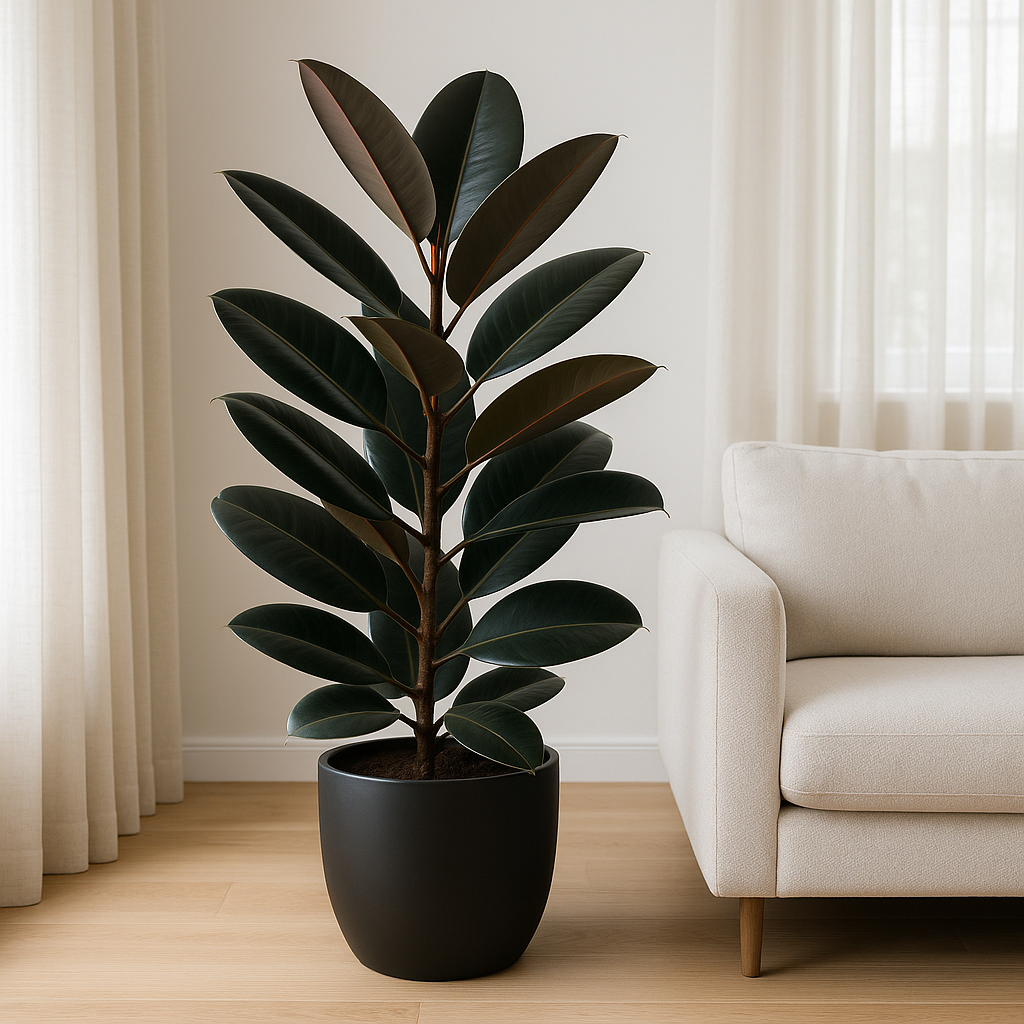
Grouping with other plants: The rubber plant works as a solo statement or grouped. If grouping, let it be the tallest element — it provides the visual anchor. Combine with trailing plants on a shelf beside it (pothos, trailing philodendron) for layered height.
For pot and planter recommendations that make good gifts, see our plant gift guide.
Frequently Asked Questions
Is rubber plant toxic to cats and dogs? Yes. Ficus elastica is toxic to cats and dogs if ingested. The plant's milky sap contains compounds that can cause oral irritation, drooling, vomiting, and skin irritation. Keep rubber plants out of reach of pets, or choose a pet-safe alternative like a spider plant or Boston fern.
How often should I water my rubber plant? Let the top 2–3 inches of soil dry completely between waterings. In summer, that's roughly every 7–10 days. In winter, reduce to every 2–3 weeks. Always check soil moisture before watering — overwatering is the most common rubber plant mistake.
Why is my rubber plant dropping leaves? Leaf drop is usually caused by overwatering, underwatering, or a sudden change in temperature or light. Check soil moisture first — if it's soggy, let it dry out. If it's bone dry, water thoroughly. Also check that the plant isn't near a cold draft, air vent, or heating source.
Why are the new leaves on my rubber plant turning red? Red or reddish-new leaves on a rubber plant are completely normal. New Ficus elastica leaves emerge wrapped in red or burgundy sheaths (called stipules) that gradually unfurl and turn green as they mature. This is a sign your plant is healthy and actively growing.
How fast does a rubber plant grow? Ficus elastica is a moderately fast grower under the right conditions — adding 1–2 feet of new growth per year indoors with bright indirect light, consistent watering, and monthly fertilizer during the growing season.
Can I grow a rubber plant from a single leaf? No. A single rubber plant leaf will root in water or soil but will not produce a new stem or plant — it will simply sustain itself indefinitely. To propagate a rubber plant, you need a stem cutting that includes at least 2–3 nodes.
Products We Love
We use and recommend these products for rubber plant care:
- Moisture meters on Amazon
- Perlite, orchid bark, and horticultural charcoal on Amazon
- Live Ficus elastica varieties (Tineke, Ruby, Burgundy) online
- Moss poles and plant stakes on Amazon
- Balanced liquid houseplant fertilizer on Amazon
- Neem oil and insecticidal soap on Amazon
For more on watering fundamentals, see our watering guide. For general pruning technique, see how to prune houseplants. For propagation basics, see our propagation guide.