Rubber Plant Care & Varieties: Burgundy, Tineke, Ruby and More
Ficus elastica is dramatic, gorgeous, and — unlike certain other figs — actually doable indoors. Here's how to keep yours alive and looking good.
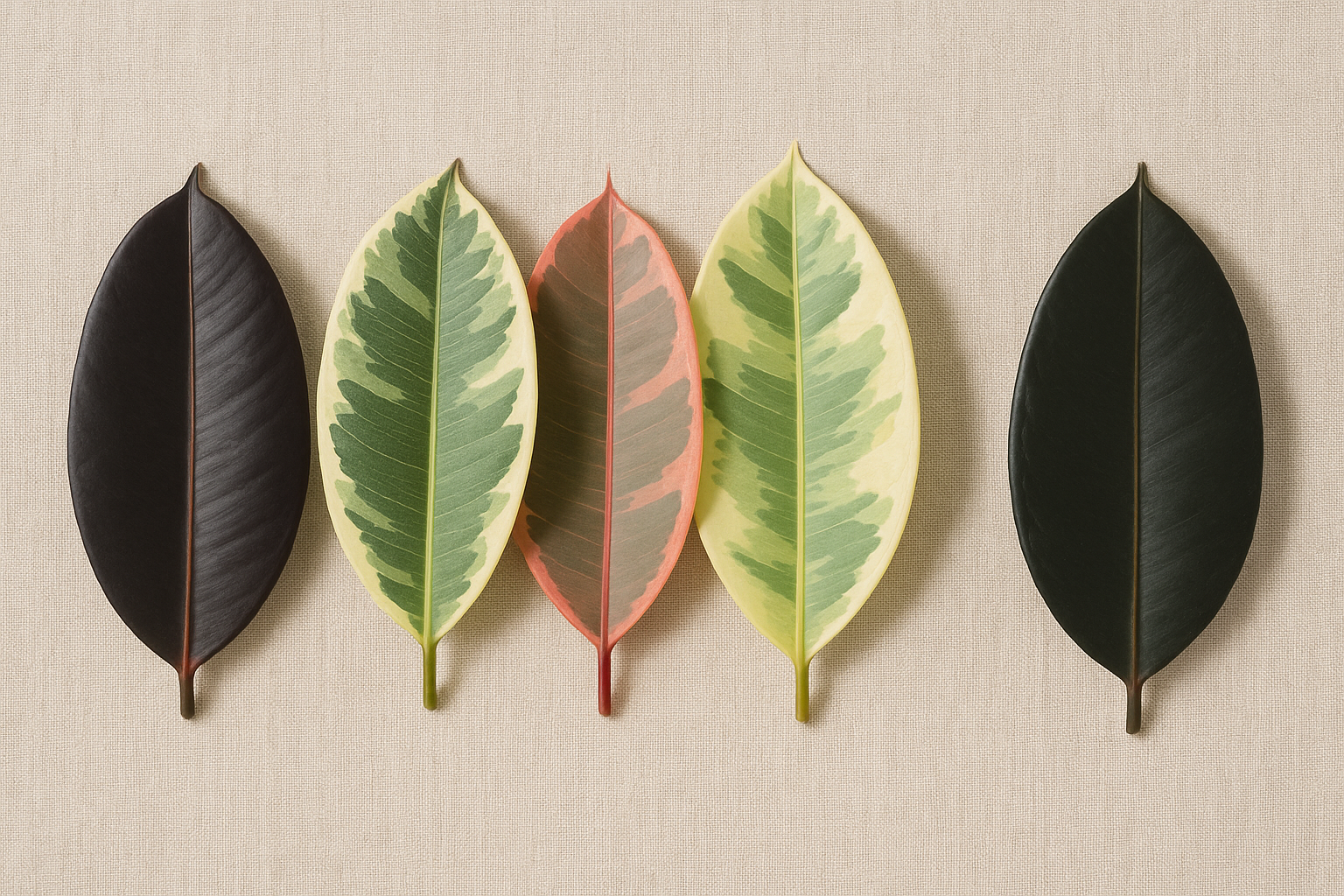
Meet the Rubber Plant Family
Ficus elastica — the rubber plant — is having a moment, and honestly, it's deserved. It's been a staple in lobbies and sunrooms since your grandmother's era, but somewhere along the way it got a reputation for being fussy. It isn't. It's just got opinions about drainage and air flow, which — surprise — most indoor plants also want.
Native to Southeast Asia and India, the rubber plant grows into a tree in the wild (30–50 feet), but indoors it tops out at a manageable 6–10 feet depending on the variety and your pot size. The thick, waxy leaves aren't just decorative — they're built to retain moisture, which makes this plant more forgiving of occasional neglect than, say, a calathea.
The main thing that trips people up: it's related to fiddle leaf fig. If you've killed a FLF, you might assume you're cursed from the rubber plant family. You're not — elastica is significantly tougher. But the two share similar sensitivities to overwatering and cold drafts, so the lessons from fiddle leaf care translate directly.
Variety Guide: Burgundy, Tineke, Ruby and More
The rubber plant family has some genuinely beautiful members, and they're not all the same plant with different labels. Here's how to tell them apart at a glance.
The Big Five
Burgundy (Ficus elastica 'Burgundy') The classic. Deep, almost black-green leaves with a central vein that can show a faint red. Solid color, no variegation. Burgundy is the most tolerant of lower light conditions — it's the workhorse of the rubber plant family. If you have decent indirect light from a north or east window, it'll be happy.
Tineke (Ficus elastica 'Tineke') Variegated green and cream, sometimes with a pink flush on the newer leaves. This is the variety most people are referring to when they say "variegated rubber plant." Tineke needs more light than Burgundy — the variegated patches have less chlorophyll, so the plant works harder to photosynthesize. Less light means the variegation will fade and the plant will get leggy reaching for sun.
Ruby (Ficus elastica 'Ruby') Pink-edged variegation on a green leaf — think of it as Tineke's more dramatic sister. Ruby has more pink than cream in its patterning, and the contrast is striking when the plant is healthy. Same light requirements as Tineke: bright, indirect, no direct sun on the leaves.
Doescherii (Ficus elastica 'Doescherii') The rarest of the common varieties. Pale green and yellow variegation rather than the cream of Tineke or the pink of Ruby. It's harder to find and a bit slower growing, but the coloring is worth tracking down if you're a collector. Light needs match Tineke and Ruby.
Black Prince (Ficus elastica 'Black Prince') Very dark, nearly black leaves with a subtle red midrib. Black Prince is the moodiest of the bunch — it's dramatic in bright rooms and almost gothic in lower light. Growth rate is slower than Burgundy. It tolerates slightly lower light better than the variegated varieties, but not as well as Burgundy itself.
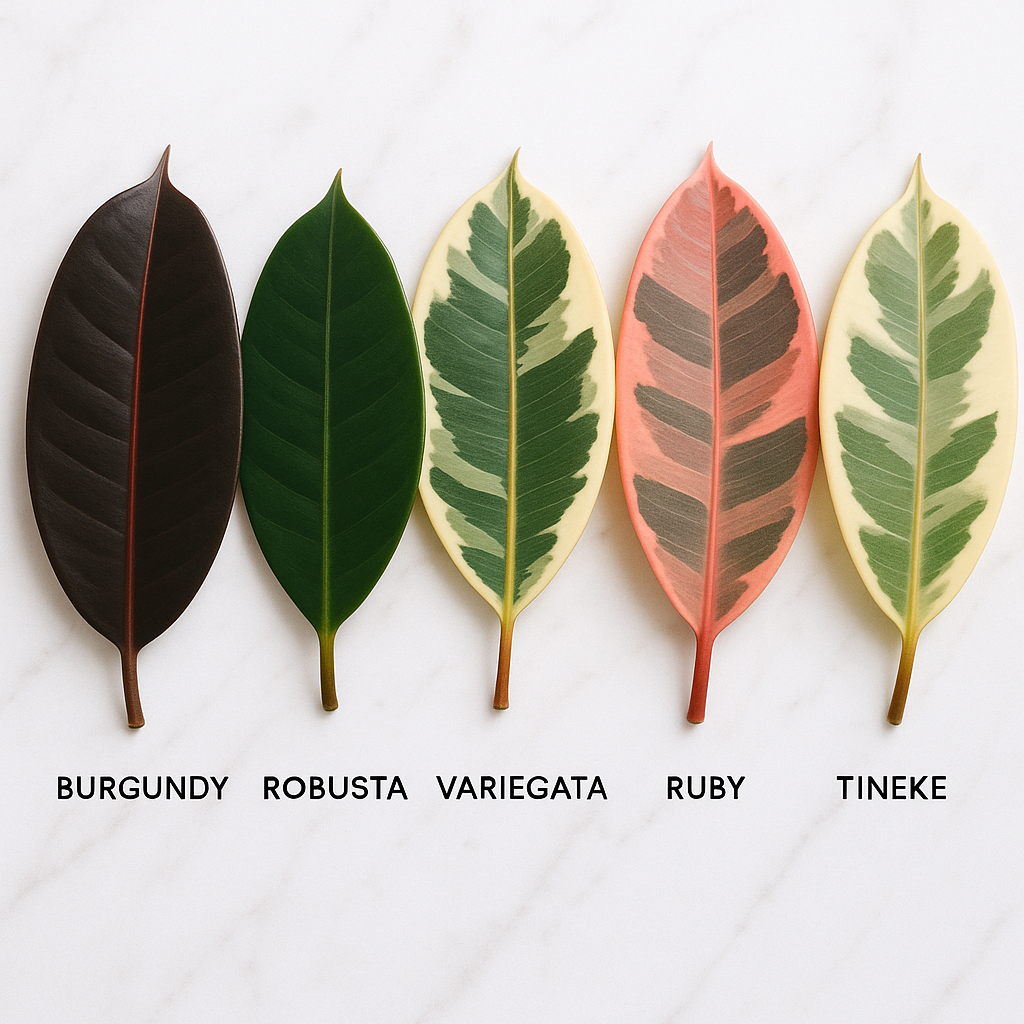
Quick Comparison
| Variety | Leaf Color | Variegation | Light Needs | Rarity |
|---|---|---|---|---|
| Burgundy | Deep green-black | None | Low-moderate | Common |
| Tineke | Green + cream | Moderate-heavy | Bright indirect | Common |
| Ruby | Green + pink | Moderate-heavy | Bright indirect | Moderately common |
| Doescherii | Green + yellow | Light | Bright indirect | Rare |
| Black Prince | Near-black | None | Low-moderate | Moderately common |
Light: The Single Most Important Factor
Light is where rubber plant care lives or dies. Everything else — watering, soil, fertilizer — is tuned around the light situation. Get this right and the rest is easy.
Bright indirect light is the sweet spot. This means a spot near a window where the sun's rays don't hit the leaves directly. South or west-facing windows usually need a few feet of distance or a sheer curtain. East-facing windows are often ideal — morning sun is gentler.
Direct sun is bad. The thick leaves will get scorched, showing up as brown, bleached patches. It's not pretty and the damage is permanent (you'll need to prune those leaves off).
Variegated varieties need more light. Tineke, Ruby, and Doescherii all have patches of leaf without chlorophyll. They need more total light to photosynthesize effectively. If your variegated rubber plant is losing its pattern — reverting to solid green — it needs more light. Move it closer to the window or consider a grow light.
Too little light shows up fast. The plant will lean toward the light source, grow leggy (long stems with widely spaced leaves), and stop producing new leaves from the top. If your rubber plant hasn't produced a new leaf in months, light is probably the culprit.
Seasonal adjustments: During winter in northern latitudes, a plant that was perfectly happy 3 feet from a south window in July might need to be right in front of it in January. Move with the season, or add a grow light for the dark months.
Watering: The Overwatering Trap
Rubber plants die from overwatering. Not underwatering — though that happens too — but overwatering is the actual killer in most rubber plant failures. Here's why:
The thick, waxy leaves are excellent at retaining moisture. The plant's root system evolved to handle intermittent rainfall that drains quickly. Sitting in wet soil — especially in a pot without drainage — means the roots can't breathe and root rot sets in quietly. By the time the plant looks bad, the roots are often already compromised.
The finger test is your best friend. Push your finger into the soil up to the first knuckle. If it feels dry, water. If it feels moist, wait. This simple check prevents most overwatering problems.
Water thoroughly when you do water. Bring the pot to a sink, water until it flows freely out the bottom drainage holes, let it drain completely, and return it to its spot. Don't leave it sitting in a saucer of water — that's a root rot invitation.
The yellow leaf signal: Lower leaves turning yellow first typically means the soil has been wet too long. This is the plant using its oldest leaves as a resource dump because the roots are stressed. Check the soil immediately. If it's soggy, you may need to how to save a rubber plant from root rot rather than just adjusting your watering schedule.
Drooping can mean thirsty. If the whole plant looks droopy and wilted, and the soil is dry, it probably needs water. Rubber plants are dramatic about drought — they'll perk back up within hours of a good watering.
Seasonal frequency: In summer (active growing season), every 7–10 days is typical. In winter, every 2–3 weeks. Let the plant's behavior guide you, not the calendar.
Check Soil Moisture Before You Water →
Soil and Potting
Rubber plants want a fast-draining, chunky mix. Standard potting soil from the garden center will stay too wet for too long — it's designed to retain moisture, which is the opposite of what you need.
The recipe: One part indoor potting mix, one part perlite, one half part coarse bark or orchid bark. This gives you something with structure and drainage rather than a dense, moisture-retentive mat.
Pot size matters more than you'd think. Rubber plants want to be slightly root-bound. A pot that's too large means more soil volume, which means more water retention, which means root stress. Go up only 1–2 inches in diameter from the current pot, and make sure there are actual drainage holes.
Repotting timing: Every 2–3 years in spring, or when you see roots coming out of the drainage holes. Don't repot in winter — the plant is semi-dormant and adjusting to a new pot is rougher in low-light, low-energy months.
For pot recommendations, see best pots for rubber plants.
Temperature and Humidity
Rubber plants want that 60–80°F range that most humans also want, which is convenient. Below 55°F and you'll start seeing problems — cold damage shows as dark, water-soaked spots on leaves or sudden leaf drop.
Cold drafts are the enemy. This is the most common cause of sudden, dramatic leaf drop in rubber plants. A vent blowing on the plant in winter, a frequently opened door, a window that leaks cold air at night — any of these will stress the plant. Watch for your plant dropping leaves after a cold snap or when you've moved it near an exterior door.
Humidity is not a big deal. Unlike tropicals like alocasia or ferns, rubber plants tolerate average household humidity just fine. They're not going to brown-tip their way into your prayers. If your home is very dry (below 30% relative humidity, which is rare), a pebble tray or occasional misting helps, but it's not essential.
Consistency matters more than hitting exact numbers. The plant can handle 62°F perfectly well if that temperature is steady. What it can't handle is swings — 72°F during the day and 50°F at night from a drafty window. Pick a spot and leave the plant there.
Feeding
Feed during the growing season only (spring and summer). Use a balanced liquid fertilizer diluted to half strength — the package directions usually say "for indoor plants" and that strength works fine at half.
Over-fertilizing shows up as salt buildup. You might see a white crust on the soil surface, or brown leaf tips that look crisp rather than soft. If this happens, flush the soil thoroughly with plain water — run water through the pot several times to leech out the salts.
Don't feed in fall and winter. The plant isn't actively growing and doesn't need the extra fuel. Feeding when the plant is dormant is one of the main ways people accidentally burn their plants.
Pruning and Shaping
Rubber plants grow from a single terminal bud — the top of the main stem produces growth hormones (auxin) that suppress the buds below. Cut that top off and the plant wakes up those dormant buds, producing multiple new branches. This is called apical dominance, and exploiting it is how you get a bushy rubber plant instead of a tall single pole.
When to prune: Late spring through summer is ideal. The plant is actively growing and can recover quickly. Avoid pruning in fall or winter when the plant's energy is low.
How to prune for branching: Cut just above a node (where a leaf meets the stem) on the main stem. Make the cut clean — use sharp, clean pruning shears. Dull cuts crush the vascular tissue and can cause excess sap bleed.
The sap situation: Rubber plant sap is milky white, irritating to skin, and will stain fabric. Wear gloves. Have paper towels ready. Don't do this over your good rug.
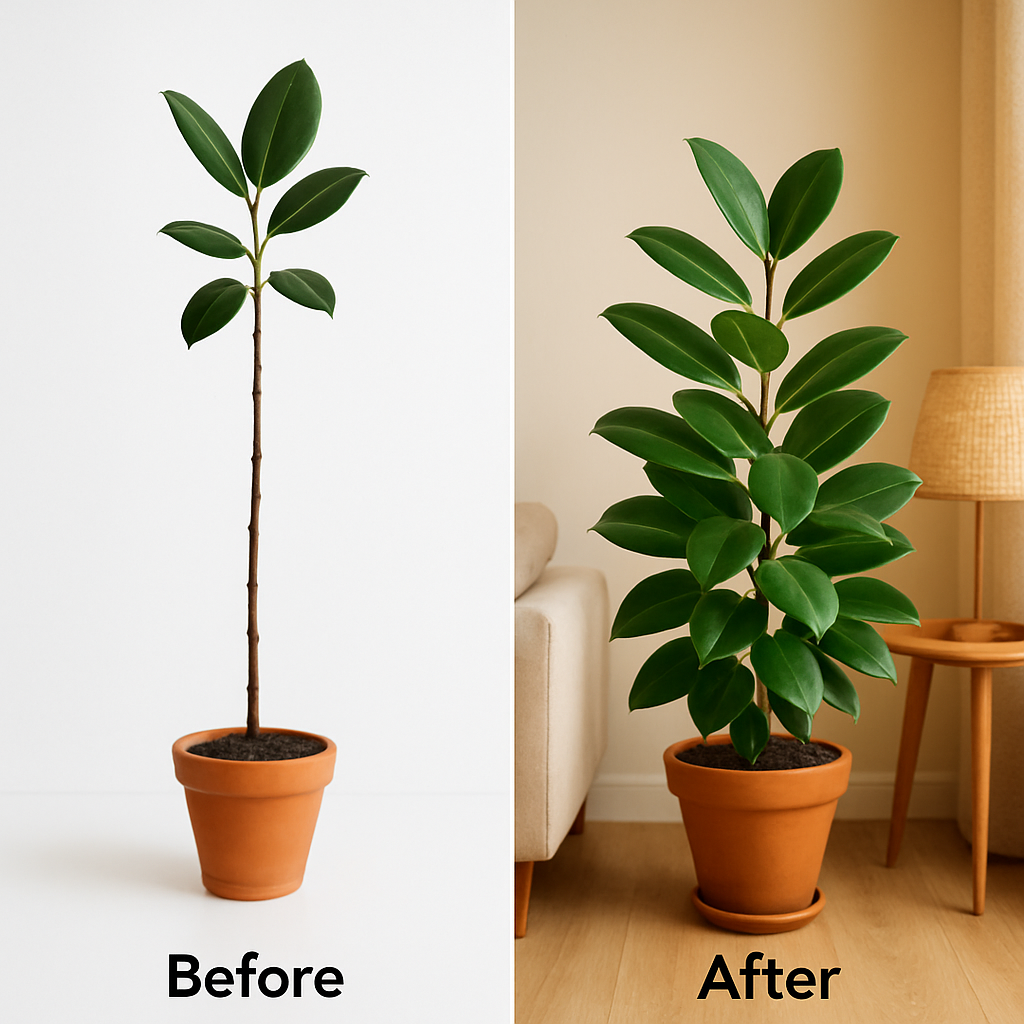
Controlling height: If your rubber plant has gotten taller than you want, you can cut it back to the desired height. Cut just above a node, and the bud at that node will activate. New growth will come from that point, usually producing 2–3 new branches.
Tool hygiene: Clean your shears before and after pruning, especially if you're moving between plants. Rubbing alcohol or a 10% bleach solution works fine. Dirty tools spread disease between plants quietly, and rubber plants are susceptible to bacterial and fungal issues that can enter through wound sites.
For more on general pruning principles, including technique and timing, see our full guide.
Propagation
The good news: rubber plants root easily. The propagation method that works most reliably for most people is water propagation.
Step 1: Take the cutting. Find a stem section with at least one node (the slightly swollen ring where a leaf meets the stem) and one healthy leaf. The node is where the roots will come from — without it, you're just rooting a leaf that will never produce a new plant. Cut with sharp, clean shears.
Step 2: Manage the sap. Hold the cut end under running water or place it in water immediately — this stops the sap from hardening at the cut site, which would block water uptake. Pat the cut end dry, then proceed.
Step 3: Place in water. Use a clear glass container so you can monitor root development. Fill with room-temperature water, enough to cover the node but not so much that the leaf is submerged. Place in bright indirect light.
Step 4: Wait. Change the water weekly. Roots appear in 4–6 weeks typically. Don't yank the cutting out to check — disturbing it slows the process.
Step 5: Pot it up. Once the roots are 2–3 inches long, pot in the chunky soil mix described earlier. Keep the new plant in bright indirect light and maintain consistent moisture for the first few weeks while it adjusts.
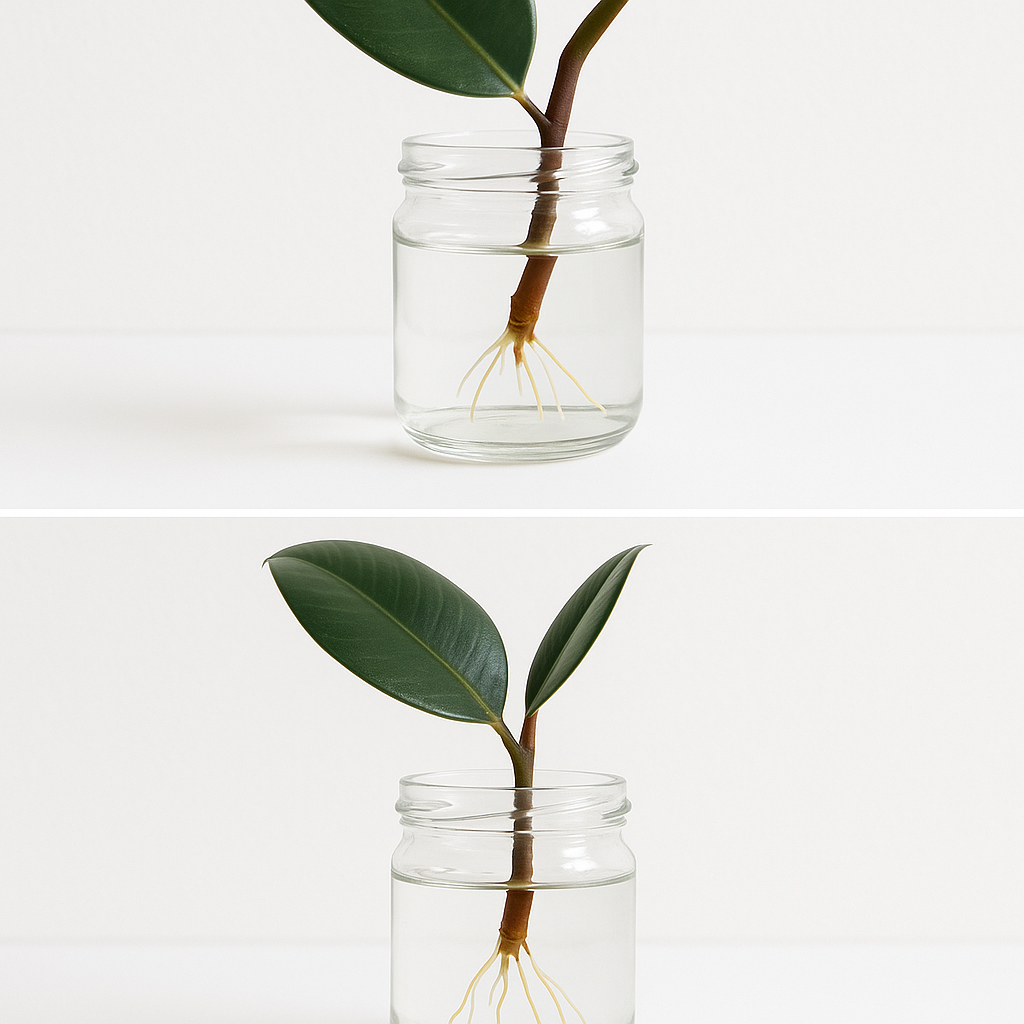
Soil propagation is also an option — dip the cut end in rooting hormone and plant directly in moist chunky mix. It works, but you can't see what's happening below the soil line, which makes some people nervous. Water propagation lets you watch the roots grow, which is satisfying and diagnostic.
For the full general propagation guide, including soil method details and troubleshooting, see our article.
Problem Doctor: What's Wrong With My Rubber Plant?
Rubber plant problems tend to fall into a few distinct patterns. Here's how to read them.
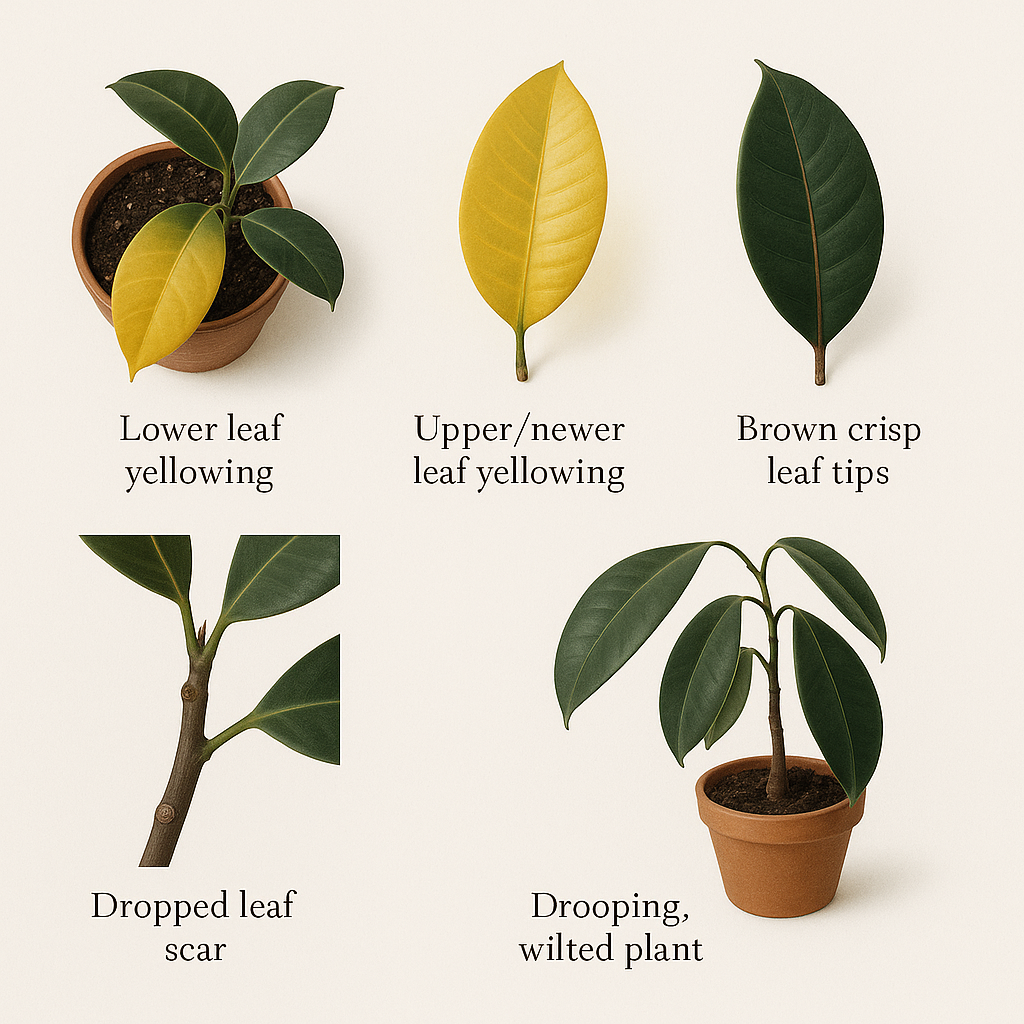
Why Is My Rubber Plant Dropping Leaves?
Sudden leaf drop — especially multiple leaves at once — is almost always an environmental shock. The most common causes:
- Cold drafts from doors, windows, or HVAC vents
- Moving the plant to a new location with different light or temperature
- Inconsistent watering — too dry, then soaked, then dry again
- Root rot from overwatering (check the soil)
If your plant drops a single leaf and it's clearly an old one (at the bottom of the stem), that's normal — plants shed older leaves routinely. If it's dropping multiple leaves or new leaves, something is wrong with the environment or the roots.
Fix it: Identify and remove the stressor. Check for drafts, check your watering schedule, check the roots if you suspect rot. Move the plant back to its original spot if you recently moved it. Rubber plants don't like change.
Why Are My Rubber Plant Leaves Turning Yellow?
Lower leaves yellowing: Almost always overwatering or root issues. The plant is shedding older leaves because the roots are stressed. Check soil moisture — if it's wet and hasn't dried out, let it dry before watering again. If it's been wet for weeks, you may need to unpot and check for root rot.
Upper/newer leaves yellowing: Can mean the plant is getting too much direct sun, or it could be overwatering in a different stage. Check light exposure first — is the plant in direct sun during peak hours? Move it back from the window.
Widespread yellowing across the whole plant: Usually indicates a serious root problem — rot, compaction, or a pot-bound situation where the roots have no room to breathe. Repotting may be necessary.
Why Is My Rubber Plant So Leggy?
Legginess — long stems with widely spaced leaves, typically with smaller leaves than the original plant — means the plant is reaching for light. It's not a disease; it's a light problem.
Fix it: Move the plant closer to its light source, or add a grow light. Pruning the main stem back will also help — cutting the apical meristem (top growth point) redirects energy to the side buds, producing a denser, more compact plant.
Can I Save a Rubber Plant With Root Rot?
Often, yes — if you catch it early. Root rot happens when roots sit in waterlogged soil and start to decay. The smell is distinctive — musty, sour, not like healthy earth.
How to check: Gently unpot the plant and examine the roots. Healthy roots are firm and light-colored (tan or white). Rotting roots are mushy, dark, and smell bad. If most of the root mass is still firm, trim the rotted roots, let the root ball dry for a day, and repot in fresh, chunky mix. Water lightly at first.
If most of the roots are gone: You can still try. Trim all rotted roots, let the plant dry out for 24 hours, then pot in fresh mix. Be patient — the plant will regrow roots if the stem is still viable. Water sparingly until you see new growth.
For the full step-by-step, see how to save a rubber plant from root rot.
Safety Note
A quick word on the sap: Ficus elastica bleeds a milky white latex sap when cut or damaged. This sap is irritating to skin, toxic if ingested, and will absolutely ruin your clothing or upholstery.
What to do if you get sap on your skin: Wash thoroughly with soap and water immediately. It shouldn't cause lasting damage if cleaned promptly.
Placement considerations: If you have pets that chew plants or curious toddlers who explore with their mouths, rubber plants aren't the best choice. The plant is toxic to cats and dogs — ingestion causes oral irritation, drooling, and GI upset. Consider pet-safe alternatives if this is a concern in your household.
Practical setup: Wear gloves when pruning. Lay down newspaper or a tarp. Do the pruning over a surface you can clean. Have paper towels and a bucket of water nearby to manage the sap immediately.
FAQ
How often should I water my rubber plant? Water when the top 2–3 inches of soil are dry. In summer this is typically every 7–10 days; in winter every 2–3 weeks. The finger test is more reliable than any schedule — every home's conditions are different.
Why are the leaves on my rubber plant turning yellow? Yellow lower leaves usually mean overwatering. Yellow upper/newer leaves can mean too much direct sun. Check soil moisture first and adjust watering accordingly. If the yellowing is widespread, check the roots for rot.
Why is my rubber plant dropping leaves? Leaf drop is usually caused by a sudden change in environment — cold drafts, moving the plant, or inconsistent watering. Rubber plants are sensitive to change. Check for drafts and maintain consistent watering.
How do I make my rubber plant bushier? Prune the main stem just above a node during the growing season to encourage branching. Each cut point will typically produce 2–3 new growth shoots. Be patient — new growth appears in 4–6 weeks after pruning.
How do I propagate a rubber plant? Take a stem cutting with at least one node and one healthy leaf. Place in water, change water weekly, and roots develop in 4–6 weeks. Transfer to well-draining soil once roots are 2–3 inches long.
Why is my rubber plant so leggy? Legginess means the plant is reaching for more light. Move it closer to a window or add a grow light. Pruning the tall stem back will also encourage branching, which creates a fuller shape.
Our Favorite Rubber Plant Care Tools
We use these products ourselves:
Check Soil Moisture Before You Water →
Want to make sure you're watering correctly every time? See our more on watering technique guide.