Mealybugs on Houseplants — Complete Treatment Guide
These white cottony nightmares are persistent, but they're not invincible.
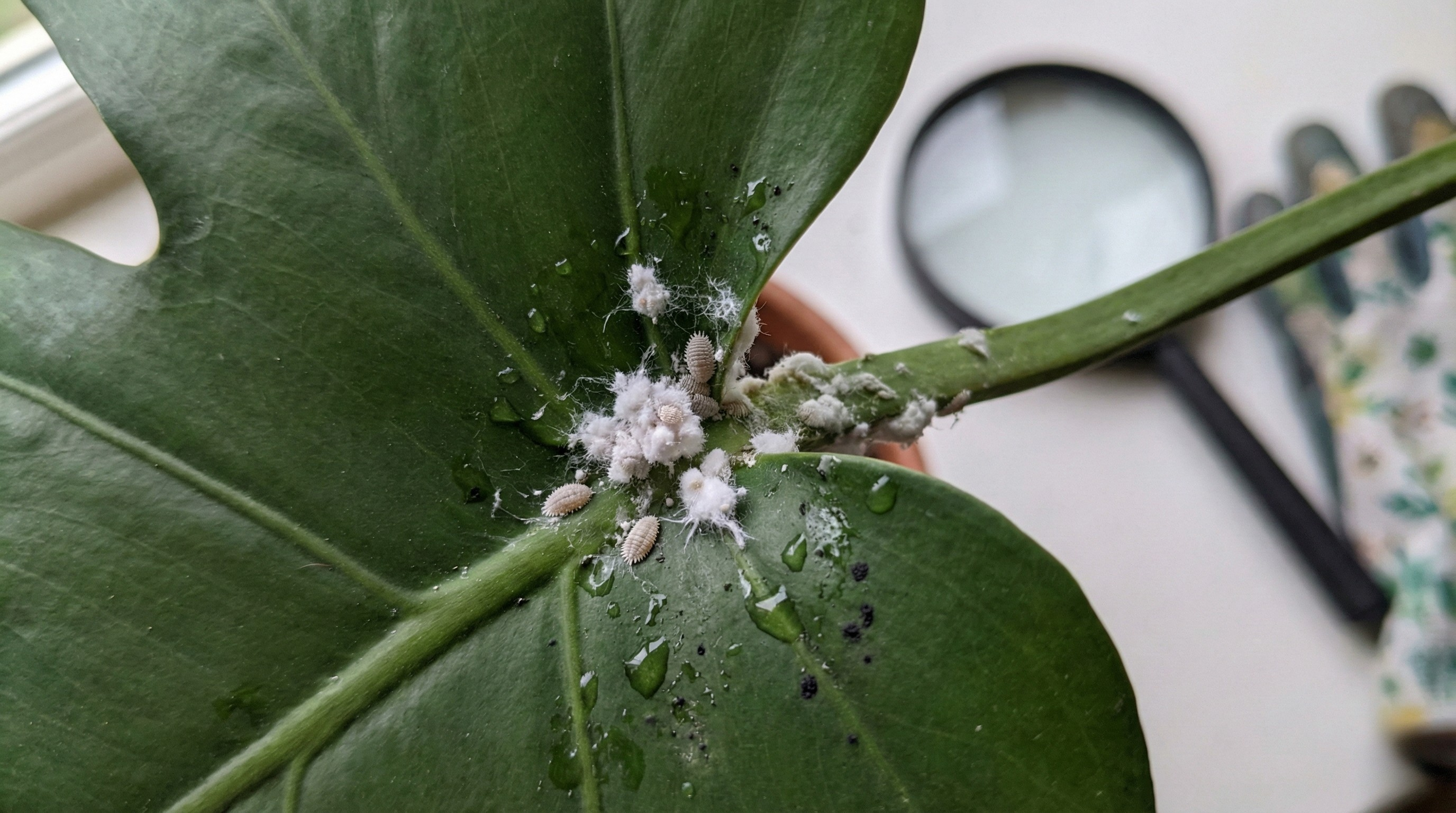
What You're Dealing With
Mealybugs are small, soft-bodied insects that cluster in the cozy crevices of your plants — leaf joints, stem junctions, under leaves, and (the worst part) in the root zone. They look like tiny pieces of cotton candy that somehow ended up on your plant, except they're alive and sucking the life out of your foliage.
The key identifying features:
- White, cottony, waxy masses (that's their protective coating)
- Slow-moving soft-bodied bugs underneath the fluff
- Sticky honeydew residue on leaves (this leads to sooty mold)
- Plants that look progressively weaker, yellowing, or sticky
They reproduce FAST. A single female can lay 100-200 eggs in a protective cottony sac, and those eggs hatch in about a week. This is why mealybug infestations feel like whack-a-mole — by the time you see one colony, there are probably three more hiding.
Why Mealybugs Keep Coming Back
If you've fought mealybugs and lost, it's usually one of these reasons:
1. You only treated the visible ones. Mealybugs hide in places you can't see. Miss one egg sac and you're back to square one in two weeks.
2. You didn't treat for long enough. One spray isn't enough. Their life cycle is 4-8 weeks depending on conditions, and you need to break that cycle.
3. They moved to the roots. Root mealybugs are the nightmare scenario. They're invisible until your plant starts declining for "no reason," and they survive most surface treatments.
4. They spread to neighboring plants. Mealybugs can crawl from plant to plant, especially when plants touch. One treated plant next to an untreated one = reinfestation city.
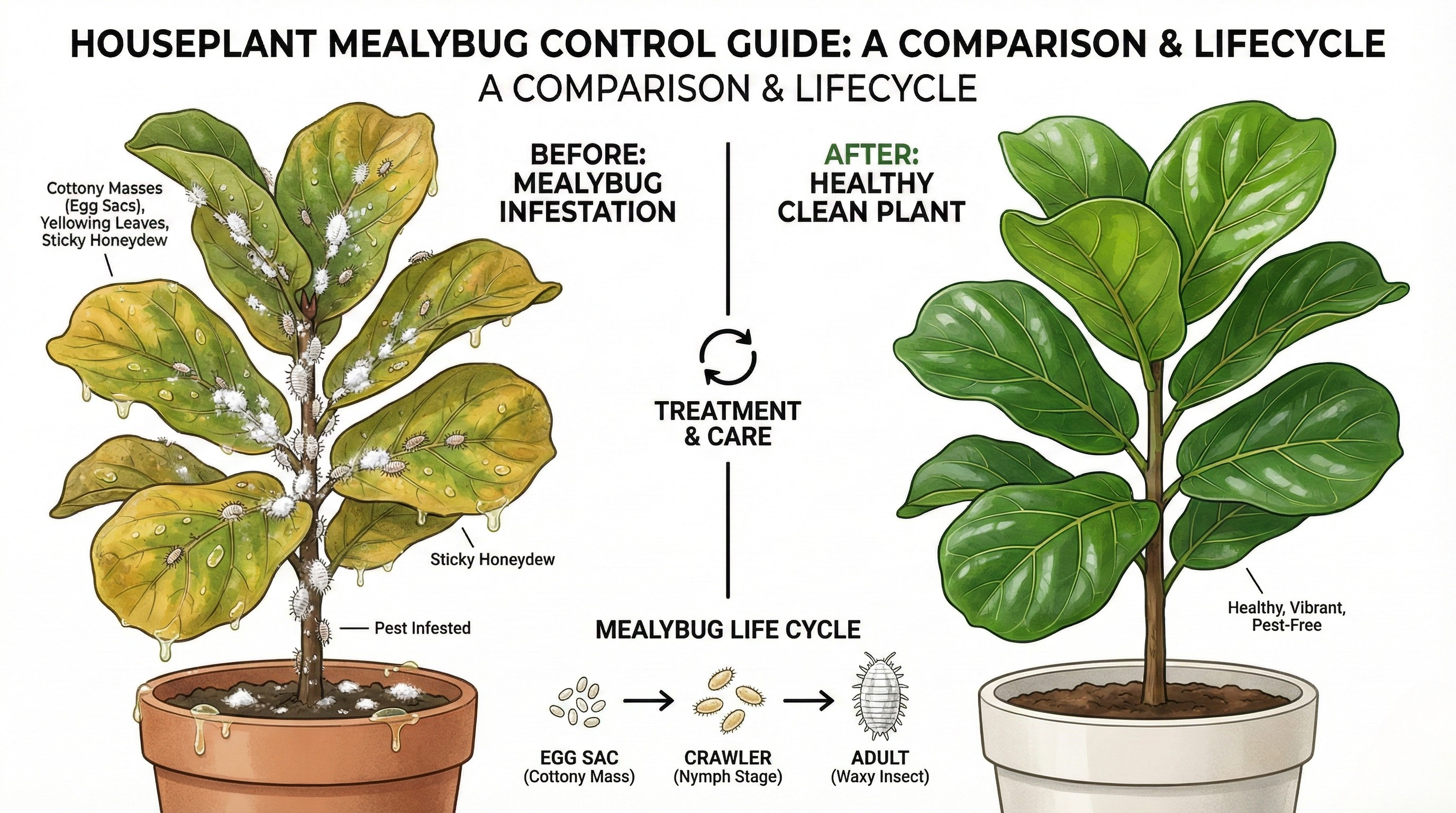
Step-by-Step Treatment
Step 1: Isolate Immediately
This is non-negotiable. Move the affected plant far away from everything else — different room if possible. Check all nearby plants carefully. Mealybugs crawl, and they'll find new homes if given the chance.
While you're at it, inspect your other plants. Look especially at plants that were near the infected one, and check the cozy spots (leaf joints, new growth).
Step 2: Manual Removal (First Pass)
Before reaching for sprays, physically remove what you can:
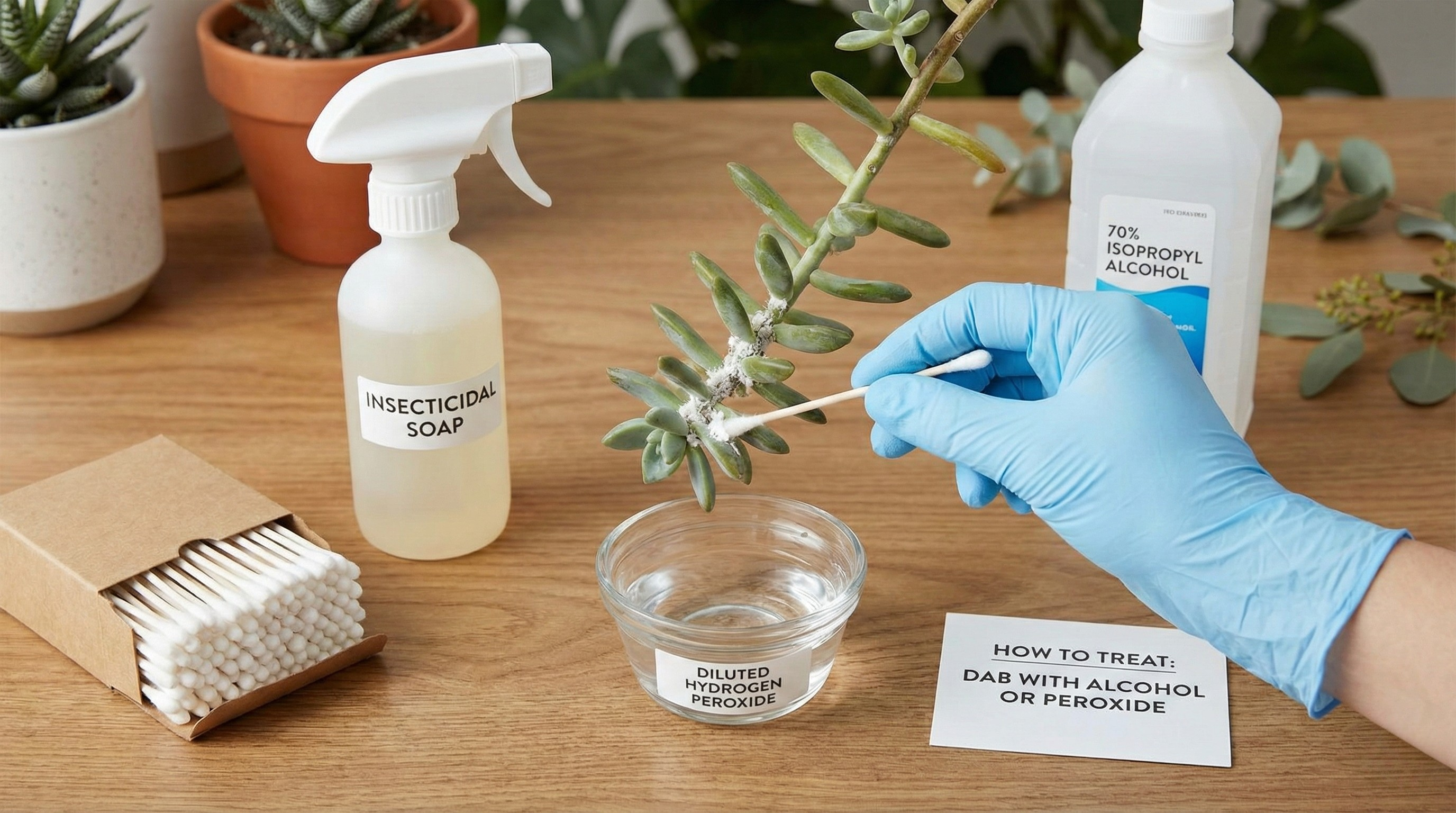
- Dab visible bugs with a cotton swab dipped in 70% isopropyl alcohol. This dissolves their waxy coating and kills them on contact.
- Scrape off egg sacs with your fingernail or a soft toothbrush.
- Wipe down stems and leaves with a cloth dampened with alcohol or soapy water.
Don't bother rinsing yet — you're just removing the obvious stuff. The spray comes next.
Step 3: Insecticidal Soap — The Workhorse
Insecticidal soap is your best friend for mealybugs. It works by suffocating the bugs (breaking down their waxy coating), and it's safe for most houseplants.
How to apply it properly:
- Spray every surface of the plant — tops of leaves, undersides, stems, leaf joints
- Don't drench it; a fine mist that coats everything is better than a heavy soak
- Wait, then apply again (coverage matters more than quantity)
- Repeat every 5-7 days for 3-4 weeks minimum
Why so long? Because you're trying to catch the next generation as they hatch. If you stop after one or two sprays, the survivors will repopulate and you'll be right back where you started.
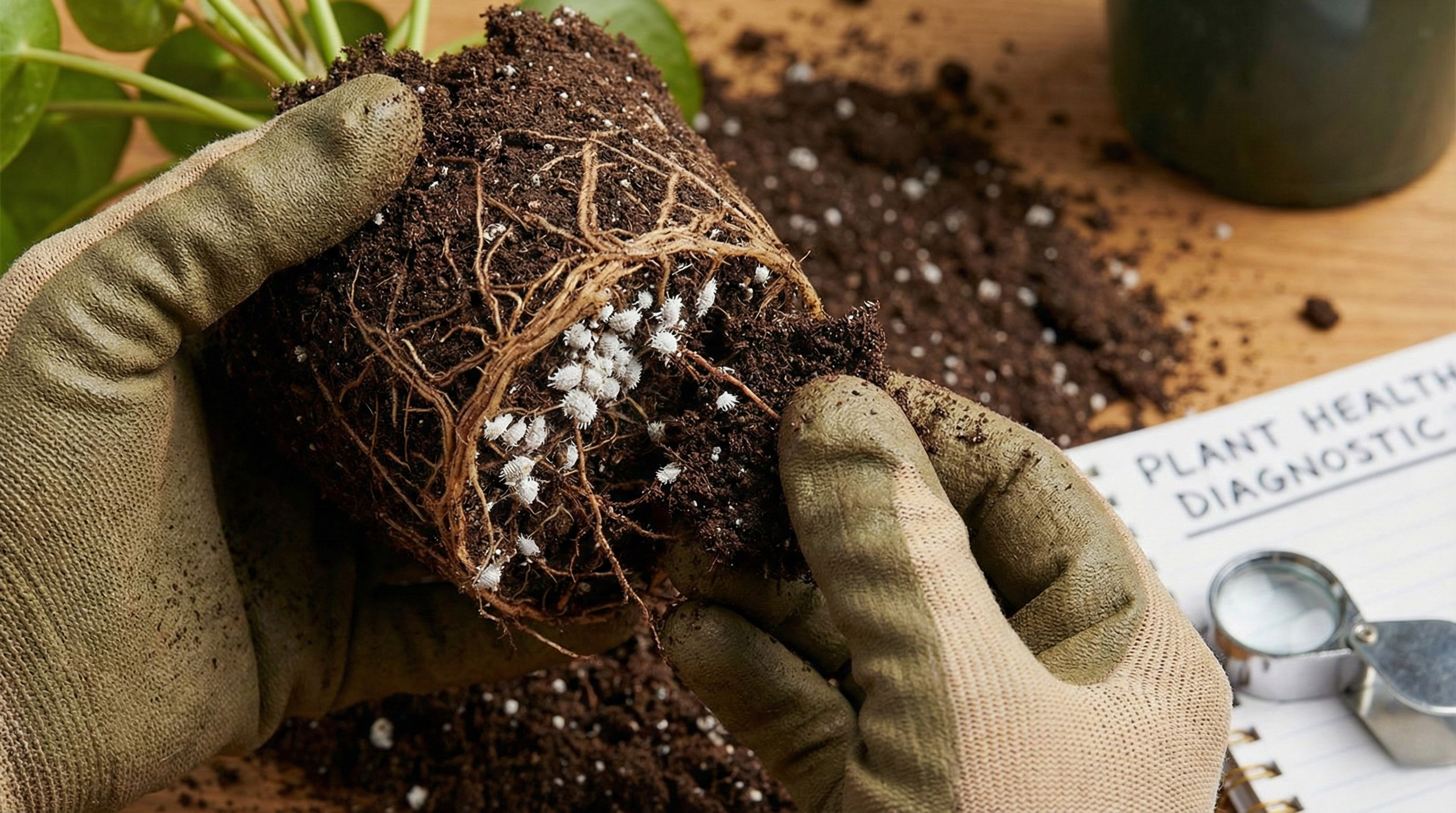
Step 4: Check the Roots (If It Keeps Coming Back)
If you've done everything right and mealybugs still show up after 3-4 weeks of treatment, the odds are good they're living in the soil. Root mealybugs are exactly what they sound like — mealybugs that infest the root zone instead of the foliage.
How to check:
- Gently remove the plant from its pot
- Look for white, cottony masses on the roots
- If you see them, you've got root mealybugs
Treatment options for root mealybugs:
- Repot entirely — shake off all soil, clean the pot with 10% bleach solution, repot in fresh soil
- Systemic granules — Bonide Systemic Houseplant Insect Control works into the soil and poisons the bugs from the inside. (Edibles: no. Ornamentals: yes.)
- Soak treatment — water with a diluted insecticidal soap solution, let it soak the root zone, repeat for 2-3 waterings
Step 5: Prevention — Because Nobody Wants Round Two
Once you've eradicated mealybugs, keep them from coming back:
- Quarantine new plants for 2-3 weeks before adding to your collection
- Inspect regularly — check leaf joints and new growth weekly
- Isolate at first sign — one white blob is an infestation waiting to happen
- Don't over-fertilize — nitrogen-heavy fertilizer produces soft new growth that mealybugs love
Products That Actually Work
| Product | When to Use |
|---|---|
| 70% isopropyl alcohol | Dabbing visible bugs, wiping leaves |
| Insecticidal soap | Main treatment, repeat weekly |
| Neem oil | Preventive spraying, stubborn cases |
| Systemic granules | Root mealybugs only |
The Secret Weapon: Hydrogen Peroxide
Here's the trick that most guides skip: 3% hydrogen peroxide.
Mix 1 part 3% hydrogen peroxide with 2 parts water, and use it as a soil drench for root mealybugs or as a foliar spray. It kills on contact and breaks down into water and oxygen — no toxic residue.
It's not a standalone solution (it doesn't penetrate the waxy coating as well as soap), but it's a fantastic addition to your rotation, especially for root infestations.
FAQ
Can I just wipe mealybugs off?
No. The waxy coating protects them. Alcohol dissolves it, soap suffocates it. Wiping alone just distributes them to new spots.
Will neem oil alone fix it?
Neem oil helps with prevention and light infestations, but it works slower than insecticidal soap. For a full-blown infestation, soap is more reliable.
How long does treatment take?
3-4 weeks minimum for foliar mealybugs. Root mealybugs can take 6-8 weeks if you repot and treat.
Should I throw away heavily infested plants?
That's your call. If the plant is completely overrun — multiple colonies, severe decline, root involvement — sometimes the math doesn't work out. But if there's still healthy growth, it's worth trying to save.
Are mealybugs harmful to humans?
Nope. They're plant pests, not a health hazard. Wash your hands after treatment anyway, because the honeydew is sticky and the treatments can irritate skin.
Bottom Line
Mealybugs are persistence pests, not invincible ones. The keys are:
- Isolate fast — don't let them spread
- Be thorough — check leaf joints, undersides, and roots
- Stay consistent — treat for 3-4 weeks minimum
- Don't skip the root check — if it keeps coming back, that's why
Yes, it's annoying. But you can win this.
Need help identifying what you're dealing with? Our Pest ID Guide covers mealybugs plus the other common houseplant pests. Already got your treatment supplies? Here's the minimal Pest Control Starter Kit worth having on hand.