LECA & Semi-Hydro for Houseplants: The Complete Beginner's Guide
Ditch the soil, simplify watering, and grow happier roots — without the overwhelm.
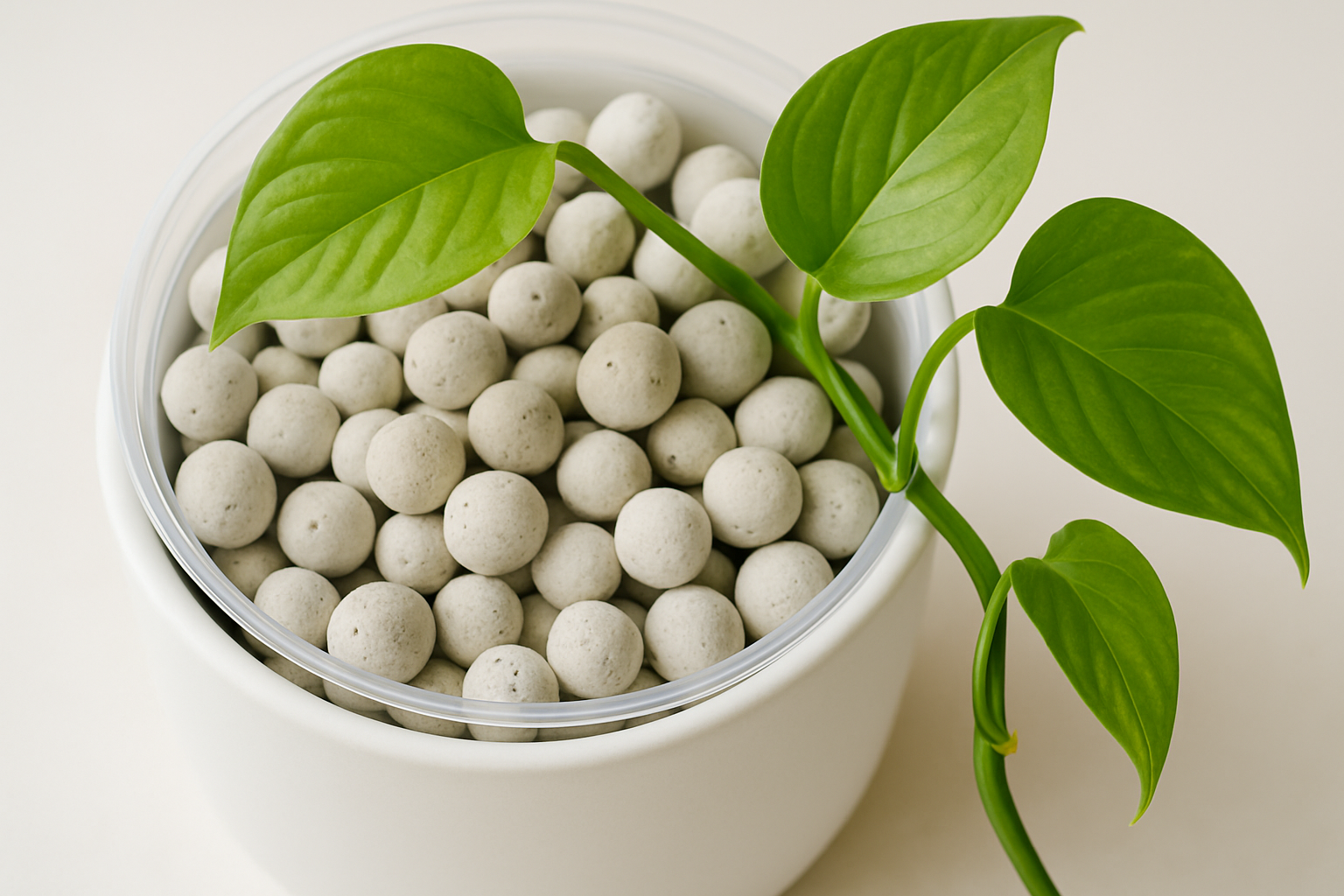
What Is LECA — And Why Are So Many Plant People Obsessed With It?
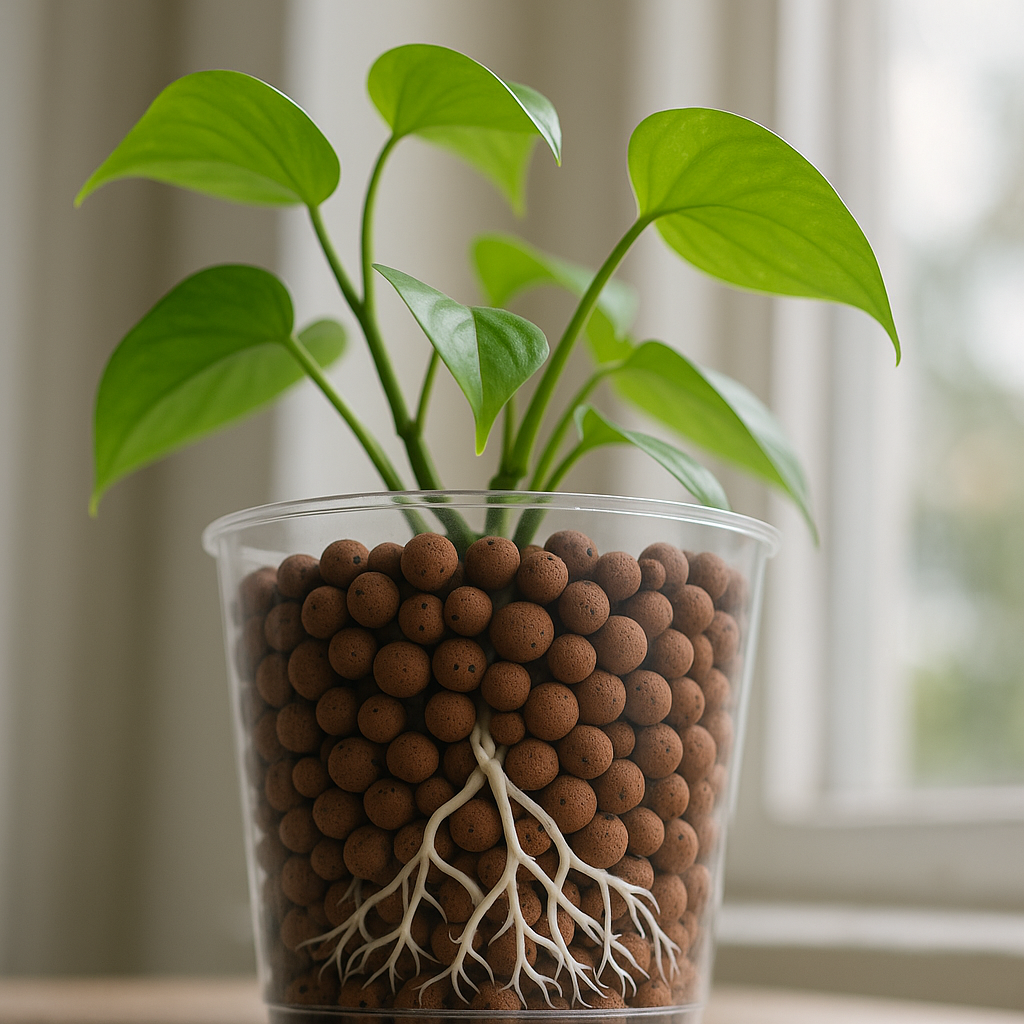
LECA stands for Lightweight Expanded Clay Aggregate. In plain English: little clay balls that get fired in a kiln until they puff up like tiny, porous rocks. They look like this:
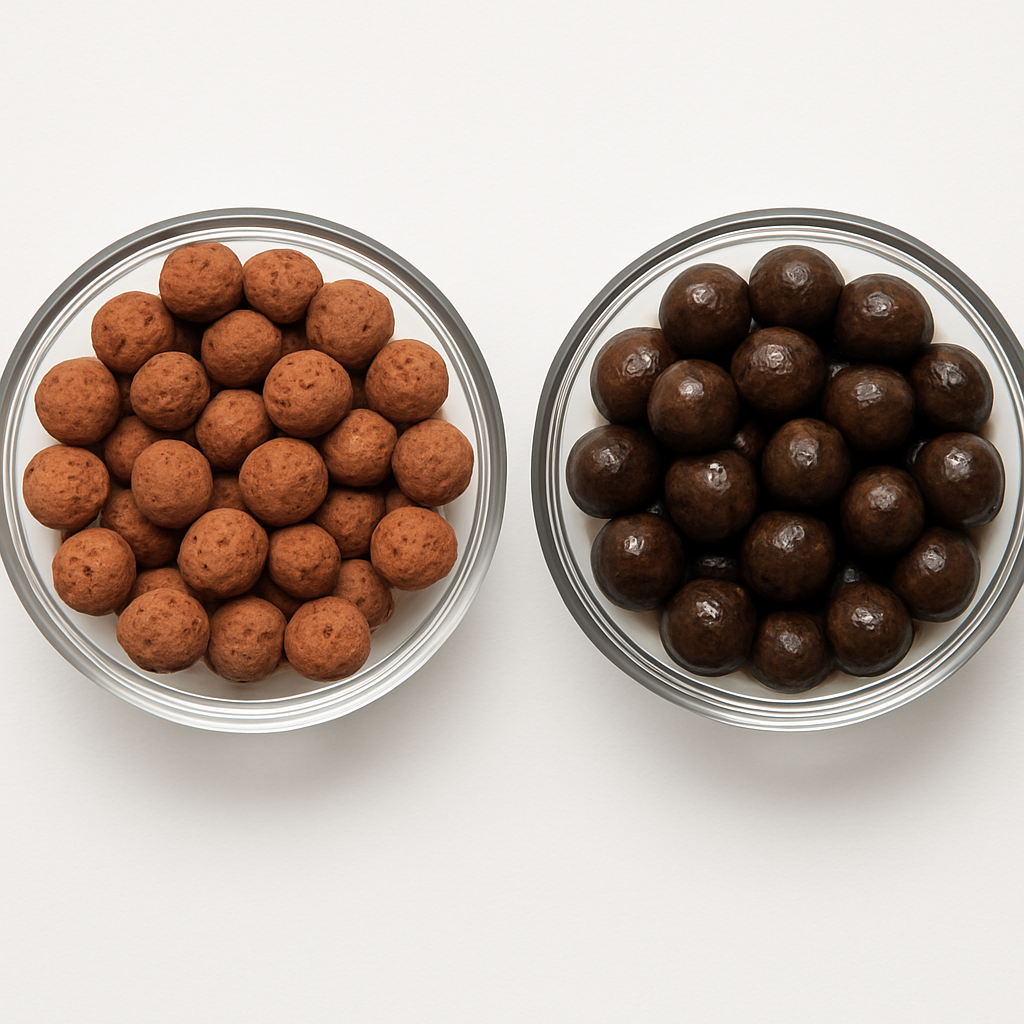
Here's the deal: LECA balls have millions of tiny pores. When you set them in water, they wick that moisture upward through capillary action. Plant roots reach down into the LECA and drink what they need. No soggy soil. No root rot from sitting in standing water. Just... moisture on demand.
The hype is real, but it's not magic. People lose their minds over LECA because it solves two persistent soil problems: overwatering (soil stays too wet too long) and root rot (the other side of that same coin). In LECA, roots get oxygen AND access to water simultaneously. That combination is genuinely hard to achieve in traditional potting mix.
But LECA isn't a plant parent cheat code. You still have to water. You still have to fertilize. You just do it differently.
Is Semi-Hydro Right for You?
Semi-hydroponics — often called "semi-hydro" — is growing plants in an inert medium (like LECA) with water or nutrient solution as the delivery system instead of soil.
You might love semi-hydro if:
- You're tired of overwatering and root rot
- You travel and want a more forgiving watering system
- You want to watch your plant's roots grow (clear pots + LECA = roots on display)
- You have issues with fungus gnats in soil (LECA doesn't host them)
Stick with soil if:
- You like simplicity and not measuring anything
- You grow plants that need very fast-draining, chunky soil (some cacti, orchids)
- You only have a few plants and don't want to change your routine
- You're not willing to learn a new system (there's a learning curve, no lie)
Semi-hydro isn't better than soil. It's just different. Different tradeoffs, different skills needed, different results.
What You'll Actually Need to Get Started
Here's what you actually need to start:
LECA clay pebbles
The primary ingredient. See Mother Earth Hydroton LECA on Amazon — this is the brand most beginners start with because it's consistent, clean, and easy to find. You'll need roughly 1 liter of LECA per 4-inch pot, so grab more than you think you need.
Inner pot + outer pot system
The pot architecture for semi-hydro is always two pots: a net pot or mesh inner pot that holds the LECA and plant, and a solid outer reservoir pot that holds water. See pot setup options on Amazon. The DIY approach: clear nursery pots (inner) + any decorative cache pot (outer). The premium approach: Lechuza Pon set with self-watering reservoir.
Hydroponic fertilizer
This is non-negotiable and most guides skip it: Get Dyna-Gro Foliage-Pro on Amazon. Standard soil fertilizer does NOT work in LECA — it relies on soil biology to break down nutrients, which doesn't exist in an inert medium. Dyna-Gro Foliage-Pro is the beginner-friendly answer: one part, pre-mixed, available on Amazon.
Filtered or distilled water
Most tap water works if your total dissolved solids (TDS) are under 200ppm. If you're not sure, a Check pH on Amazon to go with your kit — it measures TDS too and tells you if your water is safe for semi-hydro.
If you're just starting out with houseplants, here's the starter kit first — LECA is an upgrade once you've got the basics down.
How to Prep LECA the Right Way
This is the step most guides skip and then beginners wonder why their first LECA grow goes sideways. Don't skip it.
1. Rinse. LECA comes dusty from manufacturing — that dust will cloud your water and potentially clog your plant's root pores. Rinse thoroughly until the water runs mostly clear.
2. Soak. Throw your rinsed LECA in a bowl of filtered or distilled water and let it sit for at least 24 hours. Dry LECA repels water at first — the soaking makes it hydrophilic so it actually wicks moisture instead of floating on top.
3. Drain. After soaking, drain the LECA. It's now ready to use. Some people store soaked LECA in a sealed container in the fridge for up to a week (keeps it from growing algae). That's optional but smart.
Don't rush the soaking. 24 hours minimum. Some people do 48. Just do the full day.
Choosing Your First Plant for Semi-Hydro
Not all plants are equally thrilled about LECA. Some take to it like they were born for it. Others throw a dramatic fit for months before settling in.
Best beginner candidates:
- Pothos — the king of semi-hydro. Tolerates transition stress, roots like a champion, handles imperfection
- Philodendron (most varieties) — similar resilience to pothos
- Syngonium (arrowhead plant) — forgiving transition
- Scindapsus (satin pothos) — handles the change well
- Monstera — works but slow; give it 3+ months to adjust
Plants to avoid starting with:
- Succulents and cacti (they hate constant moisture access)
- Calathea and Maranta (dramatic about any change)
- Ferns (too water-sensitive)
- Plants you got from a garden center that are already stressed
Also worth knowing: rerouting in LECA works great for propagation too — if you want to try semi-hydro with a cutting before committing a full plant, start there.
The Two Methods: Reservoir vs. Shower
There are two ways to water in semi-hydro. Neither is wrong. Pick based on your plant and your habits.
Reservoir method (most common)
You fill the outer pot with nutrient solution until the bottom inch or so of the inner pot sits in water. The LECA wicks moisture upward. You refill when the reservoir empties — typically every 7–14 days depending on plant, pot size, and humidity.
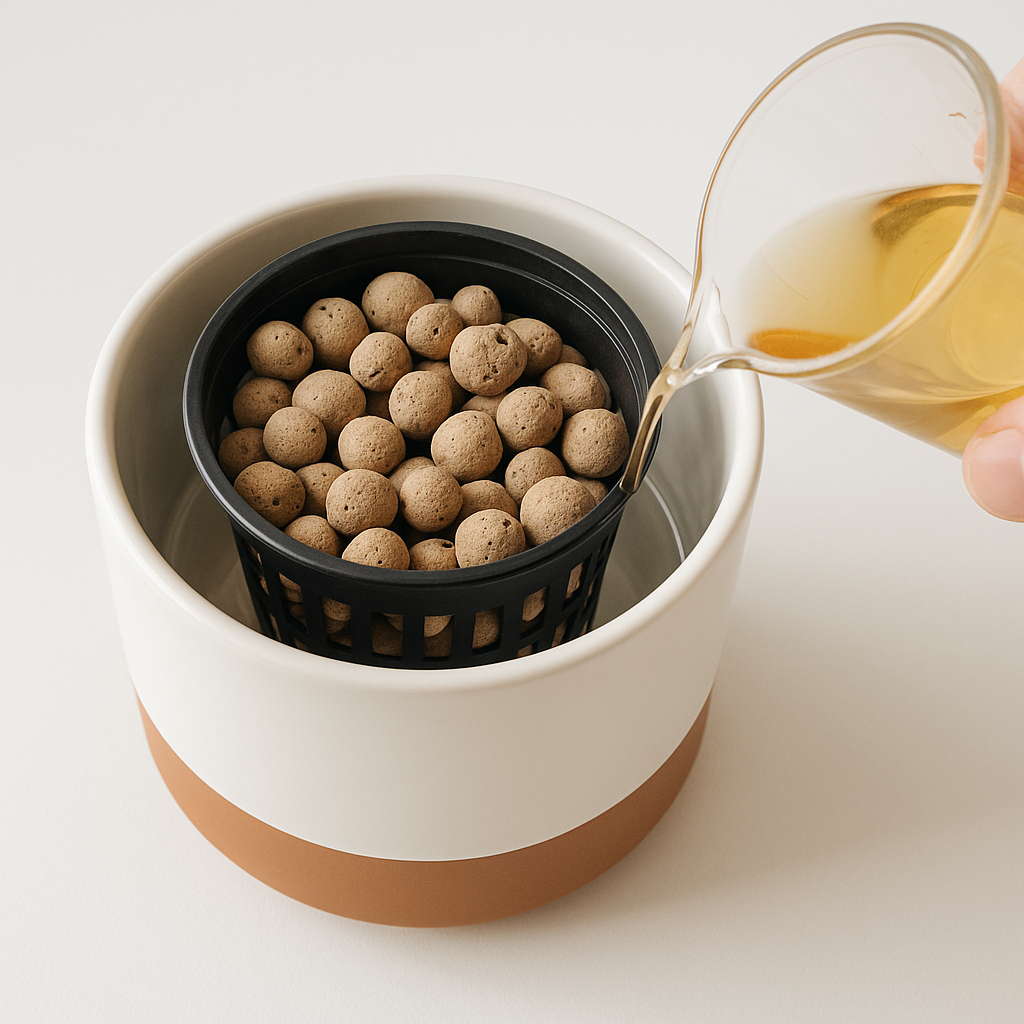
Shower method (periodic flood and drain)
You top-water the LECA thoroughly (like traditional watering) and let it drain completely through the mesh pot. Then you go back to the reservoir approach, or you repeat the shower every 1–2 weeks. Some people do shower-only and never use a reservoir.
Which to use when: The reservoir method is the standard for semi-hydro and what most people mean when they say "semi-hydro." The shower method is better for plants that are transitioning and for flushing out salt buildup. Use shower when you're doing the initial transition from soil, then switch to reservoir once the plant is established.
For the best pots for semi-hydro setups, see our guide to the best pots for semi-hydro setups (inner + outer pot system).
Step-by-Step: Transitioning a Plant from Soil to LECA
This is the part that intimidates people. It's not as hard as it looks.
What you need:
- Pre-soaked LECA (24+ hour soak)
- Clean scissors or pruning shears
- A bowl of water for root rinsing
- Inner net pot + outer reservoir pot
- Diluted nutrient solution (half-strength Dyna-Gro Foliage-Pro)
Step 1: Remove the plant from soil
Gently tip the plant out of its pot. Shake off as much soil as you can — don't force it or pull hard. The goal is to get to clean roots, not damage them in the process.
Step 2: Rinse the roots
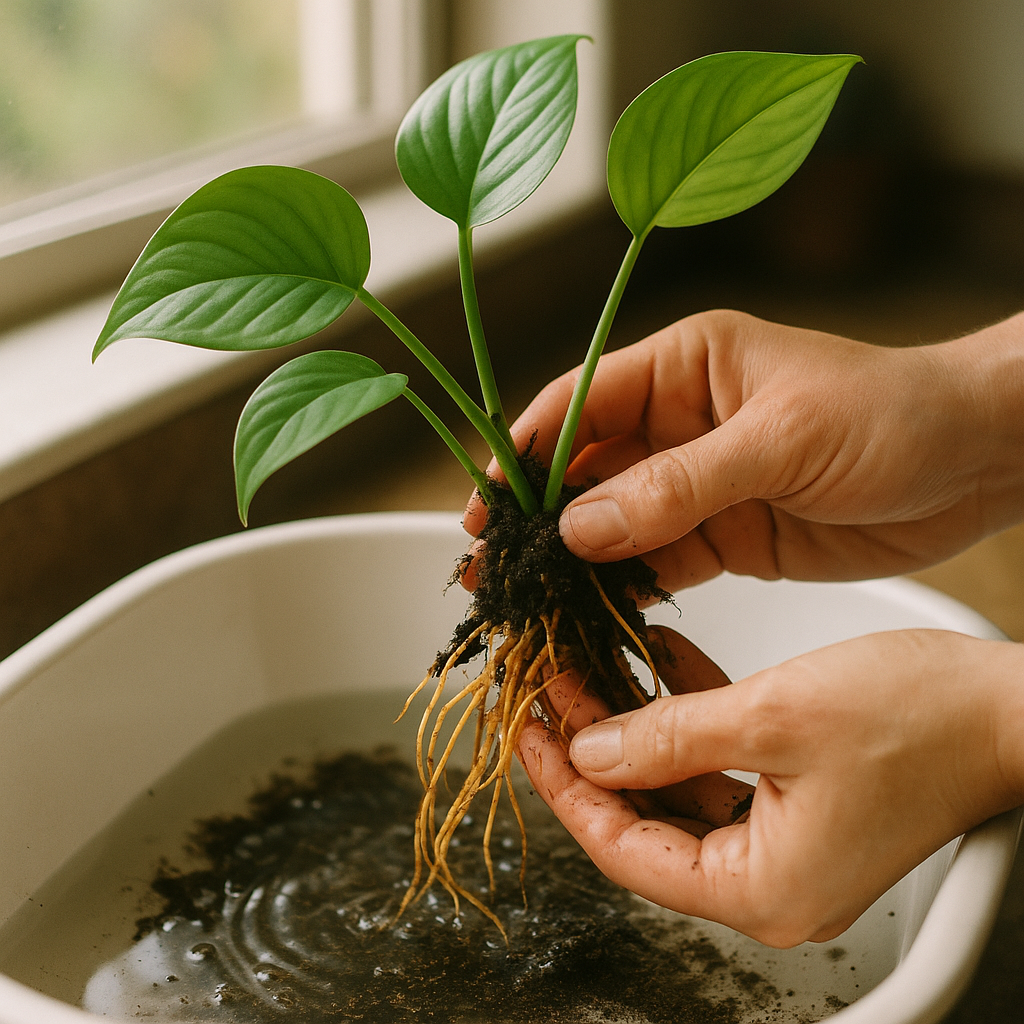
Put the root ball in a bowl of water and gently work the soil loose with your fingers. Be patient. Soil remnants harbor bacteria and fungi that can cause problems in your LECA system. Rinse until the roots are clean.
Step 3: Inspect and trim
Look at the roots. Trim anything brown, mushy, or smelly — those are already dying or dead. Healthy roots are firm and pale, often white or light tan. You're not being aggressive here; you're just removing the obviously dead parts.
Step 4: Add LECA to the inner pot
Partially fill your net pot with pre-soaked LECA. Set the plant on top, spread the roots out, then add more LECA around them until the plant is stable and sits at roughly the same depth it was in soil.
Step 5: Set up the reservoir
Place the inner pot in the outer reservoir. Add nutrient solution (mixed at half-strength for the first fill — easier on the transitioning plant) until the bottom 1 inch of the inner pot is sitting in liquid.
Step 6: Wait
Put the plant in bright indirect light and leave it alone. Don't top-water. Don't fertilize again for 4–6 weeks. Just check the reservoir level and refill when empty.
That's it. The hard part is waiting and not panicking when the plant looks sad in week 2.
What to Expect in the First 4 Weeks
Week 1–2: Transition shock. Your plant is going to look rough. Leaves may yellow, some may drop, the plant might droop a little. This is normal. Not "possible" — normal. It's the plant recalibrating from soil roots to LECA roots.
Week 2–3: Continued decline, then stabilization. The old soil roots are dying off and new LECA-adapted roots are starting to grow. This is the ugly phase. Do not repot back to soil. Do not overcorrect with extra fertilizer. Just wait.
Week 4–6: New growth begins. You'll see fresh leaves, or the plant stops looking worse. This is your signal that the transition is working.
Here's what healthy progress looks like:
And here's what's still okay:
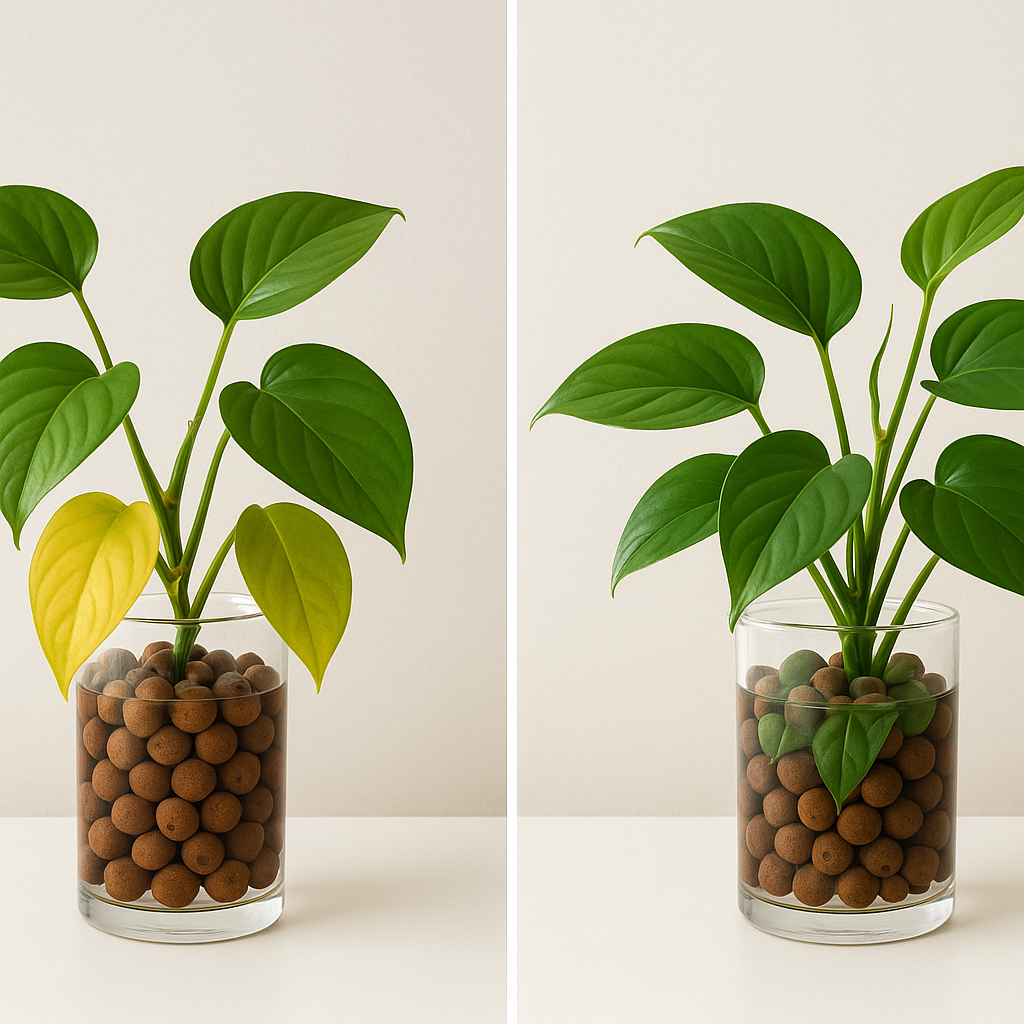
What to watch for: If the plant is dropping multiple leaves per week, or the new growing tips are turning black, that's not normal transition stress — that's something wrong. For more detail on how to spot and fix root rot in semi-hydro, check our root rot guide.
Most plants take 4–8 weeks to fully adjust. Slow growers like Monstera can take 3+ months. Patience is part of the deal.
Watering Semi-Hydro: Your New Routine
Once your plant is established (past the 6-week mark), the routine is simple:
Refill the reservoir when it empties. Not on a calendar — when it's actually empty. For most plants in most conditions, that's every 7–14 days.
Always use filtered, distilled, or RO water if your tap water has TDS over 200ppm. Our watering guide covers water quality in more detail, including how to check your tap water.
The reservoir fill level: Add nutrient solution until about 1 inch of the inner pot's bottom is submerged. You don't need to fill it higher — more water doesn't mean less watering. It means potential root exposure issues.
Flush every 4–6 weeks. Empty the reservoir, rinse the LECA briefly with plain filtered water to flush salt buildup, then refill with fresh nutrient solution. This prevents nutrient lockout and keeps roots healthy.
If you're in a dry climate or running AC all the time, your reservoir may empty faster. Check every 3–5 days until you learn your plant's rhythm.
Feeding Your Plants in LECA
Soil fertilizer doesn't work in LECA. Full stop. Soil fertilizers rely on microbial activity to break nutrients into plant-available forms. LECA has no soil biology — it's literally just clay balls.
Use hydroponic liquid fertilizer. Get Dyna-Gro Foliage-Pro on Amazon — this is the beginner-friendly recommendation because it's one bottle, it works, and it's available on Amazon. Mix at 1/4 to 1/2 teaspoon per gallon of water every time you refill the reservoir.
For more detail on which hydroponic fertilizer to start with, see our fertilizer guide.
Why not just use less soil fertilizer? Because soil fertilizer formulations don't account for the way semi-hydro works. In soil, nutrients bind to organic matter and release slowly. In LECA, they're immediately available — and over-fertilizing is a real risk. Hydroponic fertilizers are formulated for direct root uptake, which is what you have in semi-hydro.
pH matters in semi-hydro more than in soil. In soil, biology buffers pH. In LECA, you're directly managing nutrient availability. Aim for pH 5.5–6.5 in your reservoir. Check pH on Amazon with a simple drop test kit or digital meter.
The Most Common Beginner Mistakes — And How to Fix Them
These are the mistakes we see over and over. Learn from everyone else's impatience.
1. Refilling before the reservoir empties
New semi-hydro converts get nervous when the reservoir gets low and top it off before it's actually empty. This leads to root oxygen deprivation — roots need air gaps. Wait until it's dry, then refill. The plant will not die from being dry for a day or two.
2. Using soil fertilizer
See above. Just... don't. How to spot and fix root rot in semi-hydro goes into what happens when you use soil fertilizer in LECA (hint: root burn and lockout).
3. Skipping the LECA soak
Dry LECA floats and doesn't wick. You will have a chaotic mess. Soak your LECA.
4. Panicking at week 2 and repotting back to soil
This is the biggest kill of new semi-hydro plants. The plant looks sad, you assume you did something wrong, you yank it back to soil mid-transition. The plant then dies in soil because you damaged the new root growth AND stressed it twice. Wait. The plant has to go through the ugly phase. Trust the process.
5. Not flushing salt buildup
If your LECA surface has a white crust, that's mineral buildup from fertilizer. Flush it out. If you ignore it, the roots can't uptake nutrients properly even if you're fertilizing regularly.
FAQ: Real Questions Real Beginners Ask
What is LECA used for in houseplants? LECA (Lightweight Expanded Clay Aggregate) is a growing medium made from fired clay balls that absorb and wick water to plant roots. In semi-hydroponics, it replaces soil as a soilless medium that keeps roots moist and aerated while allowing you to water from a reservoir rather than from the top.
How do you water plants in LECA? In semi-hydro, you water by filling the outer reservoir pot with nutrient solution until the inner pot's bottom sits in about 1 inch of water. The LECA wicks moisture upward to the roots. You refill when the reservoir empties — typically every 1–2 weeks depending on plant, pot size, and humidity.
Do you need special fertilizer for LECA? Yes — standard soil fertilizer doesn't work in LECA because it relies on soil biology to break down nutrients. In semi-hydro, use a hydroponic liquid fertilizer (like Dyna-Gro Foliage-Pro) diluted in your water at every refill. Soil fertilizers can burn roots in a soilless medium.
How long does it take to transition plants to LECA? Most plants take 4–8 weeks to fully adjust to LECA. You'll often see yellow leaves and slight wilting in weeks 1–3 (transition shock) — this is normal. By week 4–6, most plants establish new roots in the LECA and start pushing fresh growth. Some slow-growing plants (like monsteras) can take 3+ months.
Can I use tap water for semi-hydro? It depends on your tap water quality. Most tap water works if your total dissolved solids (TDS) are under 200ppm. Above that, use filtered or distilled water to avoid nutrient lockout. Hard water (high calcium/magnesium) can cause imbalances. A simple TDS meter lets you check before each reservoir refill.
LECA vs. Pon — which is better for semi-hydro? Both work well. LECA is cheaper and more widely available (Amazon, local hydro stores). Pon is a premium mix of zeolite, volcanic rock, and pumice with better nutrient buffering. Beginners often start with LECA for the lower cost and easier availability, then graduate to Pon or mixes if they want to reduce fertilization frequency. Neither is objectively better — it depends on your setup and budget.
Our Favorite Semi-Hydro Tools & Supplies
We use these products ourselves — no gatekeeping:
Mother Earth Hydroton LECA Clay Pebbles — the standard recommendation, consistent quality
Clear nursery pots + decorative cache pots — the DIY inner + outer pot system that works reliably
General Hydroponics pH Test Kit — drop-style for beginners, accurate enough to get started