How to Make Your Houseplants Grow Faster — Proven Tips That Actually Work
You can't genetically engineer a slow-growing snake plant into a racer. But you can stop sabotaging your other ones. Here's what actually speeds up growth — and what wastes your money.
What 'Faster Growth' Actually Means (and What It Can't Do)
Let's start with the truth nobody wants to hear: genetics set the ceiling. A Pothos will never grow as fast as a Watermelon Peperomia, and a Snake Plant will never outpace a Philodendron. That's just DNA.
But genetics aren't the bottleneck for most people. Your plants are probably growing slower than they could because you're accidentally starving them of light, overwatering them, or not feeding them at all during the growing season.
Growth means two things: new leaves and bigger leaves. If your plant hasn't pushed a new leaf in months, something in its environment is holding it back. Fix that thing, and growth accelerates.
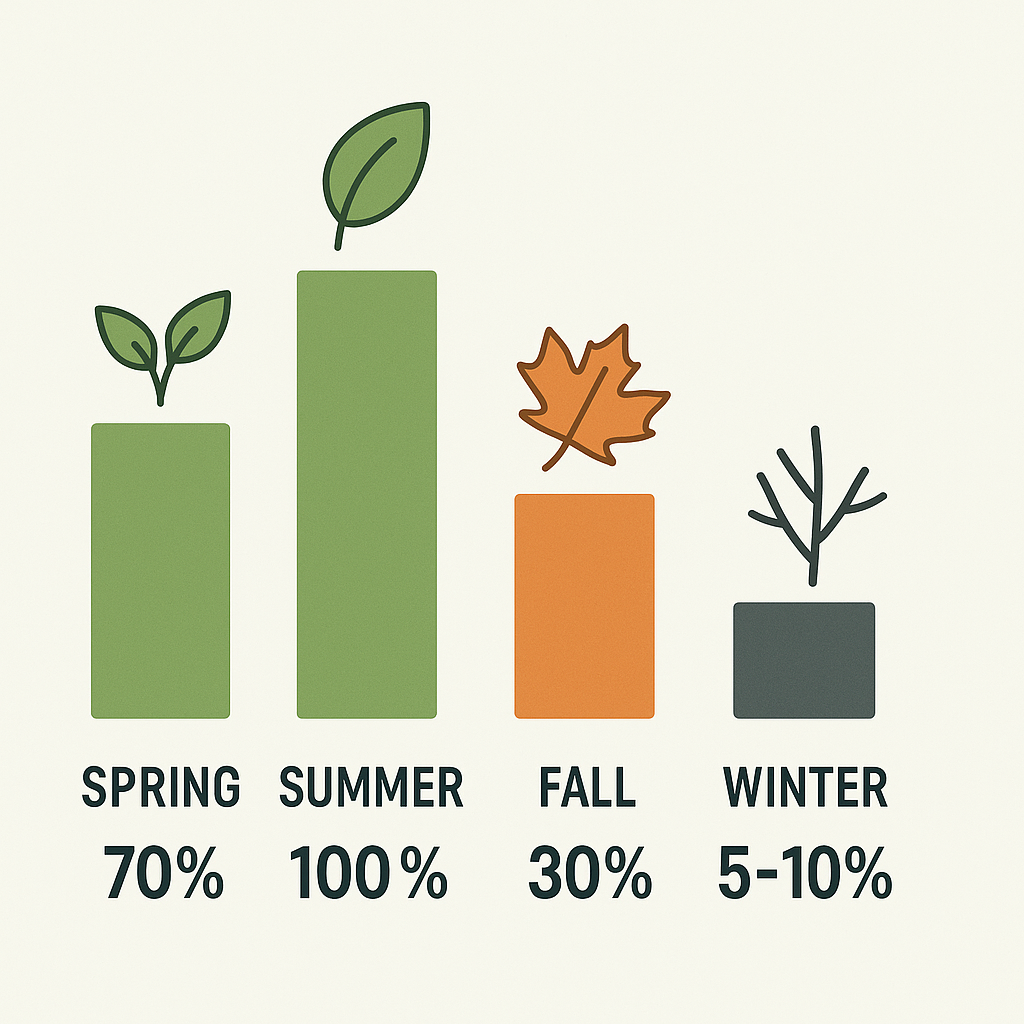
How long does it take for houseplants to grow? Most tropical houseplants push 1-3 new leaves per month during spring and summer. In winter? You might get nothing. That's not a problem — that's dormancy. Don't panic. Don't overcorrect.
The Foundation: Light, Water, and Temperature
Before the hacks, the basics. These three factors determine whether your plant is capable of growing fast. No amount of fertilizer compensates for bad light.
Light: The #1 Growth Driver
Plants grow by photosynthesis — they convert light into energy. More light = more energy = faster growth. This isn't a metaphor, it's chemistry.
If your plant is sitting in a dark corner and barely growing, the answer isn't more fertilizer. It's more light. Move it to your brightest window. East or west-facing windows are usually the sweet spot — bright indirect light without the leaf-scorching direct sun of south-facing exposures.
Signs your plant needs more light:
- Leggy, stretched-out growth (reaching for the light)
- Smaller leaves than usual
- No new growth for 6+ weeks in spring/summer
- Pale or washed-out coloring
If you don't have a bright enough window, a grow light is a legitimate upgrade — not a gimmicky one. A clip-on LED grow light can meaningfully boost growth for plants in low-light corners of your apartment. See grow light options on Amazon — most run $20-50 and last years.
For more on understanding your plant's light needs, check out our houseplant light requirements guide.
Watering Precision: Not Just How Much, But How Often
Overwatering is the #1 killer of houseplants, and it stunts growth more than underwatering ever does. Roots need oxygen. Soggy soil squeezes out the air pockets, roots suffocate, and the plant stops growing — or starts rotting from the inside.
The fix isn't "less water." It's watering at the right time, based on soil moisture, not a calendar.
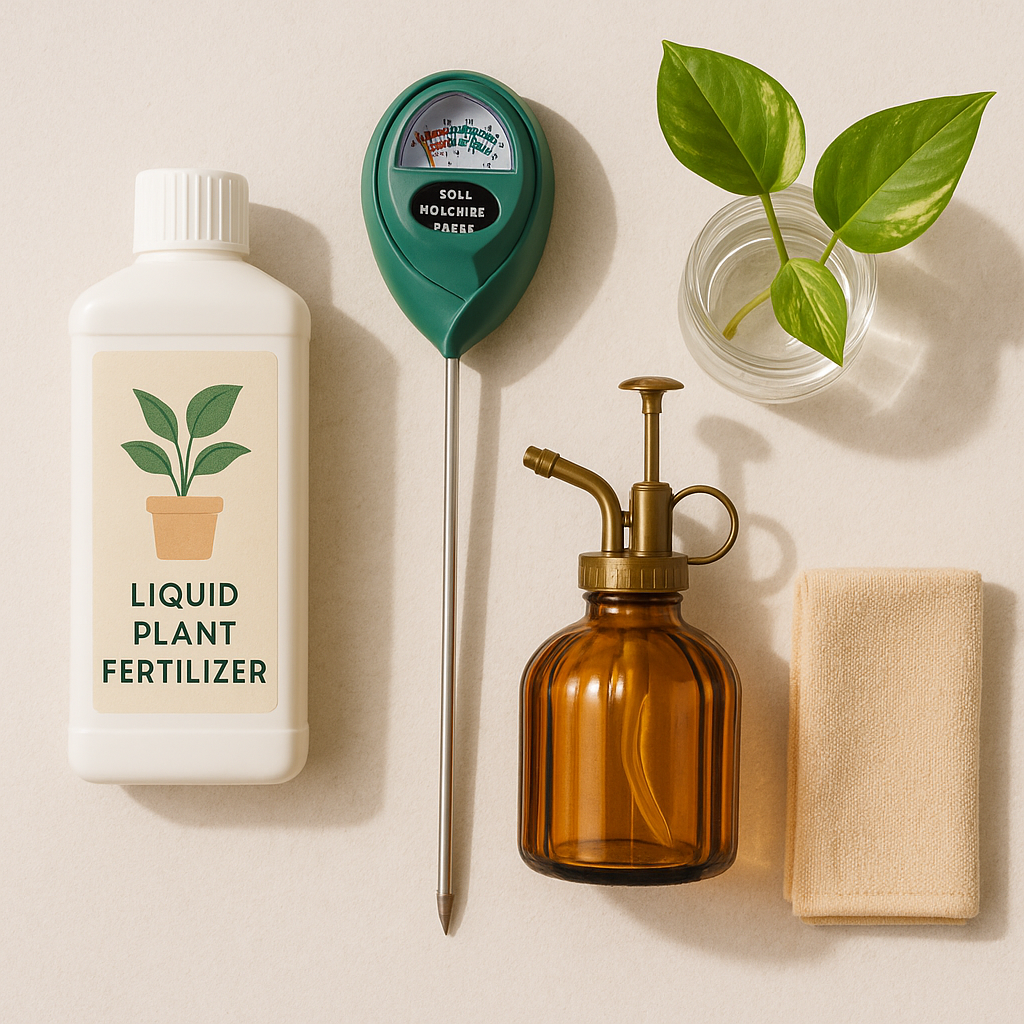
Learn to judge soil by feel: stick your finger 1-2 inches into the soil. If it feels dry, water. If it feels damp, wait. Still unsure? A moisture meter takes the guesswork out — especially useful for plants in tricky spots or people who travel.
Overwatering doesn't mean "too much water at once." It means watering too frequently, before the soil has a chance to dry out. A terracotta pot helps — the porous material lets soil dry faster than plastic.
For a full breakdown, see our watering guide and how often to water indoor plants.
Temperature and Humidity Thresholds
Most tropical houseplants are happiest between 65-80°F (18-27°C). Below 60°F, growth slows noticeably. Below 50°F, many tropicals start dropping leaves or shutting down entirely.
Humidity matters too, especially for tropicals like Monstera, Calathea, and Boston Fern. These plants evolved in humid understories — dry indoor air in winter (when heating runs) can slow their growth and cause brown leaf edges. A pebble tray, humidifier, or clustering plants together helps.
Succulents and cacti couldn't care less about humidity. Snake Plants are basically fine with anything.
5 Quick Wins: Things You Can Do This Week
No special equipment needed. These five tips take under an hour total and measurably boost growth.
Rotate Your Plants Weekly
Plants grow toward light. Rotate your pots a quarter turn each time you water — this keeps growth even instead of lopsided. A plant that's leaning hard into a window is spending energy correcting its posture instead of pushing new leaves.
Clean Dusty Leaves
Dust blocks light from hitting leaf surfaces, which reduces photosynthesis. A damp microfiber cloth wiped over leaves every few weeks does two things: your plant photosynthesizes more efficiently, and your plant looks like you actually care about it.
Check Your Drainage
Is your pot draining? I mean really draining — not just trickling water out the bottom, but water flowing freely. If water sits in a saucer for more than 30 minutes after watering, something is wrong. Either the drainage hole is blocked, the soil is compacted, or the pot is too large for the root ball. Any of those strangles growth.
Move Plants Closer to Windows
Light drops off dramatically with distance from a window. A plant 6 feet from a window receives roughly 25% of the light a plant sitting on the windowsill gets. If growth has stalled and it's spring or summer, try moving the plant closer to your brightest window.
Feed With a Balanced Liquid Fertilizer
This is the tip most people skip — or does wrong. Plants in potting mix run out of nutrients, especially in the active growing season. A balanced liquid fertilizer (something like 10-10-10 or 20-20-20) replenishes what the soil can no longer provide. Miracle-Gro Indoor Plant Food is the accessible option most people start with — apply every 2-4 weeks during spring and summer, and stop entirely in fall and winter when growth naturally slows.
Common mistake: Over-fertilizing. More is not better. Salt buildup from excess fertilizer burns roots and stunts growth. Always dilute to half the recommended strength — your plants will thank you.
For the full NPK rundown, see our fertilizer guide.
Level Up: 5 Advanced Tips for Maximum Growth
You've got the basics handled. Now let's talk about what actually pushes growth when everything else is already dialed in.
Upgrade to a Grow Light
If you're serious about faster growth, a grow light is the highest-ROI upgrade you can make. Natural light in most homes is simply insufficient for maximum growth — especially in fall and winter when days get short. A full-spectrum LED grow light delivers the wavelengths plants need for photosynthesis year-round.
Clip-on LED grow lights are the easiest entry point — they sit on a shelf or table and point at your plant. No installation, no wiring, just plug in and position. View grow lights on Amazon — quality options start around $20.
Look for "full spectrum" or "broad spectrum" LEDs. Skip the cheap purple-blur "grow bulbs" — they waste energy and look terrible in your living room.
See our best grow lights for indoor plants guide for specific recommendations.
Prune to Trigger New Growth
Pruning sounds counterintuitive — you're cutting off plant to get more plant? Yes. Here's why it works: most plants have a dominant growing tip called the apical meristem that produces a growth hormone called auxin. This hormone suppresses growth in the side shoots. Cut off the dominant tip, auxin production drops, and the side buds wake up.
The key: cut just above a node (the point where a leaf meets the stem). That's where the new growth will emerge.
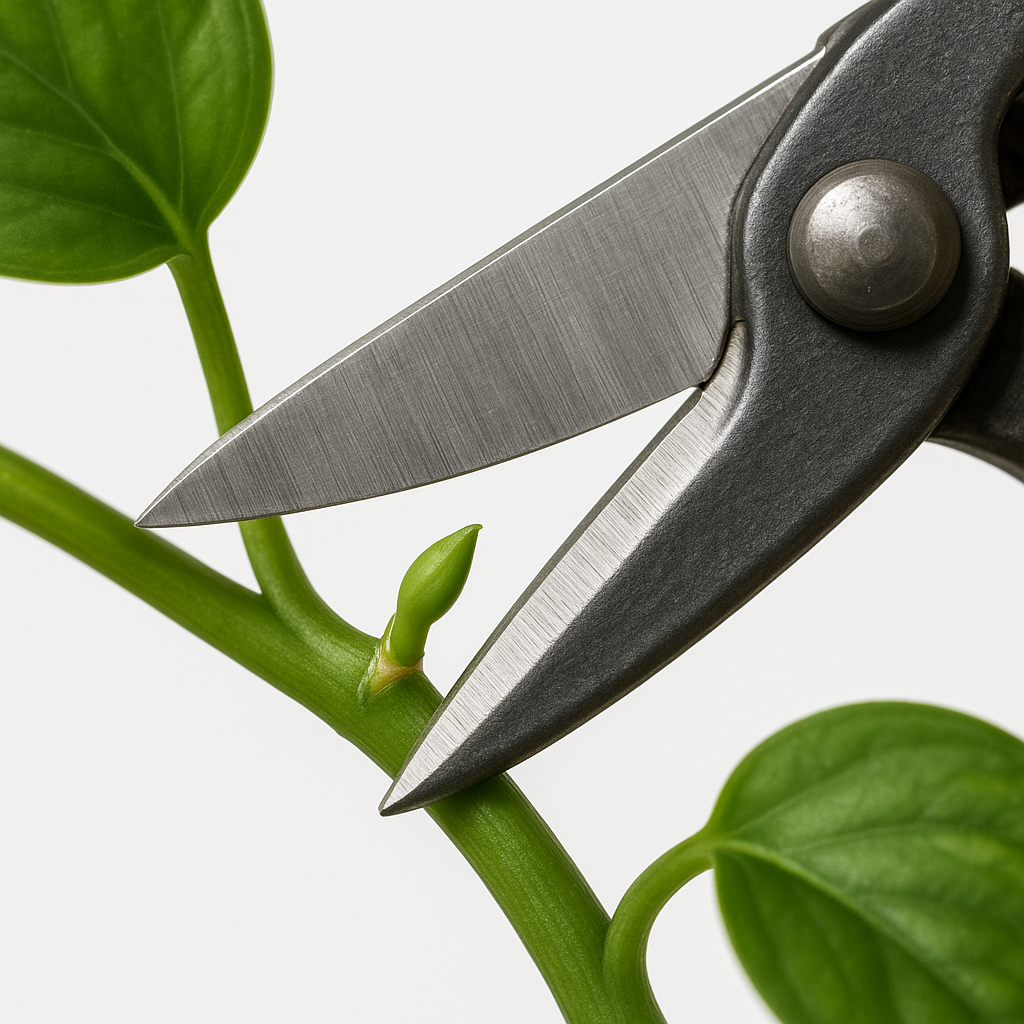
Pruning also keeps vining plants like Pothos and Philodendron from getting leggy and bare at the base. The cuttings you remove can go in water to propagate new plants. See our how to prune houseplants guide for technique details.
Repot Strategically (The Root-Bound Trick)
Here's the counterintuitive tip nobody explains properly: slightly root-bound plants often grow faster than plants in pots that are "just right."
Why? When roots hit the edges of a pot, the plant shifts its energy from "filling the pot with roots" to "pushing new leaves." It's responding to a space constraint by prioritizing above-ground growth. For some plants — especially fast-growing tropicals like Pothos and Monstera — this can actually accelerate leaf production.
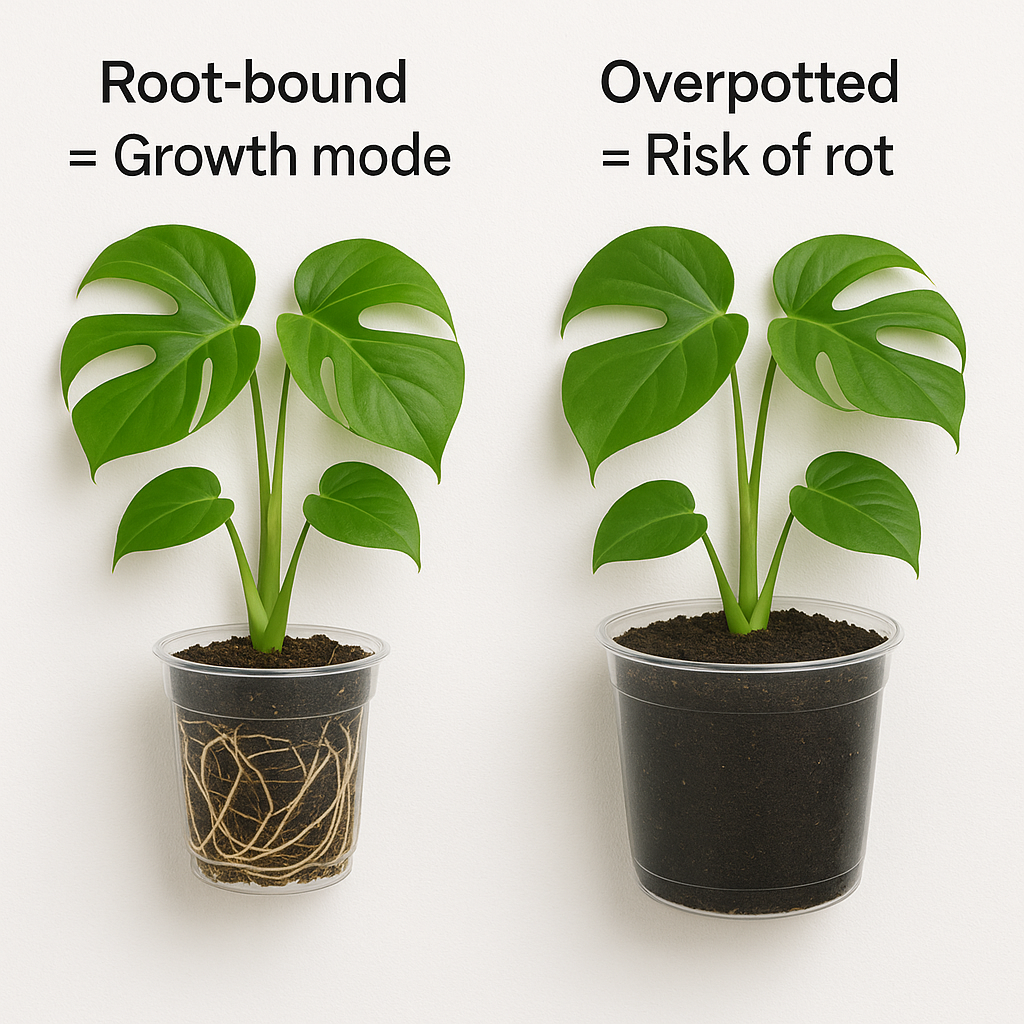
When it works: Trailing climbers and fast-growing tropicals in spring/summer. When it backfires: Slow-growing plants (Snake Plants, ZZ Plants), plants in winter dormancy, or any plant that doesn't like its roots disturbed.
The rule: Only repot when roots are visibly circling the bottom drainage hole, or growing out of the hole itself. And when you do repot, only go up one pot size — 1-2 inches larger in diameter. Jumping to a pot that's too big means the soil stays wet longer, inviting root rot.
See our how to repot houseplants guide for step-by-step instructions.
Add a Moss Pole for Climbing Plants
Monstera, Pothos, Philodendron, and Scindapsus are climbing plants. In the wild, they climb trees toward light. On a moss pole, they mimic this behavior — and the reward is bigger leaves.
When given a structure to climb, these plants activate their latent aerial root systems and redirect energy into producing larger, more deeply fenestrated leaves. A Monstera on a 4-foot moss pole will produce dramatically bigger leaves than the same Monstera trailing on a shelf.
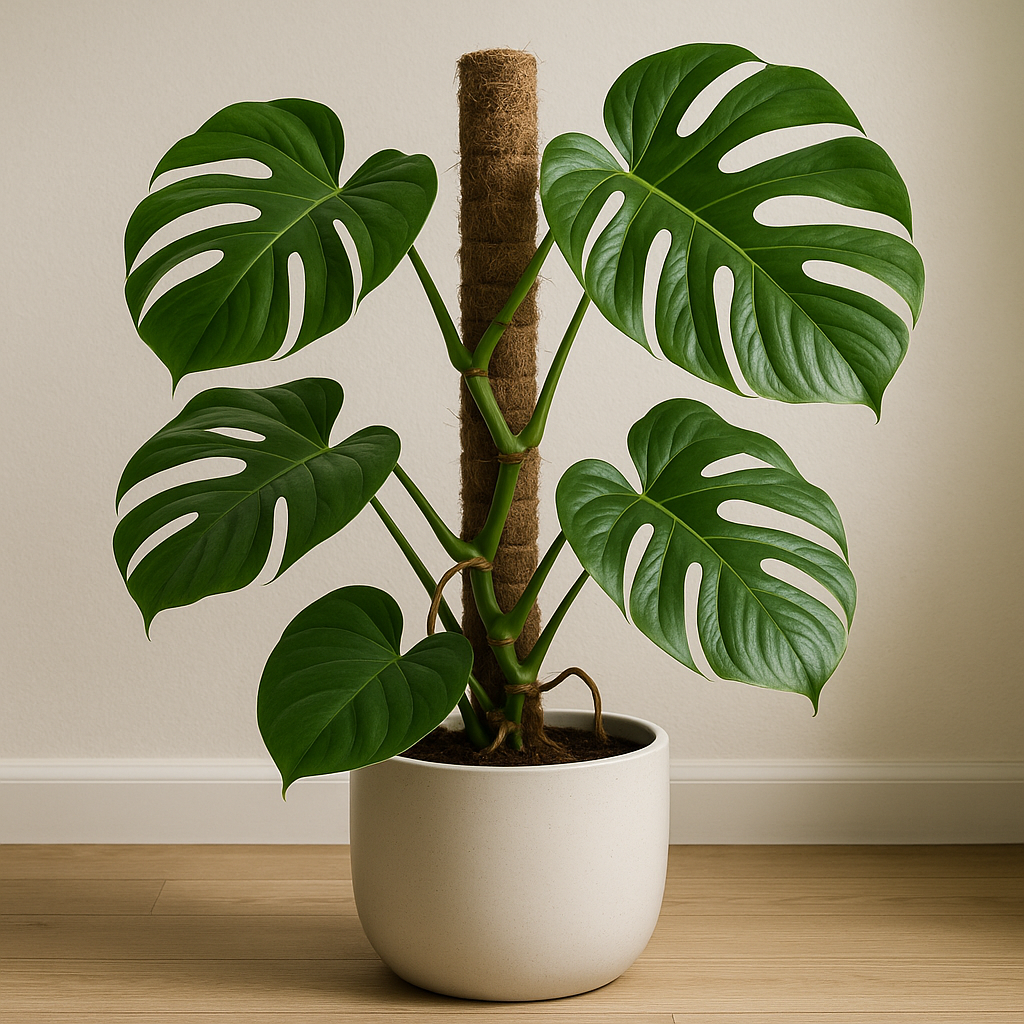
A coco coir moss pole is simple: stick it in the pot, guide or loosely tie the vines to it, and keep it moist (coir dries out faster than soil). See moss poles on Amazon — most are $10-35.
Fine-Tune Your Fertilizer Program
Once you've graduated from basic balanced fertilizer, you can start tailoring your feeding program to your plants' needs.
Nitrogen (N) drives leafy green growth — great for tropical foliage plants in spring. Phosphorus (P) supports root and flower development. Potassium (K) strengthens overall plant health and disease resistance.
Most liquid fertilizers are balanced for a reason — that ratio works well for most houseplants most of the time. But if you want to optimize, a fertilizer higher in nitrogen (like a 3-1-2 ratio) during the active growing season produces lusher foliage. Switch to a balanced or lower-nitrogen formula in fall to ease plants into dormancy.
Watch for salt buildup — a white crust on the soil surface or pot rim means fertilizer is accumulating faster than the plant can use it. Flush the soil thoroughly with plain water, then resume feeding at half strength.
Plant-Specific Growth Cheat Sheet
Here's how to adjust these tips for common houseplants:
| Plant | Light Needs | Watering | Fertilizer | Special Tips |
|---|---|---|---|---|
| Monstera | Bright indirect | Every 1-2 weeks | Monthly in growing season | Moss pole = bigger leaves |
| Pothos | Low to bright indirect | Every 1-2 weeks | Monthly in growing season | Prune to propagate; root-bound speeds growth |
| Snake Plant | Low to bright indirect | Every 3-6 weeks | Once or twice in summer | Slow grower — don't expect miracles |
| Fiddle Leaf Fig | Bright indirect | Weekly | Monthly in growing season | Hates being moved; hates cold drafts |
| Spider Plant | Moderate indirect | Every 1-2 weeks | Monthly in growing season | Produces babies when happy; easy wins |
The Root-Bound Trick: When It Works and When It Backfires
We've touched on this above, but it's worth a dedicated callout because it's genuinely useful — and genuinely dangerous if misapplied.
The trick works for: Fast-growing climbers and tropicals that are clearly signaling "I've outgrown this pot" — roots circling, roots exiting the drainage hole, water running straight through. Spring and summer only.
The trick backfires for: Anything that dislikes root disturbance (Snake Plant, ZZ Plant, most succulents), plants in fall or winter (dormancy = slow root recovery), and any plant that gets moved into a pot that's too large. A pot that's too big holds too much soil moisture relative to the root mass, and you get rot.
If you're not sure whether your plant is ready, err on the side of waiting. A plant that's slightly root-bound but otherwise healthy is better than a plant you've repotted into a pot that's too big and is now struggling with overwatered soil.
Common Mistakes That Stunt Growth (and How to Fix Them)
Over-fertilizing. The most common mistake. More fertilizer does not equal more growth — it equals salt burn and dead roots. Dilute to half strength. In winter, don't fertilize at all.
Coffee grounds. Do not put coffee grounds on your houseplants expecting them to "acidify" the soil or boost growth. In a pot, coffee grounds mat down, compact soil, and create anaerobic conditions. They can also cause fungal issues. Compost them first, or skip them entirely for indoor plants.
Wrong pot size. Oversized pots are the root-rot express. The plant's roots can't consume water fast enough to keep the soil from staying soggy, and the plant slowly drowns.
Ignoring seasonal dormancy. Plants slow down in fall and winter. They're not dying — they're resting. Don't interpret low winter growth as a problem to solve by adding more fertilizer or water. That usually kills them.
Moving plants around too much. Plants adapt to their light environment over time. If you move a plant from a low-light spot to a bright window in the middle of winter, the sudden shift can stress it. Acclimate gradually.
FAQ: Your Growth Questions Answered
Why is my plant not growing? Most common reasons: insufficient light, overwatering (root stress), under-fertilizing in the growing season, or seasonal dormancy. Check light first — it's almost always the bottleneck.
How long does it take for houseplants to grow? Most tropical houseplants produce 1-3 new leaves per month in spring and summer. Some fast growers (Pothos, Monstera) can push 4-6. In winter, growth essentially stops for most tropicals. If you're not seeing new growth in peak season, something is constraining it.
How to make plants grow faster in winter? Honestly? You mostly can't — and shouldn't try. Plants need dormancy. You can run a grow light to supplement the shorter days, but don't push fertilizer or increase watering. The plant won't use it and you'll cause root stress.
Do grow lights help plants grow faster? Yes, if natural light is the limiting factor. If your plant is already in a bright window and still not growing, light isn't the problem. But for most people in apartments with limited natural light, a grow light is the single most impactful upgrade you can make.
Should I fertilize my plants in winter? No. Most houseplants enter a semi-dormant state in fall and winter as light levels drop. They can't use the extra nutrients, and excess fertilizer accumulates as salt in the soil. Resume feeding in early spring when you see new growth starting.
Products We Love
These are the tools and products we actually use and recommend:
- Dyna-Gro Foliage-Pro — our go-to premium liquid fertilizer for foliage plants. Clean formula, no odor, mixes easily. Higher quality than most consumer brands.
- Shop Fertilizers on Amazon — browse our full fertilizer recommendations including Miracle-Gro alternatives.
We earn a commission from qualifying purchases at no extra cost to you.
Want plants that don't demand constant attention? Check out our easiest houseplants guide for low-maintenance options that thrive on neglect.