ZZ Plant Care Guide — Light, Water, Propagation & Troubleshooting
The plant that survives neglect like it's a sport
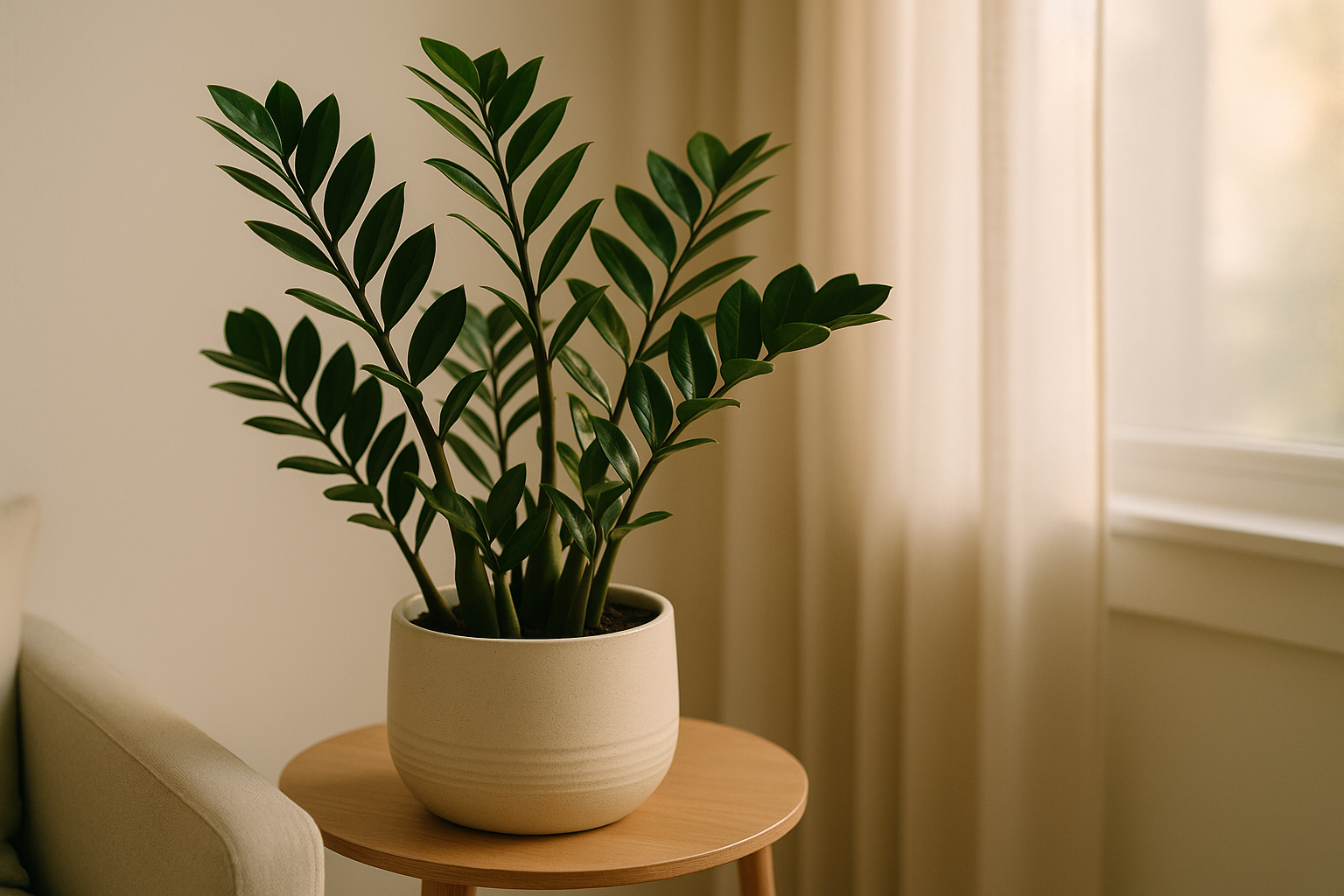
Quick ZZ Plant Facts
| Botanical Name | Zamioculcas zamiifolia |
| Toxicity | Toxic to cats, dogs, and humans if ingested. Skin irritant. Keep away from kids and pets. |
| Difficulty | Beginner-friendly, nearly impossible to kill |
| Light | Low to bright indirect; survives dim corners |
| Water | Every 2-3 weeks (summer), monthly (winter) |
Light Requirements — Low Light Is Enough (But Not No Light)
Here's the thing about ZZ plants: they'll survive in that dim corner you've been using as an excuse not to buy a lamp. They're native to Eastern Africa, where they grew under forest canopies. They've adapted to handle low light.
But — and this is important — low light means "survive," not "thrive."
If you want your ZZ plant to actually grow, produce new stalks, and look genuinely happy instead of just "alive and boring," give it bright indirect light. Think: next to an east- or west-facing window, filtered through sheer curtains. A north-facing window works too, just slower growth.
What Counts as Low Light?
- 3-4+ feet from a sunny window
- North-facing rooms with no direct sun
- Interior offices with ambient fluorescent lighting
- That corner in your living room where nothing else will grow
Will My ZZ Plant Thrive in a Windowless Room?
Honest answer: no. It will survive (barely) for a while, but it won't produce new growth. The stalks may get leggy, reaching toward whatever light source exists.
If you have no natural light at all, get a grow light. A basic LED strip panel on a timer for 8-10 hours a day will keep a ZZ plant looking good. It's not optional for windowless rooms — it's the bare minimum.
Watering Schedule — The "When in Doubt, Wait" Rule
Here's where people kill ZZ plants: they overwater them. ZZ plants have rhizomes — underground storage organs that hold water and nutrients. They're built for drought. Give them too much water and those rhizomes rot.
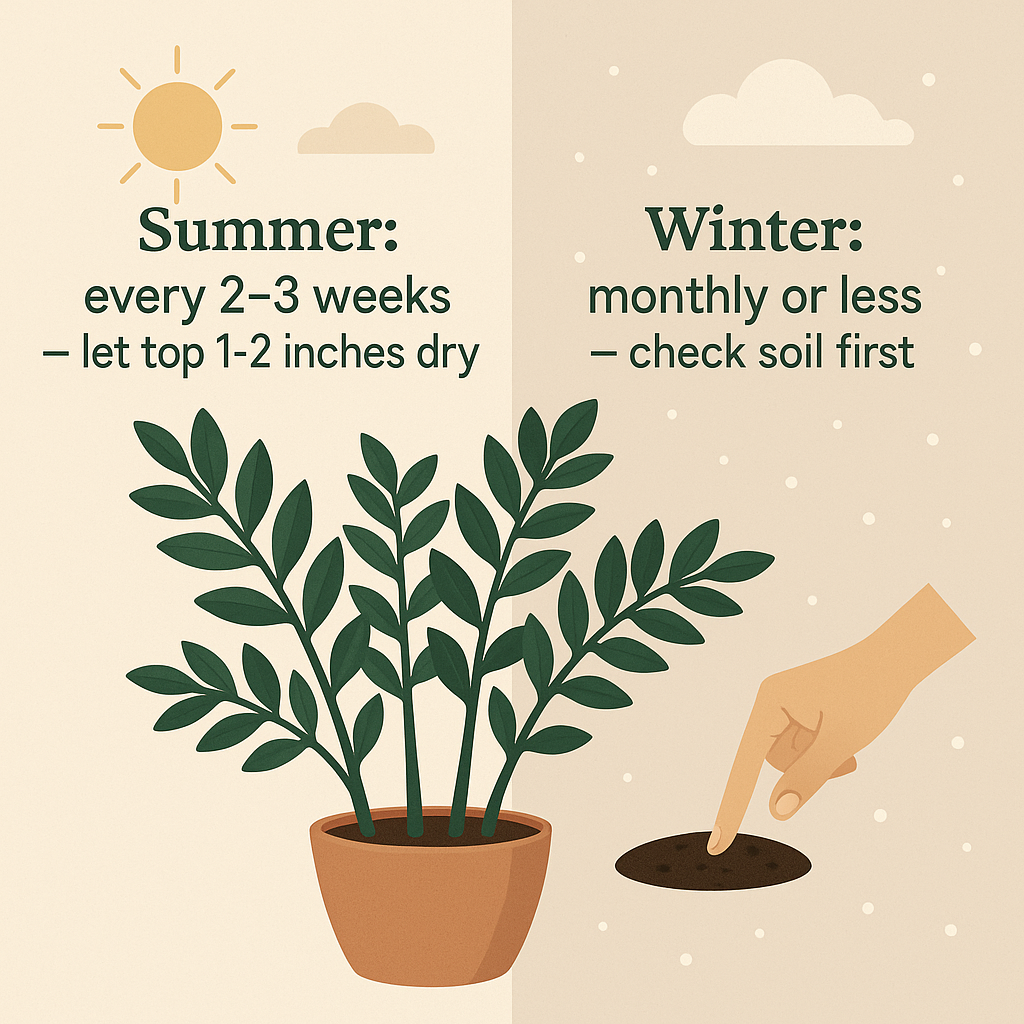
The rule: water when the top 1-2 inches of soil are completely dry. Not "mostly dry." Not "slightly damp." Dry.
Seasonal Watering Schedule
| Season | Frequency | Notes |
|---|---|---|
| Summer (growing) | Every 2-3 weeks | Check soil first. If damp, wait. |
| Winter (dormant) | Monthly or less | ZZ slows down. Overwatering is the #1 killer in winter. |
| Low light conditions | Wait longer | Less light = slower drying = water less |
Signs of Overwatering
- Yellow leaves (the classic sign — whole leaf turns yellow, not just edges)
- Mushy stems at the base — this is root rot territory
- Musty smell from the soil
- Soil staying wet for weeks after watering
Signs of Underwatering
- Drooping stalks — they'll perk back up within hours of watering
- Crispy leaf edges or brown tips
- Soil pulling away from pot edges
- Lightweight pot when you pick it up
Why Is My ZZ Plant Drooping But Soil Is Dry?
This is almost always underwatering. Give it a thorough drink: water until it drains from the bottom, then stop. It should perk up within 24 hours.
If the soil is wet and it's drooping — that's root rot. Unpot, check the roots, and follow our root rot treatment guide.
Soil & Potting — Drainage Is Everything
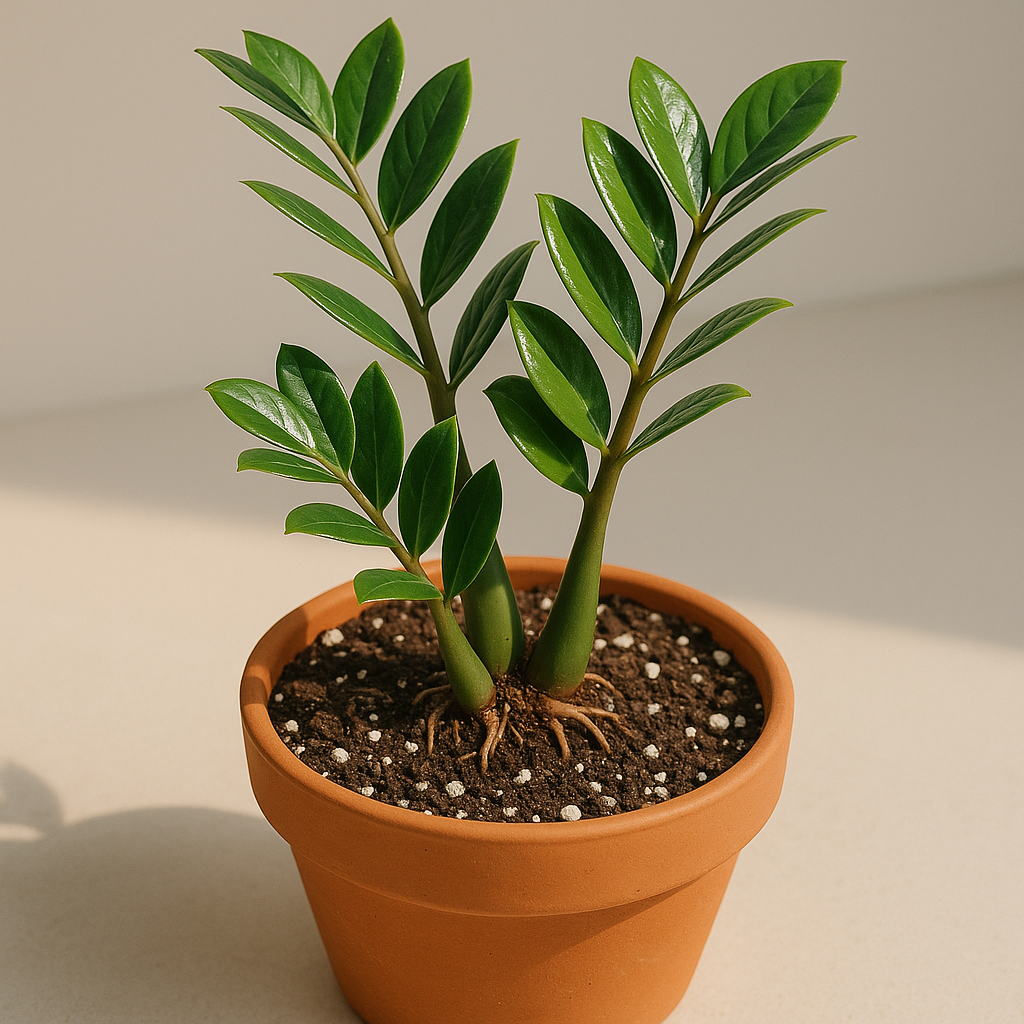
ZZ plants need fast-draining soil. Plain potting mix holds too much water. You want something that drains quickly and dries relatively fast.
The fix: cactus and succulent mix, or a regular potting mix amended with perlite (about 30-50% perlite). This well-reviewed cactus and succulent mix works well for ZZ plants.
Best Pot for ZZ Plants
Terra cotta is ideal. It's porous, which means the soil dries out faster. ZZ plants actually like being slightly root-bound, so don't size up too aggressively when repotting.
Plastic or ceramic: Will work, but be more careful with watering — they retain moisture longer. Always ensure there's a drainage hole. Always.
No drainage hole: Don't do it. Not for a ZZ plant. That's a rot-inducing trap.
Temperature & Humidity
ZZ plants are unbothered by normal household conditions:
- Temperature: 65-75°F (18-24°C). Below 50°F, they're not happy.
- Humidity: Average household humidity is fine. No need to mist.
- Cold sensitivity: Keep them away from drafty doors, cold windows, and air conditioning vents in winter.
If you're comfortable, your ZZ plant is comfortable.
Fertilizer — Go Easy
ZZ plants aren't heavy feeders. Over-fertilizing causes salt buildup and crispy leaf tips — exactly what you're trying to avoid.
Feed during the growing season (spring and summer) only, at half the strength recommended on the label. Once a month is plenty. Use a balanced liquid houseplant fertilizer — a balanced liquid houseplant fertilizer like Dyna-Gro Grow works well for this.
Skip the fertilizer entirely in fall and winter. Let them rest.
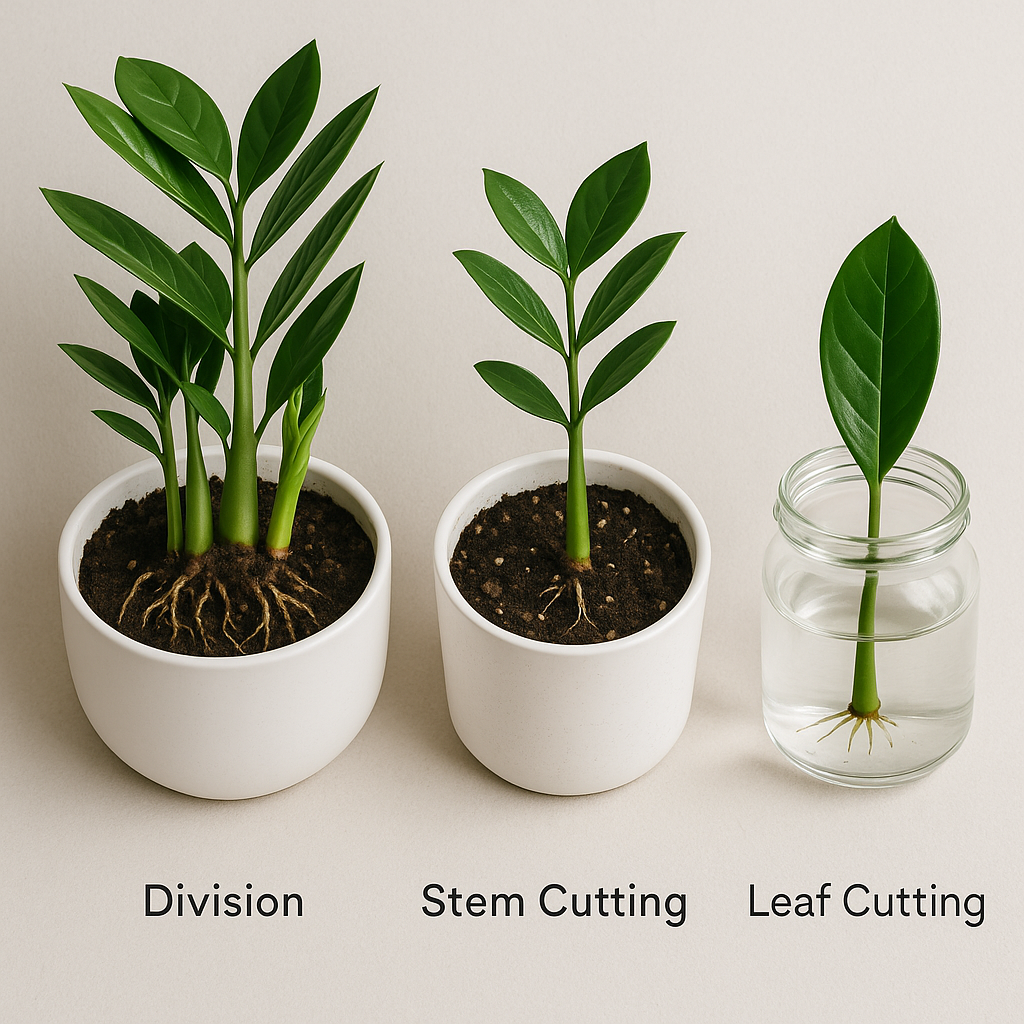
ZZ Plant Propagation — 3 Methods Compared
Here's where most guides let you down: they don't give you honest timelines. ZZ plant propagation is slow. Not "kinda slow" — slow. Let's be real about that upfront.
Division — The Fastest Method
This is the best method if your ZZ plant is mature and has multiple stalks.
Time to established plant: ~3 months
How to do it:
- Remove the plant from its pot
- Gently separate the root ball into sections — each section should have 2-3 stalks and a portion of the rhizome
- Pot each division in fresh, well-draining soil
- Water lightly, let it drain, then leave it alone
Division sounds simple because it is. The plant is already established; it just needs to settle into its new pot.
Stem Cuttings
Cut a single stalk at the base, let the cut end callus for a few hours, then plant it in moist (not wet) soil. Keep it humid. Wait.
Time to roots: 4-6 weeks
Time to a full plant: 9-12 months
Yes, that's a year. Don't give up on it. Keep the soil lightly moist and be patient.
Leaf Cuttings
The slowest method, but the one that gives you the most plants.
Cut a single leaf (with a bit of stalk if possible), let it callus, then place in water or soil. a soil moisture meter helps track when the cutting medium is appropriately moist without being soggy.
Time to roots: 2-3 months
Time to a full plant: 6-12 months
Honest timeline warning: Leaf cuttings can sit there looking dead for months before anything happens. Don't toss them. As long as the leaf is firm and green, it's working. Eventually a tiny rhizome forms, then roots, then a new stalk.
ZZ Plant Repotting — When and How
ZZ plants like being root-bound. Don't rush to repot.
When to repot:
- Roots are growing out of the drainage hole
- The pot is bulging (rhizomes pushing against the sides)
- The plant is top-heavy and tipping
- It hasn't been repotted in 2+ years
How to repot:
- Go up one pot size (or don't — they like being tight)
- Use fast-draining soil
- Don't bury the rhizomes — they should sit just below the soil surface
- Water once, then wait. They don't like wet feet after repotting.
Check out our step-by-step repotting guide for more details on the process.
ZZ Plant Troubleshooting — What's Going Wrong?
ZZ plants are tough, but they're not invincible. Here's a decision tree for the most common problems:
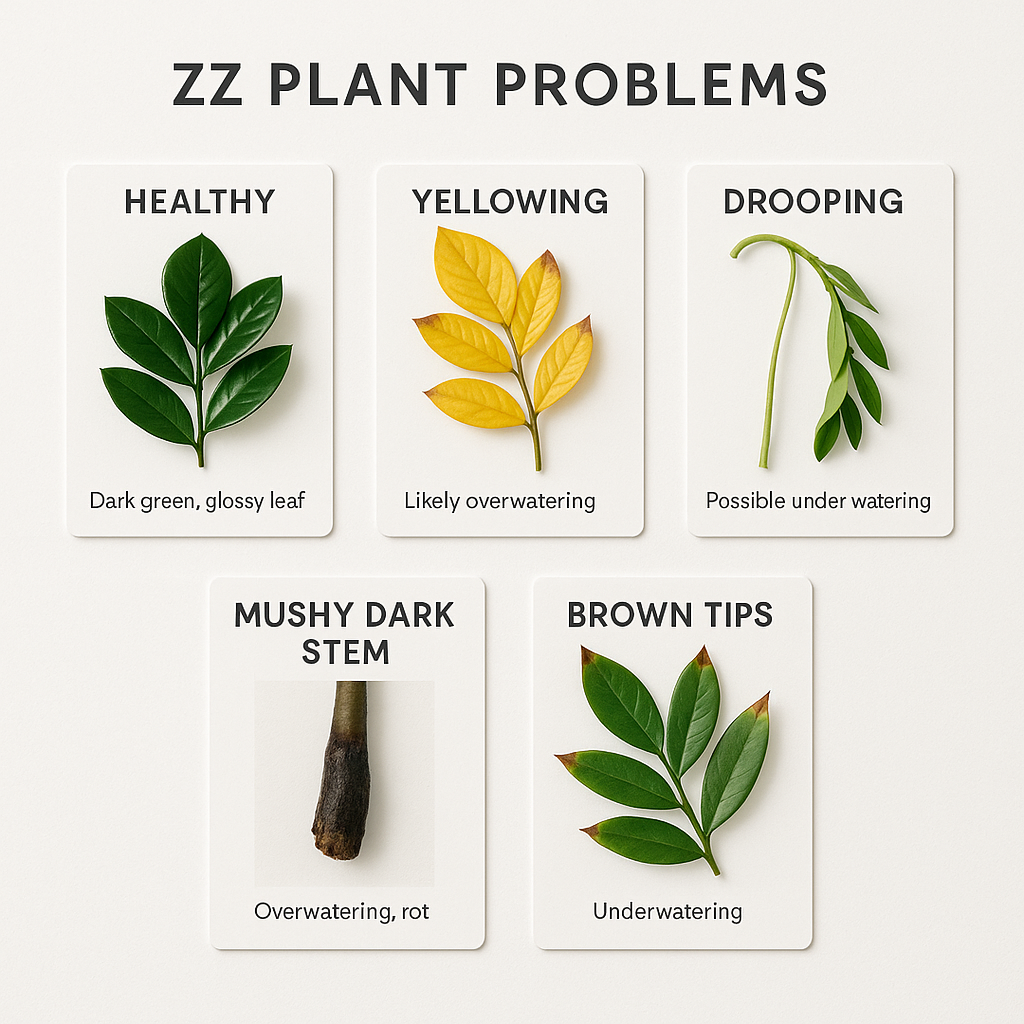
Yellow Leaves
Cause: Almost always overwatering.
Check the soil. Is it wet two weeks after you watered? That's your culprit.
What to do:
- Stop watering immediately
- Let the soil dry out completely
- If the plant is still in wet soil after 3+ weeks, unpot it, check for root rot, and repot in fresh dry soil
ZZ Plant Not Growing
Normal or not? Here's how to tell.
ZZ plants are slow growers even in good conditions. A few new stalks a year is normal. If you're getting zero new growth for 6+ months, something's off.
Check these:
- Light: Too little light slows growth to a crawl. Try brighter indirect light.
- Water: Are you watering too much? Overwatered ZZ plants stall out.
- Season: ZZ plants slow down in winter. If it's been cold, wait until spring.
- Root-bound: If it's been years in the same pot, it might need more room.
If the plant looks healthy otherwise (good color, firm stalks), it's probably fine. Just be patient.
Brown Tips
Usually one of three causes:
- Underwatering — infrequent watering, letting the soil go bone-dry between waterings
- Low humidity — not common for ZZ, but dry indoor heat in winter can cause this
- Fertilizer burn — too much fertilizer causes salt buildup; flush the soil or repot
Soft or Mushy Stems / Root Rot
This is an emergency. Mushy stems mean root rot has set in. You need to act fast.
- Remove the plant from its pot
- Rinse off the soil
- Cut away all soft, brown, mushy roots
- Let the plant dry out for several hours
- Repot in fresh, dry, fast-draining soil
- Water sparingly for the first few weeks
Our root rot treatment guide has detailed steps with photos.
Common ZZ Plant Myths
Myth 1: "ZZ plants need no water"
Wrong. They need less water than most plants, but they still need water. The rhizomes store some, but not forever. A completely neglected ZZ plant will eventually yellow and decline.
Myth 2: "ZZ plants grow in complete darkness"
Partially true — they survive. They don't grow. In low light, they'll maintain but not produce new stalks. For actual growth, give them some indirect light.
Myth 3: "ZZ plants are succulents"
Sort of, but not really. They have succulent-like water storage (the rhizomes), but they need more water than true succulents. Treat them like tropical plants that happen to be drought-tolerant.
ZZ Plant Toxicity — Safe Handling
Important: ZZ plants are toxic to cats, dogs, and humans if ingested.
All parts of the plant contain calcium oxalate crystals, which cause irritation, pain, and swelling if chewed or swallowed. The sap can also cause skin irritation.
Safe handling:
- Wash your hands after handling (or wear gloves)
- Keep out of reach of pets and small children
- If ingested, contact poison control or your vet immediately
For more information: ASPCA — ZZ Plant (Zamioculcas zamiifolia)
FAQ
How often should I water my ZZ plant? Every 2-3 weeks in summer, monthly in winter — but always check the soil first. Water only when the top 1-2 inches are dry.
Why is my ZZ plant turning yellow? Yellowing leaves usually mean overwatering. Let the soil dry out completely before watering again. Check for root rot if the soil stays wet.
How do I propagate a ZZ plant? Division is fastest (3 months to established plant). Stem cuttings take 9-12 months. Leaf cuttings take 6-12 months. All three work — it just depends on how patient you are.
Can ZZ plants grow in low light? Yes — they survive in low light. But they'll grow faster and look better in bright indirect light.
Why is my ZZ plant not growing? ZZ plants are naturally slow growers. If you're seeing zero new growth for 6+ months, check light levels, watering habits, and whether it's root-bound.
Is ZZ plant toxic to pets? Yes. It's toxic to cats, dogs, and humans if ingested. Keep it out of reach.
Looking for general watering principles? Our watering guide covers how to check soil moisture and avoid overwatering.
Products We Recommend
We use these products ourselves: