Prayer Plant Care Guide: Fix Crispy Leaves on Maranta
Prayer plants are gorgeous. Prayer plants are dramatic. Prayer plants will ruin your vibes with crispy leaf edges if you so much as look at them wrong.

What Is a Prayer Plant? (Maranta leuconeura)
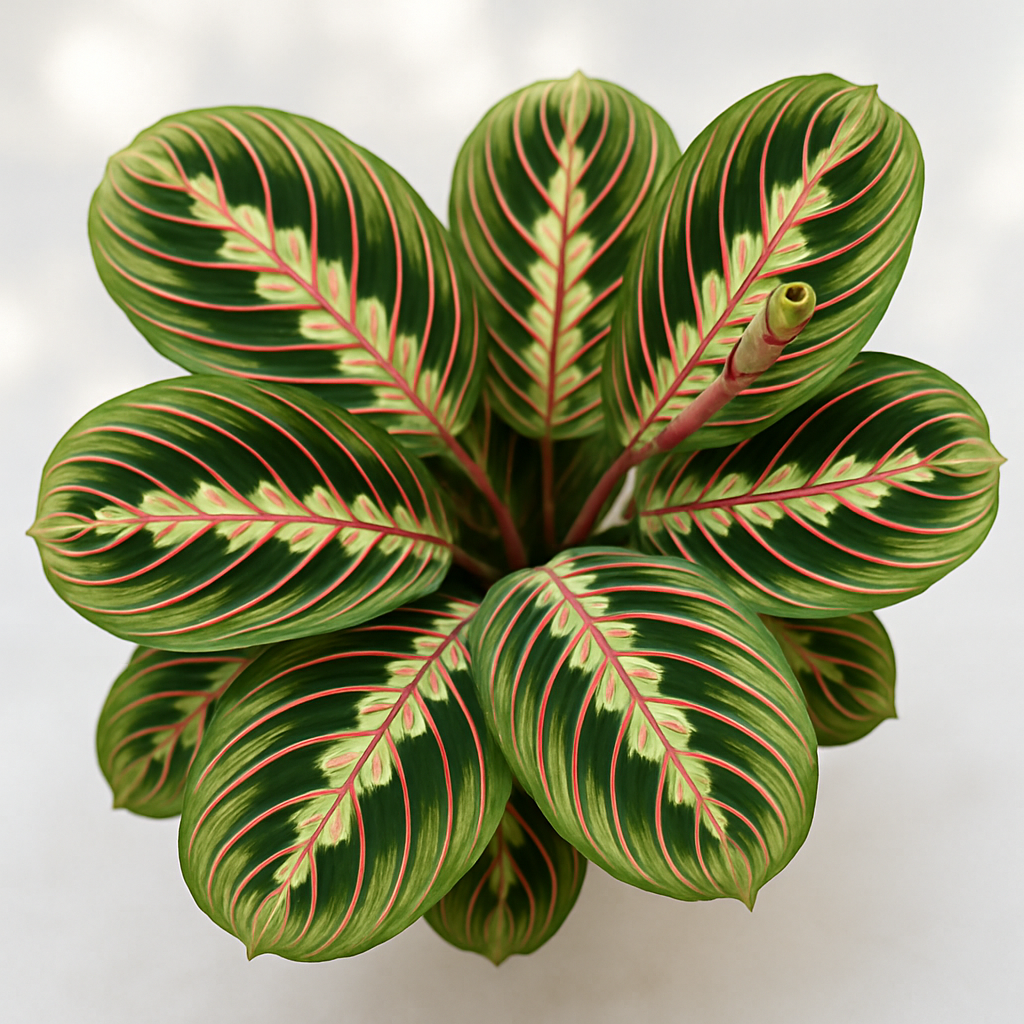
Let's get the basics straight: a "prayer plant" is a Maranta leuconeura. The most common variety you'll find at nurseries is the Red Prayer Plant (Maranta leuconeura 'Erythroneura') — dark green leaves with bright red herringbone veining. There's also the Green Prayer Plant (Maranta leuconeura var. leuconeura) and the so-called Rabbit's Foot (which is actually a Maranta species too).
Quick note on the Calathea confusion: Prayer plants and Calatheas are close cousins in the Marantaceae family, and they look similar enough to cause mix-ups. Both have patterned leaves, both fold up at night. But Calatheas are generally divas — more humidity, more specific water needs. Marantas are the slightly more forgiving sibling. If someone told you to treat your prayer plant like a Calathea and it's still struggling, this article is for you.
Why Prayer Plants Fold Their Leaves at Night
This is the thing that makes prayer plants genuinely special.
At night, prayer plant leaves fold upward into that characteristic "praying" position. Botanists call this nyctinasty — a light-responsive movement driven by specialized hinge-like cells at the base of each leaf. The plant is responding to the drop in light (and subsequent drop in photosynthesis) by closing up shop.
The practical effect: the leaf undersides — which lose moisture faster — are hidden from the air. It's a built-in moisture-conservation trick. Some people think it's magical. Others think it's creepy. Either way, if your prayer plant isn't doing this at night, something is off.
The 5 Main Causes of Crispy Leaves on Prayer Plants
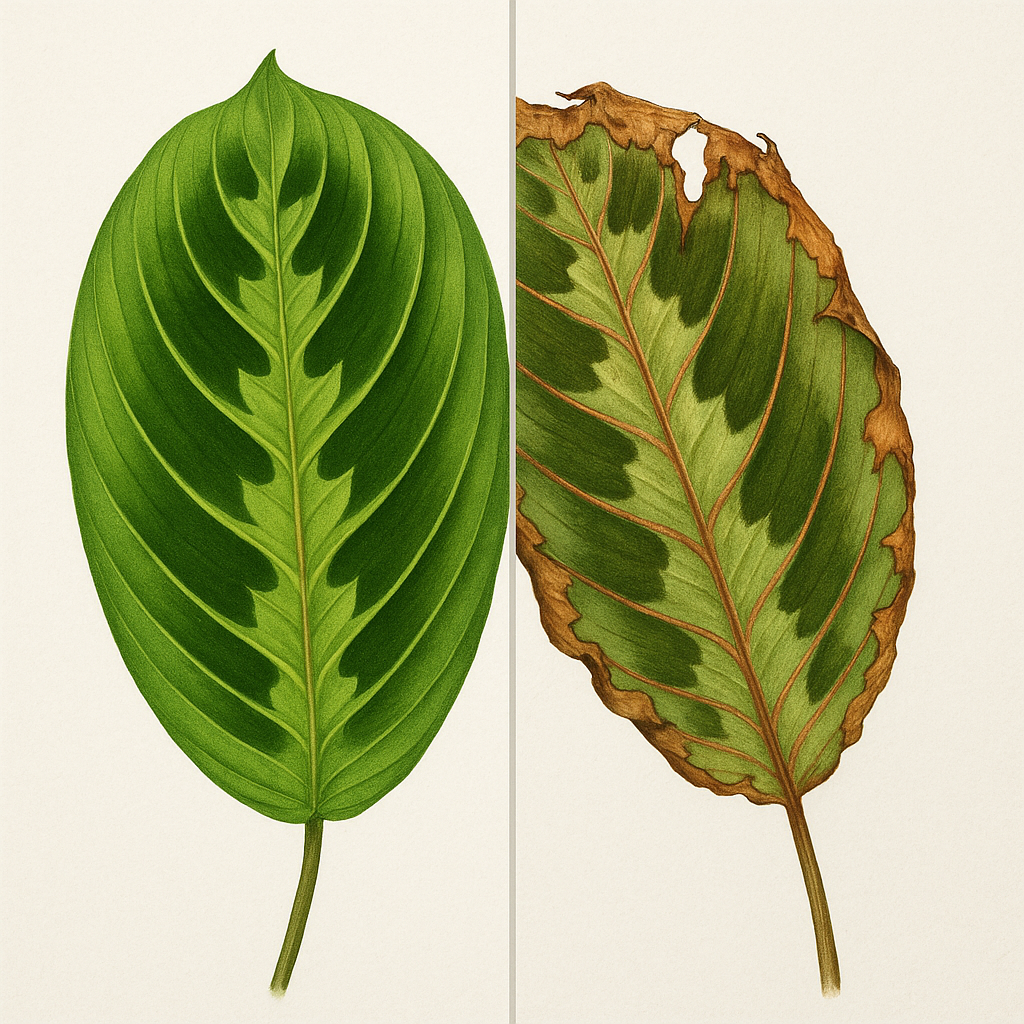
Prayer plant crispy edges are almost always environmental. These are the usual suspects, ranked by how often they show up:
- Low Humidity — the most common cause, and the most likely if only the edges are brown
- Tap Water Chemicals — chlorine and fluoride build up at leaf tips and cause browning
- Inconsistent Watering — letting the soil go bone-dry between waterings stresses roots
- Underwatering — the plant literally doesn't have enough water to push moisture to leaf edges
- Temperature Stress — cold drafts or proximity to heating/cooling vents
A quick way to tell what's happening: where the brown is.
| Location of Brown | Most Likely Cause |
|---|---|
| Leaf edges only | Low humidity or tap water chemicals |
| Whole leaf including veins | Underwatering or root stress |
| Tips only (like a crispy tip) | Tap water chemicals |
| Brown spots + yellow halos | Possible fungal, check for overwatering |
Low Humidity (Most Common Cause)
Prayer plants want 50-60% relative humidity minimum, and they'd genuinely prefer 65%+. Your average home in winter (or summer with AC running) might sit at 30-40%. That's a massive gap.
The crispy edges appear because the plant is losing moisture faster through its leaves than it can take up through its roots. The leaf edges — furthest from the water supply — are the first casualties.
Solutions ranked by effectiveness:
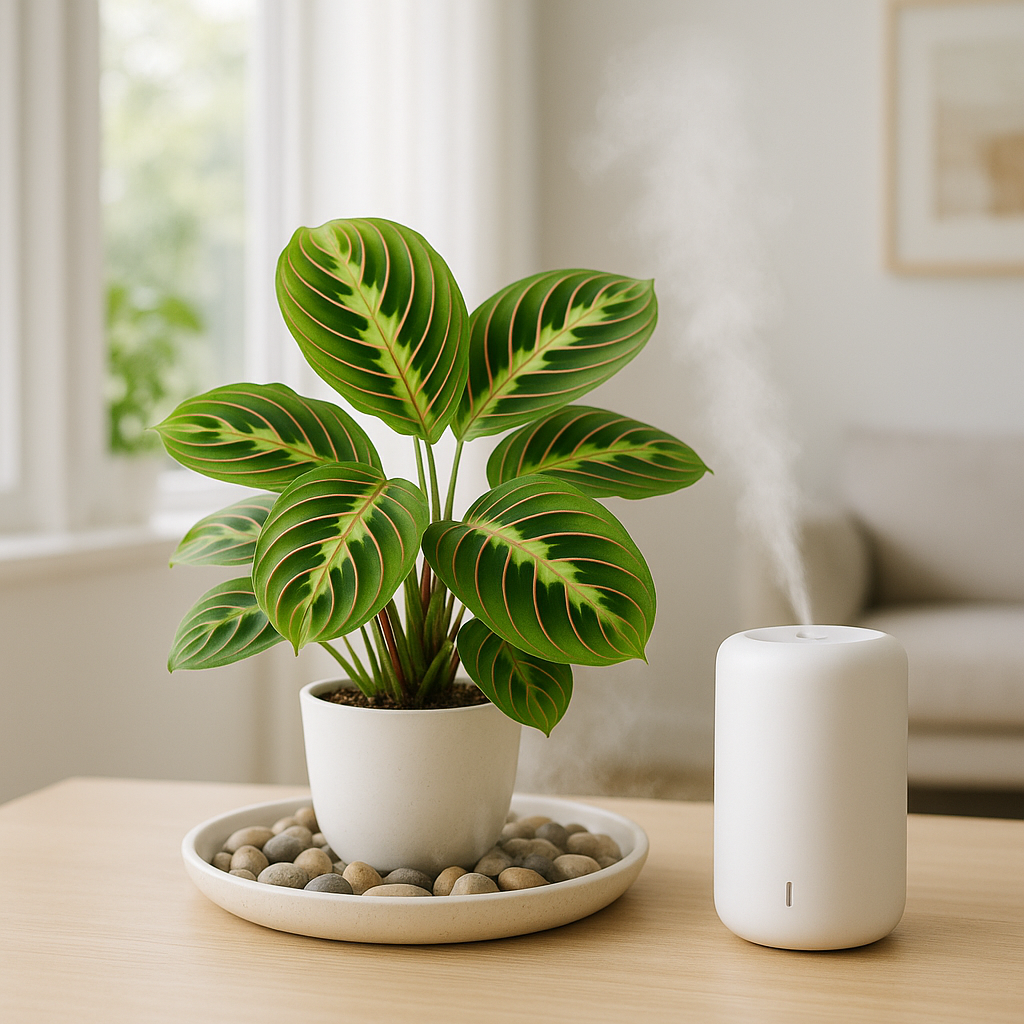
- Humidifier — the gold standard. A small humidifier near the plant can maintain 50-60% consistently. Shop LEVOIT Humidifiers on Amazon
- Pebble tray — place your pot on a tray of pebbles with water sitting just below the pot's base. Evaporation creates localized humidity. It's not as effective as a humidifier but it's cheap and passive.
- Grouping plants together — they transpire, which raises humidity in their immediate vicinity. A cluster of plants creates a little humidity microclimate.
- Bathroom placement — works IF you have good light. Bathrooms are naturally more humid. Don't try this unless the windowless-bathroom rule applies.
Tap Water Chemicals
This one sneaks up on people. Prayer plants are sensitive to chlorine, fluoride, and dissolved salts that come through tap water. These accumulate at the leaf tips (which is why you get that crispy tip effect) and in the soil over time.
The fix is either:
- Switch to distilled or rainwater — cheapest and most effective long-term
- Let tap water sit out overnight — chlorine dissipates, but fluoride remains
- Use a TDS meter — dissolved solids (ppm) above 100-150 can cause issues for sensitive plants. Shop Distilled Water for Plants on Amazon
Inconsistent Watering
Prayer plants are creatures of habit. They want to know when their next drink is coming. If you water deeply one week and forget for three weeks, the roots are stressed and can't deliver water consistently to the leaves.
Shop XLUX Moisture Meters on Amazon
The fix: establish a consistent schedule. Check the soil every 3-4 days. Water when the top inch is dry. Don't water on a rigid calendar — let the soil tell you. A moisture meter takes the guesswork out entirely.
Quick Diagnosis Decision Tree
Answer three questions to find your specific cause:
Question 1: Where is the brown located?
- Edges only → humidity OR tap water (→ go to Q2)
- Whole leaf → underwatering OR root issues (→ go to Q3)
Question 2: Do you water with tap water directly?
- Yes → tap water chemicals likely primary cause
- No → humidity is almost certainly the culprit
Question 3: Does the soil stay wet for more than 10 days after watering?
- Yes → possible overwatering/root issues
- No → standard underwatering, increase frequency
How to Fix Crispy Edges on Your Prayer Plant
Fixing Low Humidity
Set up your humidifier and run it consistently — not just when you remember. Prayer plants need sustained humidity, not occasional boosts. You want to maintain 50-60% relative humidity in the room where the plant lives.
Expected timeline: You'll see improvement in new leaf growth within 2-4 weeks. Existing crispy edges won't heal — that's dead tissue. But new leaves will come in clean.
Fixing Tap Water Issues
Switch to distilled water and flush the soil with it a few times to leach out accumulated salts. If you're using a moisture meter, now's a good time to measure your tap water's TDS — if it's above 100-150 ppm, the water is likely contributing to your crispy edge problem.
Expected timeline: Same as humidity. New growth in 2-4 weeks. Existing damage is permanent.
Fixing Inconsistent Watering
Set a recurring reminder to check your prayer plant's soil every 3-4 days. Water thoroughly — until it drains from the bottom — and then don't water again until the top inch is dry.
Expected timeline: 2-3 weeks for root system to stabilize. New leaves will show the difference.
Can Prayer Plants Recover from Crispy Leaves?
Here's the honest answer: the damaged tissue will never heal. Those brown crispy cells are dead. The plant won't regenerate them.
BUT — the plant itself absolutely recovers and produces healthy new growth once you fix the underlying issue. The key is that you need to be patient and look at the new leaves, not the old ones.
When is trimming appropriate? When the crispy edges bother you aesthetically. Use clean, sharp scissors and trim just the brown part — follow the natural curve of the leaf. Don't take healthy green tissue.
Prevention Protocol: Keep Crispy Edges from Coming Back
The fix is only half the battle. Here's what to do ongoing so crispy edges don't return:
- Keep the humidifier running — especially in winter and summer when AC/dehumidifiers dry the air
- Switch to distilled or filtered water permanently if your tap water is hard or heavily chlorinated
- Check soil moisture consistently — a moisture meter makes this habit effortless
- Avoid placing near heating/cooling vents — temperature fluctuations cause stress
- Flush soil monthly — water thoroughly until it drains, then water again. This leaches salt buildup
The one thing people consistently miss: consistency. Prayer plants aren't high-maintenance, but they are routine-dependent. Set up your setup and then stop fussing with it.
Prayer Plant Care Basics: The Full Picture
Best Soil Mix for Prayer Plants
Prayer plants want moisture-retentive but well-draining soil. Think: chunky enough that it doesn't compact, but rich enough to hold some moisture.
DIY mix:
- 2 parts peat moss or coco coir
- 1 part perlite
- 1 part quality potting soil
- Optional: a handful of orchid bark for extra drainage
If you buy a pre-mixed aroid or tropical blend, that works too. Just make sure it drains — prayer plants hate sitting in soggy soil.
How Often to Water Prayer Plants
Typically every 5-7 days, but this is completely dependent on your home's conditions. The real answer: water when the top inch of soil is dry. Use your finger or a moisture meter. Don't water on a schedule — let the plant tell you.
Light Requirements
Prayer plants want bright, indirect light. Direct sun will scorch them and cause the leaves to fade or burn. North or east-facing windows are ideal. They tolerate low light better than most people expect — but they'll grow faster and look better with more indirect brightness.
Avoid: south or west-facing windows without a sheer curtain, hot afternoon sun.
Temperature Needs
65-80°F / 18-27°C is the sweet spot. Prayer plants are flexible here — standard home temps usually work fine. The deal-breaker is cold drafts: keep them away from exterior doors, poorly sealed windows in winter, and air conditioning vents that blow cold air.
Fertilizer Schedule
Feed monthly during the growing season (spring through summer) with a diluted balanced liquid fertilizer (10-10-10 or similar). Cut back to every 6-8 weeks in fall and winter when growth slows. Don't fertilize a struggling plant — feed it only when it's actively growing.
How to Trim Crispy Edges Without Ruining the Look
This is the part other articles skip.
The right way to trim:
- Wait until the plant has 2-3 new healthy leaves — you want to make sure the underlying issue is actually fixed before you start cutting
- Use clean, sharp scissors or micro-tip pruners
- Follow the leaf's natural margin — trim just into the brown, following the curve
- Don't leave a raw edge — smooth it slightly inside the brown border
- Angle cuts to maintain the leaf's natural pointed or oval shape
What not to do: Don't square off leaf edges. Prayer plant leaves are organic and curved — a blunt cutoff looks worse than the crispy edge did.
When to remove a whole leaf: If the entire leaf is more than 50% brown, just cut it at the base where it meets the stem. A partially damaged leaf is fine to leave — it still photosynthesizes — but if it's mostly dead, remove it so the plant puts energy into new growth.
Prayer Plant Varieties to Know
Red Prayer Plant (Maranta leuconeura 'Erythroneura')
The most common and arguably most dramatic. Dark green leaves with bright red herringbone veining that looks almost painted on.
Green Prayer Plant (Maranta leuconeura)
Less contrast than the red variety — veining is more pale green or white. Still gorgeous, slightly more forgiving.
Maranta 'Rabbit's Foot'
Not actually a leuconeura — it's Maranta leuconeura var. kerchoveana. The "rabbit's foot" name comes from the distinctive brown spots on the leaf undersides that look like — you guessed it — a rabbit's foot. Lighter green overall, very different vibe.
All three have the signature nyctinasty behavior and the same care requirements.
Our Favorite Prayer Plant Care Gear
We use these products ourselves:
- Terracotta Pots on Amazon — Terracotta pots help regulate soil moisture naturally; prayer plants hate sitting in soggy soil, and terracotta wicks away excess water while letting roots breathe.
- Distilled Water for Plants on Amazon — Switching from tap to distilled water eliminates chlorine, fluoride, and dissolved salts that build up at leaf tips and cause that crispy edge look.
Want to compare prayer plants with their fussier Calathea cousins? Read our Calathea Crispy Edges guide for the sibling drama. Need help reading your plant's thirst signals? Check the best moisture meters for houseplants.