Dracaena Care Guide — Complete Guide to Growing Dragon Trees Indoors
The dragon tree is low-maintenance, striking, and almost impossible to kill — if you nail watering. Here's the full guide.
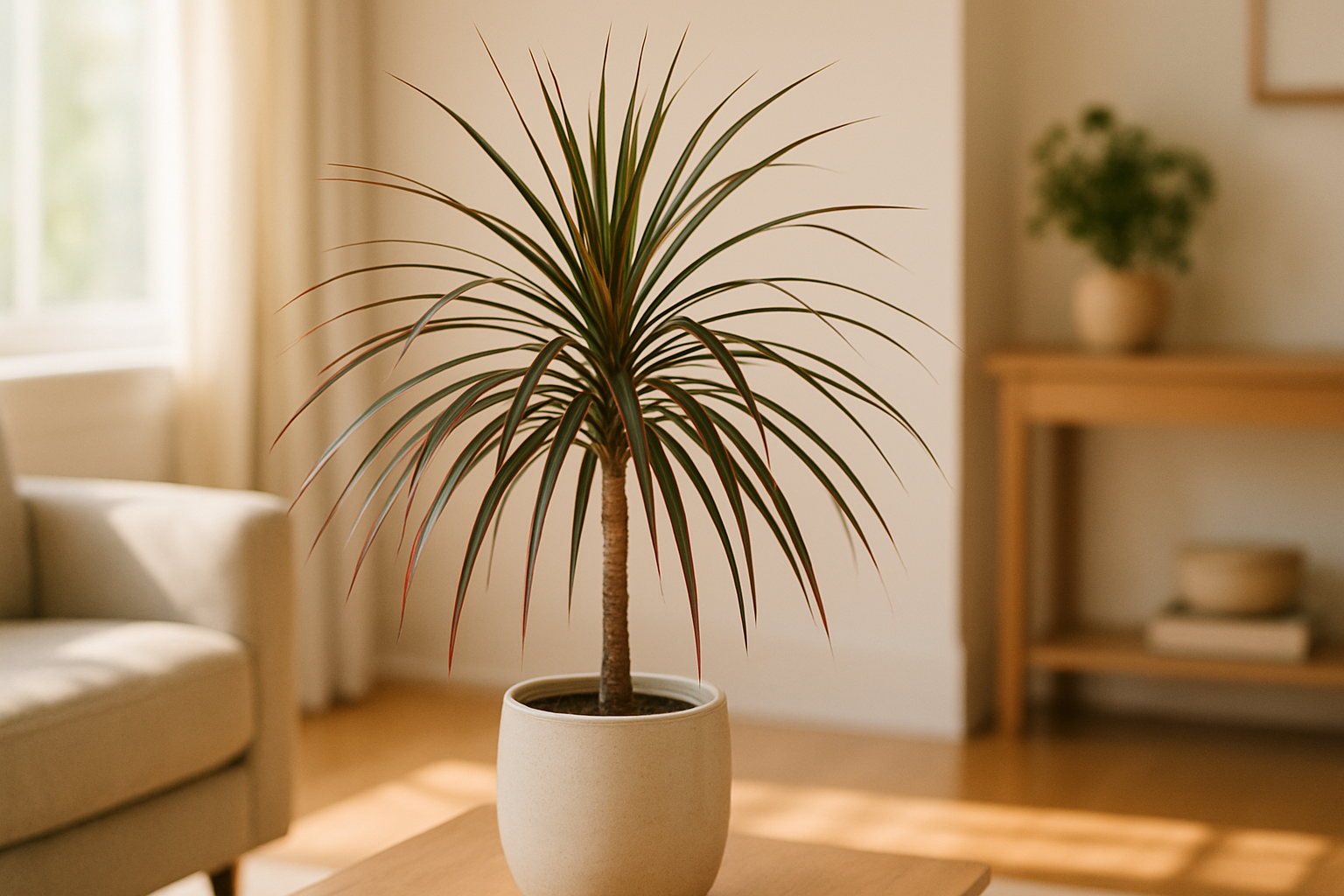
Meet the Dragon Tree: Your Beginner's Guide to Dracaena
Dracaena (druh-SEE-nuh) is the plant that makes everyone feel like a plant expert. It survives neglect, tolerates low light, and grows in a dramatic, architectural way that makes any room look designed.
The catch? Watering. Too much water and the roots rot. Too little and the leaf tips turn brown. Use tap water and the fluoride turns those tips brown anyway. It's a Goldilocks situation — but once you know the trick, dracaena is one of the most forgiving plants you can own.
This guide covers every major species (marginata, fragrans, compacta, warneckii, lemon lime) so you can identify what you're actually growing, plus the watering, light, soil, propagation, and troubleshooting info that keeps them looking good.
Which Dragon Tree Are You Growing? Quick Identification
This is where most care guides fail you — they assume you already know which dracaena you've got. You probably don't, so let's fix that.
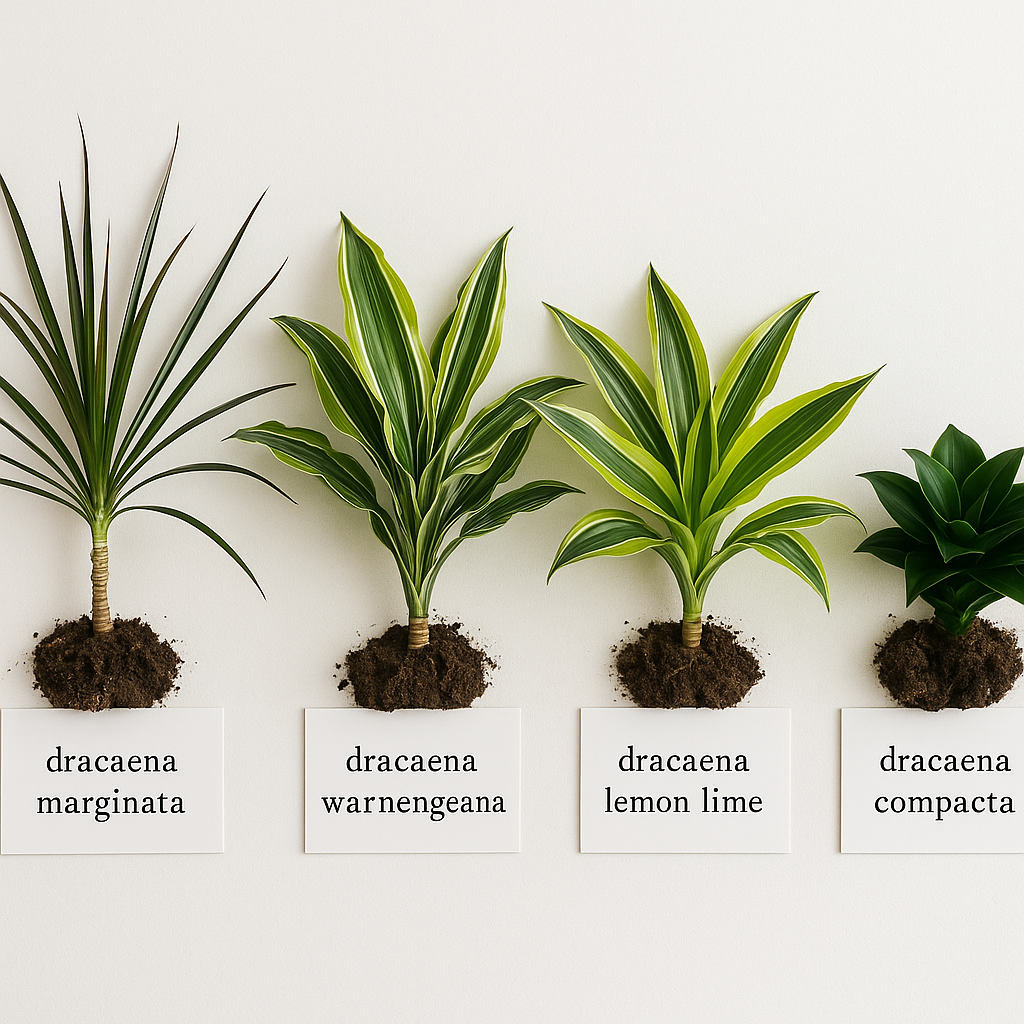
Dracaena Marginata (Madagascar Dragon Tree)
The classic dragon tree. Long, narrow leaves with red-purple margins arching from a slender cane-like trunk. The one most people picture when they hear "dragon tree." Grows tall (up to 6 feet indoors) with an architectural branching habit as it matures.
Dracaena Fragrans (Corn Plant)
Thick, corn-cob-shaped leaves with a broad yellow or cream stripe down the center. Slower growing than marginata but can reach 4-6 feet indoors. Most common variety in big-box stores.
Dracaena Compacta (Janet Craig)
Compact rosette of dark green, densely packed leaves. Much shorter and bushier than the others — maxes out around 2-3 feet. Slow grower, tolerates low light better than most.
Dracaena Warneckii
Green leaves with bold white or cream longitudinal stripes. Similar growth habit to marginata but with white-variegated foliage. Very architectural.
Dracaena Lemon Lime
Bright chartreuse-yellow and green striped leaves. The most vibrant variety — practically glows in bright indirect light. Grows 4-6 feet tall.
No matter which variety you have, the core care is nearly identical. Watering technique and water quality are the universal keys.
Light Requirements: Can Dragon Trees Handle Low Light?
Short answer: yes, better than most plants. But "tolerates" and "thrives" are different things.
Bright Indirect Light (Preferred)
All dracaena varieties grow fastest and healthiest in bright, indirect light — a few feet back from a sunny window. They won't mind if the light is filtered through a sheer curtain.
Low Light Tolerance
Dracaena compact, marginata, and warneckii all tolerate low light remarkably well. You'll see slower growth and potentially smaller leaves, but they'll survive. This makes them top picks for offices and dim corners.
Warneckii and lemon lime lose some of their variegation in low light — the stripes fade. If you want that bold coloring to stay bright, give them more light.
Direct Sun: Avoid It
Full direct sun scorches dracaena leaves, causing bleached, crispy patches. Not fatal, but ugly. If your plant sits in hot afternoon sun through a window, move it back or filter the light.
Watering: The #1 Mistake to Avoid with Dracaena
Here's the thing about dracaena: it's not a water lover. In the wild, it grows as an understory plant in subtropical forests — not a swamp. That means it wants to dry out between waterings.
The rule: Water when the top 50-75% of soil is dry. In most homes, that's every 7-14 days, depending on the season, pot material, and humidity.
How to Check Soil Moisture (Finger Test + Moisture Meter)
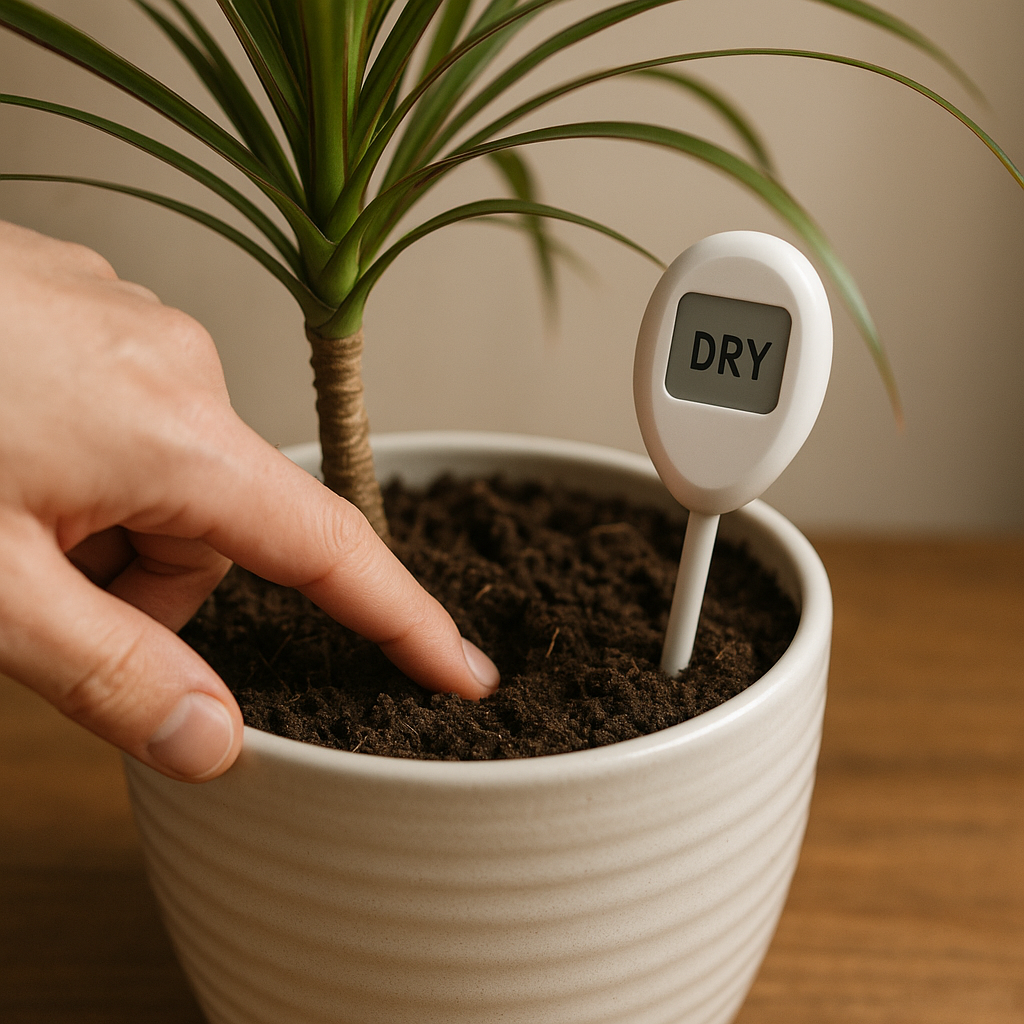
Sticking your finger 2 inches into the soil is free and reliable. If it feels dry past your first knuckle, water. If it feels damp, wait.
A moisture meter removes the guesswork entirely — especially useful if you're the type who either over-waters from anxiety or forgets for weeks and then floods it. Check Soil Moisture Before You Water →
Water Quality: Why Tap Water Harms Dracaena
This is the part most plant guides gloss over, and it's the #1 reason dracaena leaf tips turn brown.
Dracaena is fluoride and chlorine sensitive. Tap water in most US cities contains measurable fluoride (added for dental health) and chlorine. For most plants, this is no big deal. For dracaena, those chemicals accumulate in leaf tissue and cause tip burn — brown, crispy leaf edges that spread over time.
You won't see the damage for weeks or months, so it's easy to miss the connection.
The fix: Use filtered water, distilled water, or rainwater. A basic Get Filtered Water for Your Dracaena → pitcher works fine. If you've been using tap water and your dracaena has brown tips, switch now — the plant won't recover damaged leaf tissue, but new growth will come in clean.
This also means you should avoid fluoride-containing fertilizers. Use a simple, water-soluble fertilizer without fluoride additives.
Seasonal Watering Schedule
| Season | Frequency | Notes |
|---|---|---|
| Spring/Summer | Every 7-10 days | Active growth, more water |
| Fall/Winter | Every 14-21 days | Slowed metabolism, less water |
| After repotting | Wait 10-14 days | Roots need to recover before watering |
Soil & Potting Mix: What Substrate Does Dracaena Need?
Dracaena wants a well-draining, slightly acidic mix. That's it.
Ideal pH and Drainage
pH 6.0-7.0 is the sweet spot. More importantly: drainage. Roots sitting in soggy soil = root rot = dead plant. Always use a pot with a drainage hole.
DIY Potting Mix Recipe
- 2/3 standard houseplant potting mix
- 1/3 perlite or pumice
- Optional: a handful of orchid bark chips for extra aeration
The perlite or pumice keeps the mix from compacting and staying wet too long. Straight potting mix from the bag can retain too much moisture for dracaena. Improve Drainage with Perlite →
One thing dracaena does better than most plants: it tolerates being root-bound. You don't need to repot often — every 2-3 years is fine, and the plant won't suffer if the roots are snug.
Temperature & Humidity
Ideal Temperature Range (18-30°C / 65-86°F)
Dracaena thrives in normal household temps — 65-80°F is ideal. It tolerates down to about 55°F for short periods, but anything below that causes damage. Keep it away from cold drafts in winter and AC vents in summer.
Humidity Needs: 40-60%
Dracaena tolerates dry indoor air better than tropicals like ferns or calathea. That said, brown leaf tips are more common when humidity drops below 40% — especially in winter when heating systems dry the air.
If you see persistent brown tips despite using filtered water, your air is probably too dry. A Boost Humidity for Your Dracaena → near your plant helps, especially in winter. Aim for 40-60% and you'll see improvement in new growth.
Fertilizing Dracaena: When and How
Feed monthly during spring and summer with a diluted general houseplant fertilizer. Dracaena isn't a heavy feeder — more is not better.
Stop fertilizing entirely in fall and winter. The plant's metabolism slows and excess salts build up in the soil, causing root burn and tip burn that looks identical to fluoride damage.
Salt Buildup Warning
If you see brown tips and you've ruled out water quality, check your fertilizing schedule. Leftover fertilizer salts in the soil draw moisture away from roots. If you suspect buildup, flush the pot thoroughly with plain filtered water — run water through the drainage hole until it runs clear.
Propagation: How to Grow New Dragon Trees from Cuttings
Dracaena propagation is almost comically easy. Cut a piece off, put it in water or soil, and it roots. That's it.
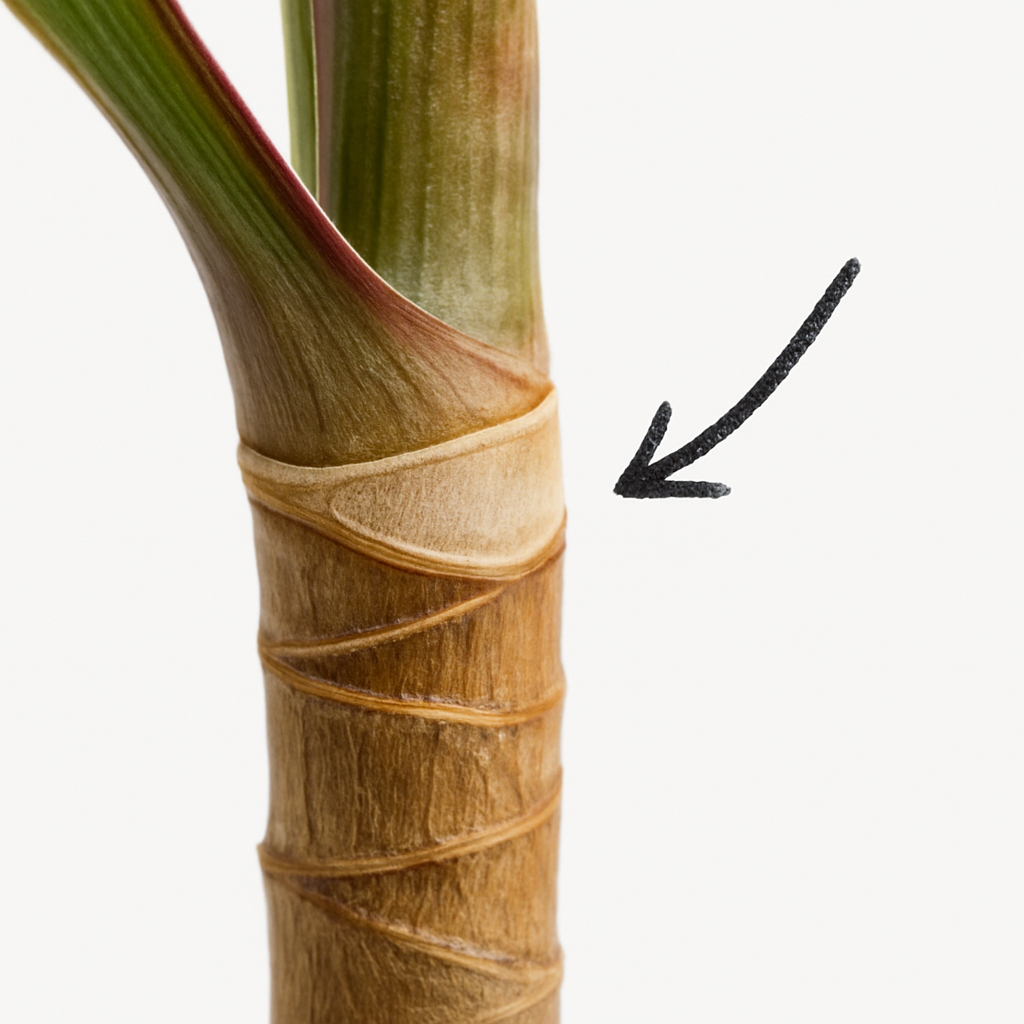
Method 1: Top Cutting
- Cut 4-6 inches below the growing tip, just below a node (the ring where leaves attach)
- Remove the lower leaves, leaving 3-4 at the top
- Place in water or moist potting mix
- Keep in bright indirect light
- Rooting takes 4-6 weeks
Method 2: Cane (Stem) Sections
- Cut the main cane into 3-4 inch sections, each with at least 2 nodes
- Lay horizontally on moist soil, or plant vertically with the top node just above the soil line
- Keep moist and in bright indirect light
- Each node will sprout a new shoot
Water vs. Soil Rooting
Water rooting lets you watch the roots develop — satisfying and educational. Change the water every week. Soil rooting is lower-maintenance once planted but you can't see progress. Either works; dracaena roots readily in both.
For more propagation basics, see our general propagation guide.
Repotting Your Dragon Tree: When and How
Dracaena doesn't need frequent repotting. Every 2-3 years is plenty. In fact, it actually tolerates being root-bound better than most plants — a slightly cramped root system doesn't slow it down much.
How to Know It's Time to Repot
- Roots growing out of the drainage hole
- Water runs straight through the pot (pot is entirely root-bound)
- Plant is top-heavy and tipping
- Growth has stopped despite good care and fertilizing
Step-by-Step Repotting
- Water the plant a day or two before repotting
- Go up one pot size (e.g., from 6" to 8" diameter)
- Use the well-draining mix recipe above
- Place the root ball at the same depth — don't bury the trunk
- Fill around the sides, tamp gently
- Water thoroughly and let drain
For more detail, see our how to repot houseplants guide.
Terracotta vs. Plastic Pots
Terracotta is ideal for dracaena — the breathable walls dry the soil out faster, which helps prevent overwatering. Plastic retains moisture longer, which is fine if you're careful about watering but increases rot risk if you're prone to overwatering.
Troubleshooting: What's Going Wrong with Your Dracaena?
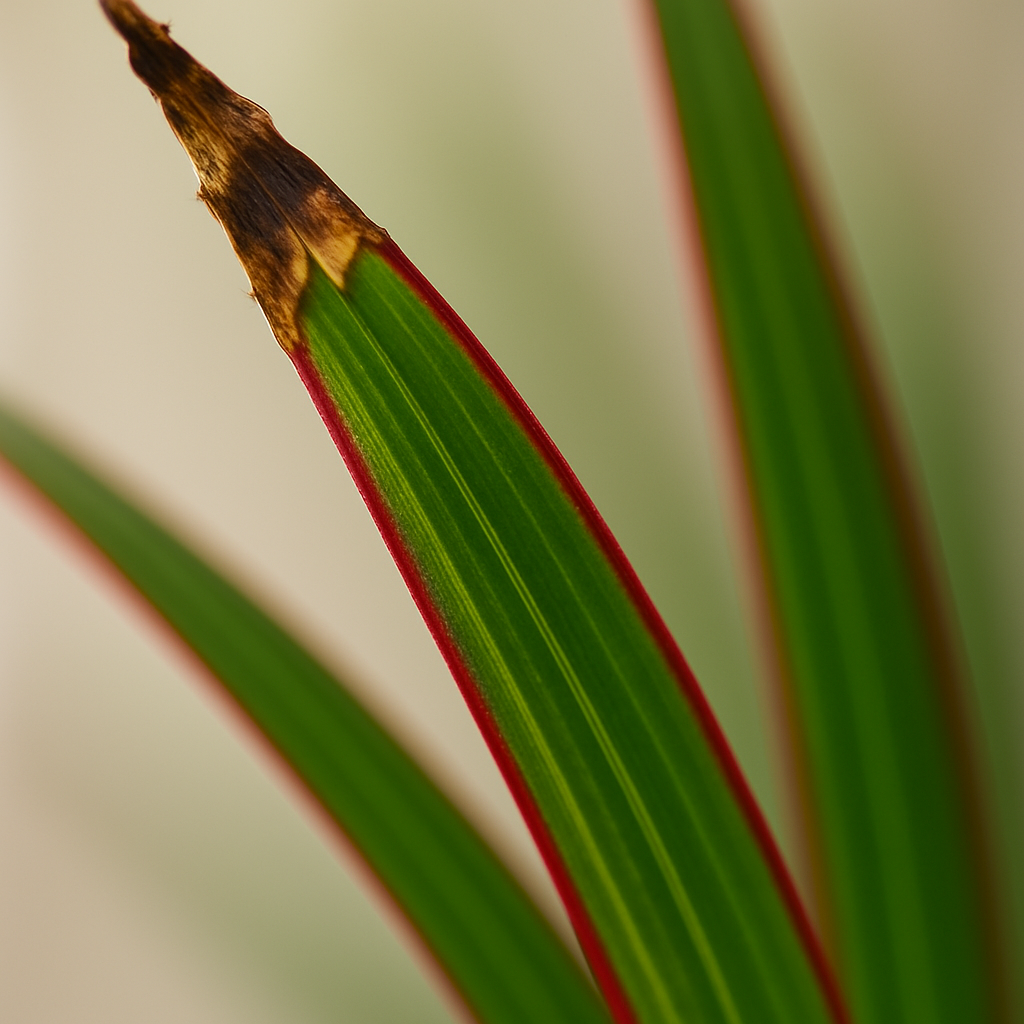
Dracaena tells you when something's wrong. Here's the symptom decoder.
Brown Leaf Tips
Causes: Fluoride/chlorine from tap water (most common), low humidity, underwatering, fertilizer salt buildup. Fix: Switch to filtered/distilled water. Increase humidity. Check soil moisture with the finger test. Flush salts with plain water if you suspect buildup. Trim brown tips with clean scissors — they won't heal, but new growth will come in clean if you fix the cause.
Yellow Leaves
Causes: Overwatering (most common), root rot, nutrient deficiency, natural leaf shedding. Fix: Check soil moisture — if it's wet below the surface, ease up on watering. If the soil stays wet for days after watering, check for root rot (mushy, smelly roots). Yellowing lower leaves that fall off one at a time are usually normal — dracaena sheds lower leaves as it grows. If multiple leaves yellow at once, it's a care issue.
For root rot diagnosis, see how to treat root rot.
Leaf Drop
Causes: Cold shock (temp below 55°F), sudden change in environment, overwatering, root rot. Fix: Move away from cold drafts or AC vents. Check soil moisture. If roots are mushy, treat for root rot. Some lower leaf drop is normal as the plant grows and sheds older foliage — but sudden, widespread drop is a stress signal.
Drooping Leaves
Causes: Underwatering (most common), root rot (from overwatering), root-bound. Fix: Check soil moisture — if it's bone dry, water thoroughly and the plant usually perks up within 24 hours. If soil is wet and the plant droops, it's likely root rot — see our Plant ER symptom checker.
Root Rot
Causes: Overwatering, poor drainage, soil that stays wet too long. Fix: Remove the plant from the pot, trim any brown/mushy roots, repot in fresh, well-draining mix, reduce watering frequency. See our full how to treat root rot guide for the step-by-step.
Popular Dracaena Varieties at a Glance
| Variety | Common Name | Light Needs | Water Frequency | Growth Rate | Difficulty |
|---|---|---|---|---|---|
| Dracaena marginata | Madagascar Dragon Tree | Bright indirect, tolerates low | Every 7-14 days | Medium-Fast | Easy |
| Dracaena fragrans | Corn Plant | Bright indirect, tolerates low | Every 7-14 days | Medium | Easy |
| Dracaena compacta | Janet Craig | Low to bright indirect | Every 10-14 days | Slow | Easy |
| Dracaena warneckii | Warneckii | Bright indirect (variegation fades in low light) | Every 7-14 days | Medium | Easy |
| Dracaena lemon lime | Lemon Lime | Bright indirect (best color) | Every 7-10 days | Medium-Fast | Easy |
Is Dracaena Safe for Pets? Toxicity Guide
No — dracaena is toxic to cats and dogs.
All dracaena species contain saponins, which are toxic when ingested. Cats are particularly prone to investigating and chewing on houseplants, so this matters if you have curious pets.
Symptoms of Dracaena Poisoning in Cats & Dogs
- Vomiting (with or without plant fragments)
- Drooling
- Lethargy and weakness
- Loss of appetite
- Dilated pupils (in cats)
Symptoms are usually mild to moderate and rarely fatal, but your pet needs veterinary attention if ingestion is confirmed.
What to Do If Your Pet Ingests Dracaena
- Remove the plant from your pet's reach
- Call your vet or a pet poison helpline (ASPCA Animal Poison Control: 888-426-4435)
- Rinse your pet's mouth with water if possible
- Bring a photo of the plant to help your vet identify it
Pet-Safe Alternatives
If you want the dracaena aesthetic without the pet risk, consider these pet-safe houseplants:
- Spider plant — similar arching growth habit, non-toxic
- Parlor palm — tropical look, safe for cats and dogs
- Boston fern — lush and full, completely non-toxic
- Prayer plant — beautiful foliage, pet-safe
Quick Care Summary Card
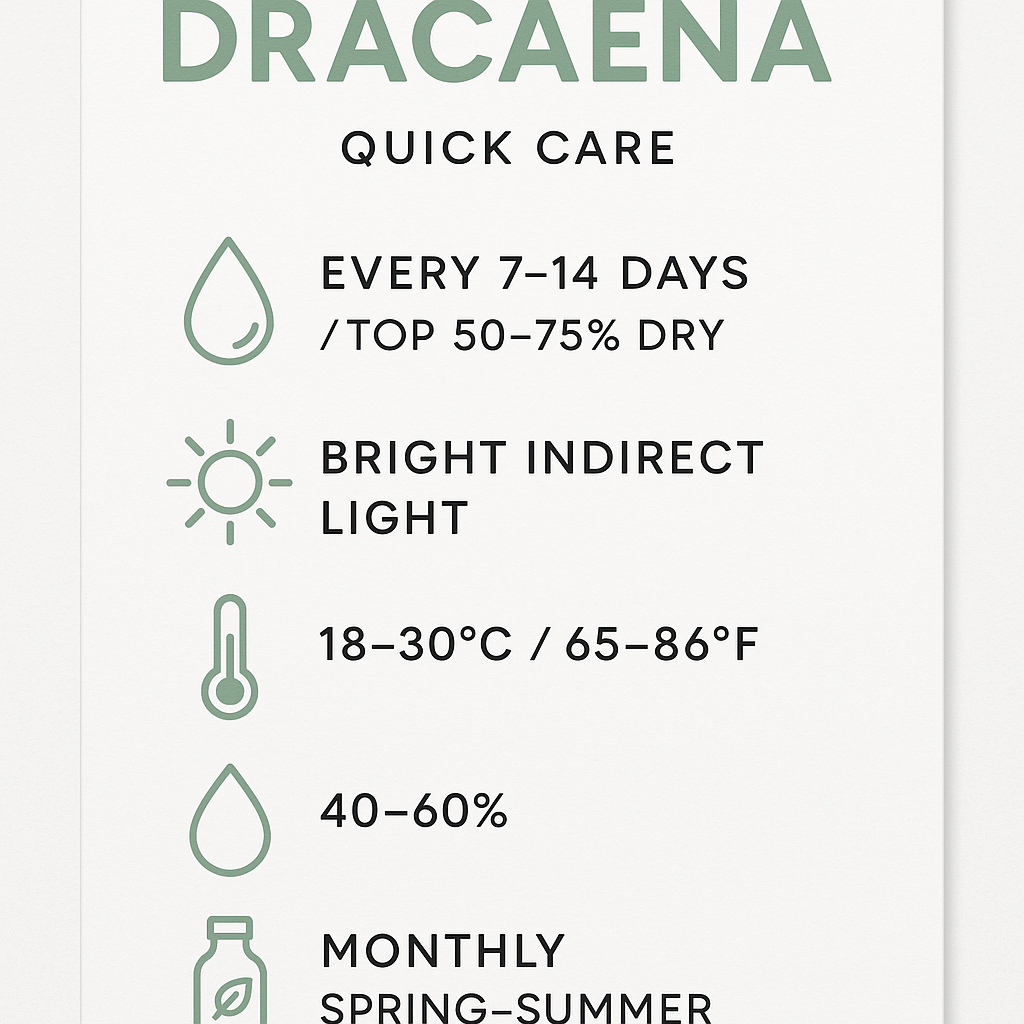
| Water | Every 7-14 days / top 50-75% dry |
| Light | Bright indirect (preferred), low light tolerated |
| Temperature | 65-86°F / 18-30°C |
| Humidity | 40-60% (tolerates dry air) |
| Fertilizer | Monthly, spring/summer only |
| Water Quality | Filtered or distilled — no tap water |
| Pet Safe? | No — toxic to cats and dogs |
Frequently Asked Questions
How often should I water my dracaena? Water when the top 50-75% of soil is dry. In most homes, that's every 7-14 days. Use the finger test — stick your finger 2 inches into the soil. If it's dry, water. If damp, wait. Always use filtered or distilled water.
Can dracaena live in low light? Yes. Dracaena compact, marginata, and warneckii all tolerate low light. Growth will be slower and the plant may become leggy over time, but it will survive. Bright indirect light produces the best growth and coloration.
Is dracaena toxic to cats? Yes. All dracaena species are toxic to cats and dogs due to saponins. Symptoms include vomiting, drooling, and lethargy. Keep dracaena out of reach of pets or choose pet-safe alternatives like spider plants or Boston ferns.
Why are the tips of my dracaena turning brown? Brown tips are usually caused by fluoride or chlorine from tap water, low humidity, or inconsistent watering. Switch to filtered or distilled water, increase humidity, and make sure you're checking soil moisture before watering rather than following a fixed schedule.
How do I propagate dracaena from cuttings? Cut 4-6 inches below the growing tip just below a node (the ring where leaves attach). Remove lower leaves, place in water or moist soil, and keep in bright indirect light. Rooting takes 4-6 weeks. You can also cut the main cane into 3-4 inch sections with multiple nodes and lay them horizontally on moist soil.
Ready for more? See our general watering basics for houseplants or browse the best moisture meters for houseplants.