Caladium Care Guide: Heart-Shaped Leaves for Shade Gardens
These tropical tubers will completely change what you think a "low light" plant can do.
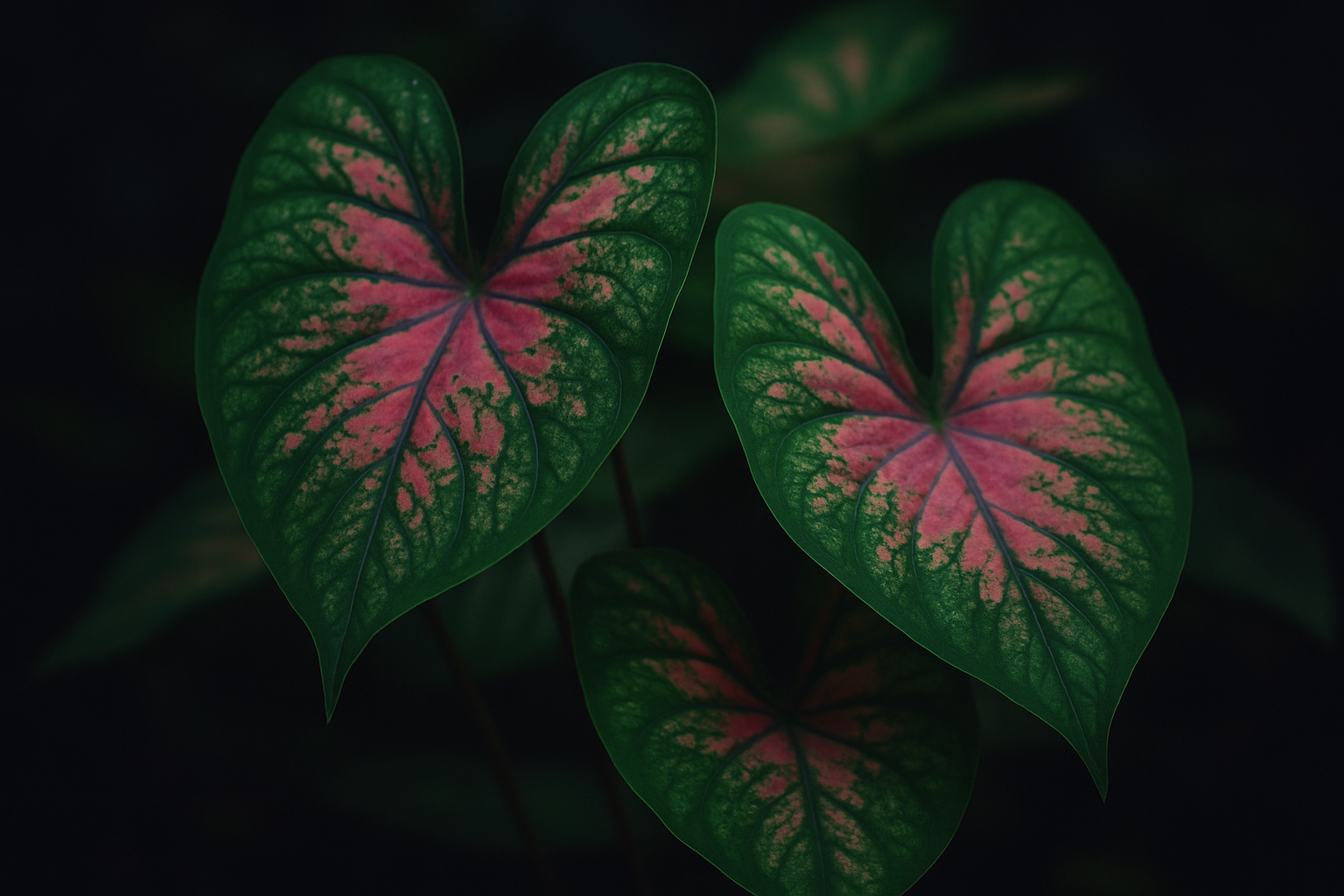
What Is a Caladium?
Caladiums are tropical tubers grown for one reason: the leaves. Specifically, those dramatic, heart-shaped, often-brightly-colored leaves that make them look like nature threw paint at a greenhouse. Pink, red, white, green — usually all on the same leaf.
The catch? They're technically shade plants. Not low-light-tolerant in the "will survive in a dark corner" way — more "actually prefer shade" way. Which makes them weirdly specific and genuinely useful for anyone who's exhausted the usual "bright indirect light" recommendations.
Outdoors, caladiums grow under tree canopies. They handle morning sun, but afternoon sun shreds those thin leaves. Indoors, that translates to an east-facing window or a few feet back from a north-facing one. They'll tolerate less light than most colorful houseplants, and they actually prefer it.
Most caladium species are Caladium bicolor, though breeding has exploded the variety. They're tuber-based — not rhizome, not bulb, tuber — which matters when we get to dormancy and storage.
Light & Placement — Finding the Right Spot
Caladiums have a reputation problem. People see "tropical" and "colorful" and assume they need bright light like a croton. They don't. They evolved under tree cover, and those thin leaves will crisp up in direct afternoon sun like tissue paper in a rainstorm.
The goal: bright indirect light, period.
Morning Sun vs. Indirect Light
An east-facing window — where they get gentle morning sun and bright indirect light the rest of the day — is basically caladium heaven. You can also push them further back from a north window, or tuck them into a room that gets good ambient light but no direct rays.
South and west windows are trickier. A few feet back from a south window can work if the light is filtered through a sheer curtain. Up against a west window? The afternoon sun will scorch those leaves. You'll see it as "crispy edges" and assume it's a humidity problem. It's not — it's light.
Varieties: Fancy-Leaf vs. Strap-Leaf
Not all caladiums handle the same light. This matters for indoor placement:
- Fancy-leaf caladiums have big, rounded, heart-shaped leaves. They're slightly more tolerant of bright conditions and can handle a bit more light than you'd expect. Still indirect, though.
- Strap-leaf caladiums have narrower, more elongated leaves and tend to be more shade-preferring. They do better on shelves, in lower-light corners, or further from windows. They also stay more compact, which is useful if you don't have floor space.
If you're putting a caladium on a windowsill, a strap-leaf variety is the safer bet. If it's on a shelf 3-4 feet back from a window, a fancy-leaf can work.
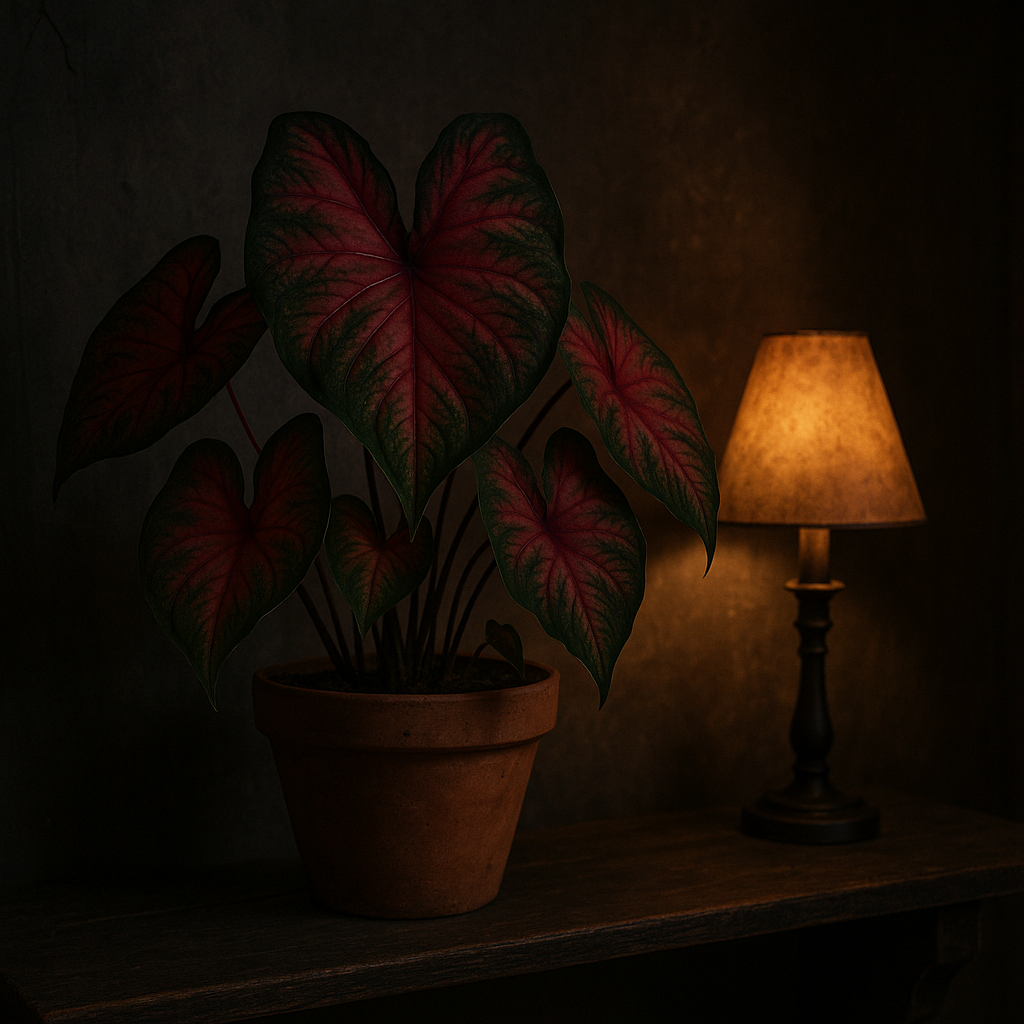
Caladiums thrive in the kind of low light that kills most houseplants — making them perfect for that dark corner you've been wondering what to do with.
Watering — The Moist-but-Never-Soggy Rule
Here's where caladiums are slightly less forgiving: they want moisture, but they hate sitting in it. Root rot is the main way people kill these plants. The tubers are storage organs — they hold water and nutrients — so the plant can survive a brief dry spell. It cannot survive weeks in sodden soil.
How to Know When to Water
The top inch of soil is your cue. Stick your finger in. If the top inch is dry, water. If it's still moist, wait.
During active growth (spring through late summer), caladiums drink a lot. Depending on your pot size, humidity, and temperature, you might be watering every 2-4 days. Yes, frequently. They're not succulents.
In fall and winter, watering frequency drops sharply as the plant slows — and eventually stops entirely during dormancy.
Overwatering Signs
Overwatering is the most common caladium death. The signs look like underwatering (drooping, yellowing) because root rot disrupts water uptake — the plant is technically drought-stressed even though the soil is wet.
Key indicator: if the soil is damp and the plant is drooping, don't add more water. Check the roots. Healthy roots are firm and white-to-cream colored. Rotted roots are mushy, dark, and smell bad.
A moisture meter removes the guesswork entirely.
Check humidity and soil moisture with one tool →
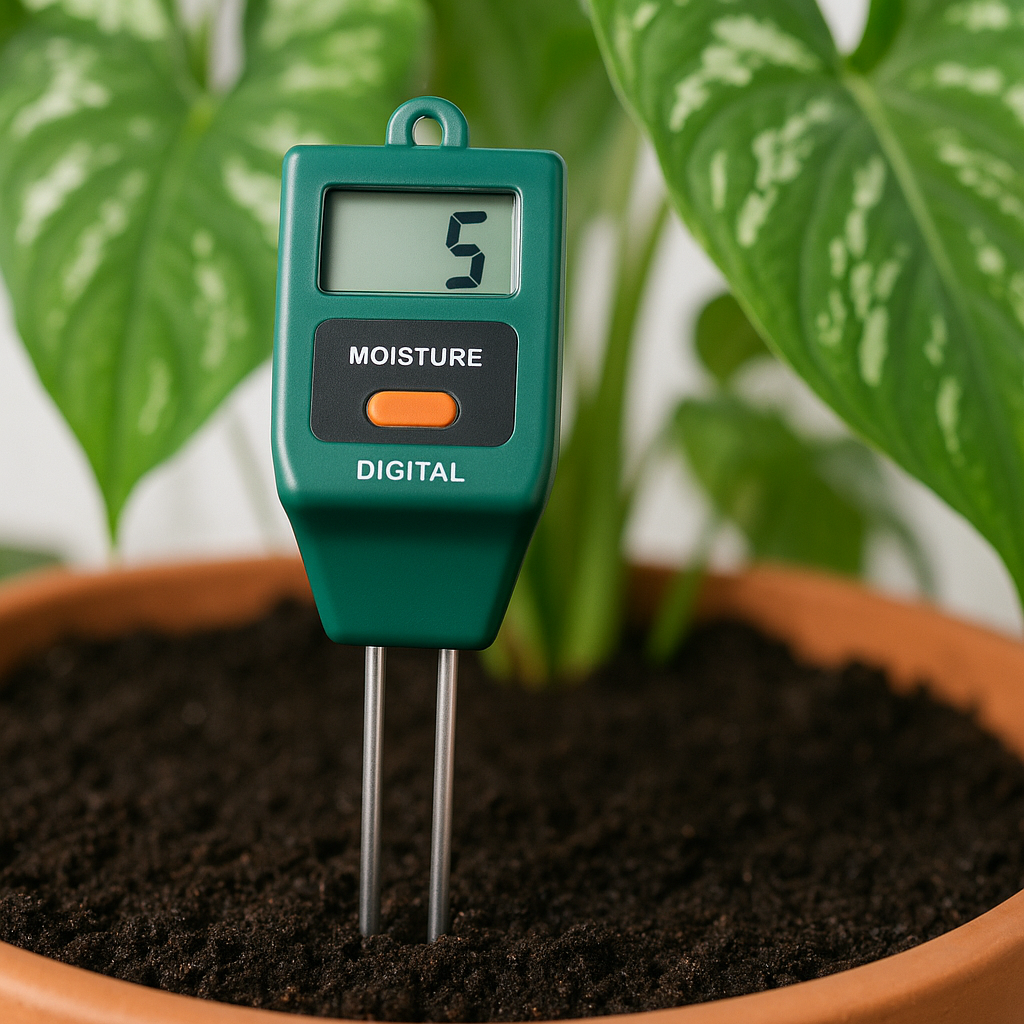
The top inch of soil is your cue — if it's dry, water. A moisture meter takes the guesswork out entirely.
Soil & Potting Mix — Drainage Is Everything
Caladium tubers rot in compacted, poorly draining soil. This is not a flex — it's a fact. Get this wrong and no amount of perfect watering will save your plant.
The ideal mix: peat-based potting mix with perlite added. Roughly 70% peat, 30% perlite. The peat holds moisture, the perlite keeps it from packing down and ensures excess water drains fast.
Avoid garden soil, avoid dense potting mixes with no perlite, and avoid anything marketed as "moisture-retaining" — that's the opposite of what you want.
You can also add some coarse orchid bark for extra drainage, especially if your humidity is on the lower side and you want the mix to dry slightly faster between waterings.
Get the well-draining mix caladiums need →
Pot Size
Caladium tubers spread horizontally. Use a pot that's wider than it is deep — think 8-12 inches wide and 6 inches deep. A too-deep pot holds water in the bottom that the roots can't reach, creating a rot zone.
Find the right pot for caladium tubers →
Temperature & Humidity — Keep It Warm and Tropical
Caladiums are not cold-tolerant. At all. Below about 55°F, they start looking unhappy. Below 50°F, they can start dying back or go dormant prematurely. This matters if you're putting them near cold windows in winter.
Ideal Indoor Temps
65-75°F (18-24°C). That's the sweet spot. Not the "average room temperature" which might be fine in summer but can dip too low near windows in winter. If your caladium is near a drafty window, move it.
Avoid placing caladiums near:
- Cold windows in winter
- Air conditioning vents
- Doors that open to outside frequently
- Any spot where the temperature fluctuates significantly
Humidity Hacks for Dry Homes
Caladiums want 60%+ humidity. Most homes in winter (or summer with AC running) are drier than that. Crispy leaf edges are the first sign.
Humidity-boosting options:
- Bathroom placement — if you have a bright bathroom window, this is actually ideal
- Pebble tray with water — place the pot on a tray of pebbles and water (evaporation raises local humidity)
- Grouping plants together — they create a micro-humidity zone
- Humidifier — the most reliable solution, especially if you run AC a lot
The humidity section links back to the practical tools worth having for this exact reason:
Check humidity and soil moisture with one tool →
Fertilizing — Light Feeder, No Burn
Caladiums are not heavy feeders. Over-fertilizing is a real risk — the salts build up in the soil, burn the roots, and cause the exact crispy-edge symptoms you'd blame on low humidity.
During active growth (spring through late summer): use a balanced liquid fertilizer diluted to 1/4 strength once a month. That's it. Half-strength at most.
During dormancy: do not fertilize. The plant isn't growing, so it won't use the nutrients. They'll just accumulate and cause problems.
If you're using a slow-release granular fertilizer, apply at the lowest recommended dose.
Dormancy & Overwintering — When Your Caladium Disappears
This is the part that trips people up. Around fall, your caladium will start looking terrible. Leaves yellowing, drooping, dying back. Then the whole thing collapses and looks dead.
It's not dead. It's dormant.
Caladiums are tender tubers. In their native tropical climate, they might not go fully dormant — but in your home, with winter light and lower temperatures, dormancy is triggered. The plant dies back to the tuber. The tuber sits in the soil all winter. In spring, it comes back.
This is normal. This is fine. And if you handle it wrong, you'll throw out a perfectly good tuber.
Is My Caladium Dead or Dormant?
Check the tuber. Not the leaves — the tuber.
- Firm, solid tuber → alive. The leaves died back but the plant is resting.
- Mushy, shriveled, or soft tuber → it's gone. Compost it.
- Tuber is firm but the eyes (growth points) have started to swell → it's waking up, ready to grow.
Check humidity and soil moisture with one tool →
Tuber Storage Step-by-Step
If you want to store the tuber outside of soil (for more control, or if you've pulled it out of the pot):
- After the leaves die back completely, stop watering
- Let the soil dry out for 1-2 weeks
- Remove the tuber, brush off soil, let it air-dry for a day
- Store in a paper bag filled with dry perlite or vermiculite — the perlite absorbs excess moisture and prevents rot
- Keep in a cool (55-65°F), dark, dry place — a closet or basement works
- Check every 4-6 weeks — discard any tubers that are soft or moldy
- In spring, repot the tuber in fresh mix, water lightly, and wait
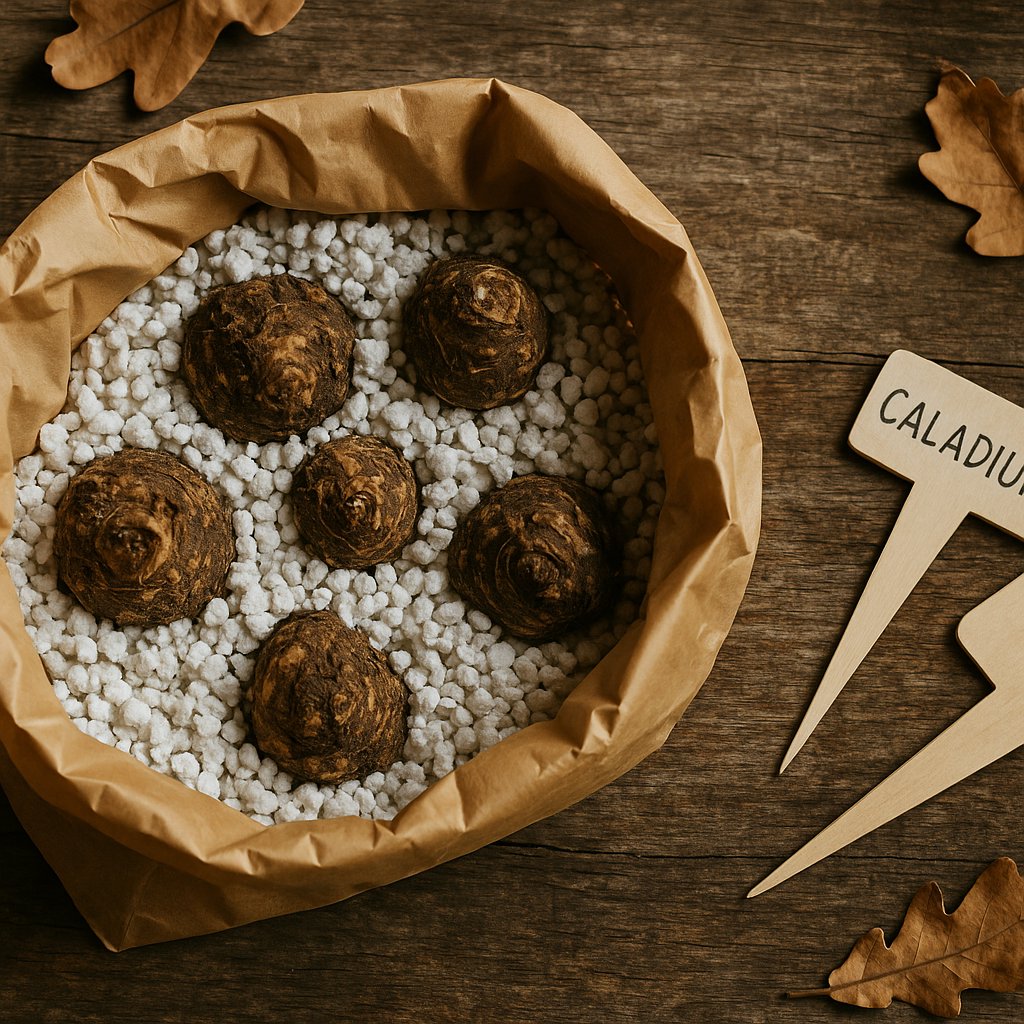
Paper bag + dry perlite = the simplest dormancy storage method. No special equipment needed.
Resprouting in Spring
When days lengthen and temperatures rise, the tuber will send up new growth. This usually happens 4-8 weeks after repotting in spring. New leaves emerge from the eyes on the tuber.
If you stored the tuber loose, check it in early spring — if it looks firm and has visible eyes ( bumps or reddish points), it's ready to plant.
Don't panic if it takes a while. Caladiums can be slow to break dormancy. As long as the tuber is firm, it's alive.
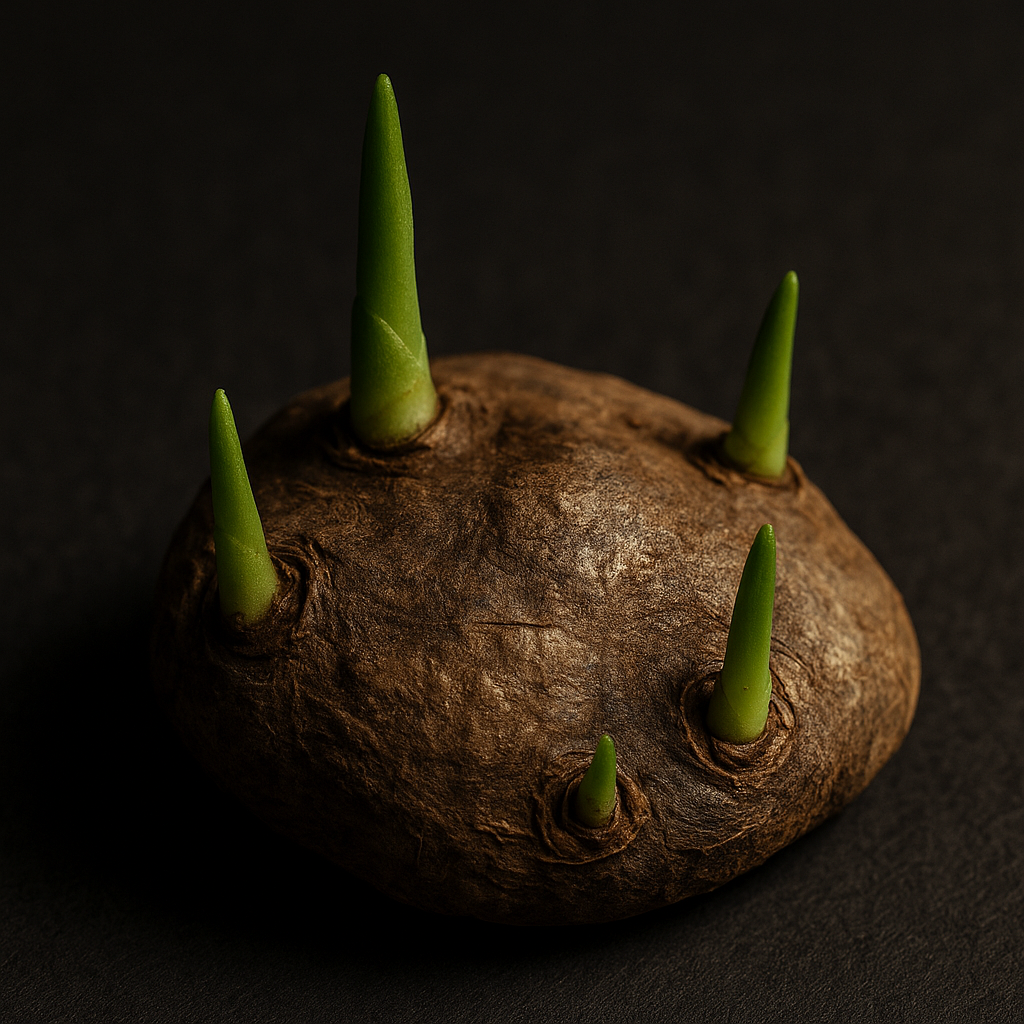
Don't toss a dormant caladium — a firm tuber with emerging eyes is very much alive. This is what healthy dormancy looks like.
Common Problems & How to Fix Them
Caladiums are relatively drama-free when their conditions are right. When something's wrong, it usually shows in the leaves first. Here's the diagnosis-first approach — because "what's normal vs. what's dying" is genuinely hard to read with caladiums.
Yellow Leaves — Overwatering or Underwatering?
Overwatering is the most common cause. Caladium tubers rot when waterlogged, and yellowing leaves are often the first sign. Check the soil — if it's wet and the plant is drooping, you've found your problem.
Underwatering also causes yellowing, but usually with more pronounced drooping and crisping at the edges first. If the soil is dry and the plant is drooping, water it and see if it perks up within hours.
Normal aging causes the oldest leaves (at the base) to yellow and die while the new growth continues. If it's one or two older leaves and everything else looks fine, this is normal.
Crispy Leaf Edges — Low Humidity or Sunburn?
Low humidity causes crispy edges, especially in winter or in air-conditioned rooms. If the edges are brown and papery but the rest of the leaf looks fine, the plant is showing you it wants more moisture in the air.
Sunburn looks different — the leaf turns pale or yellowish, often with browned patches, and the crispy areas are specifically where direct light hits. If your plant is in direct afternoon sun, this is likely the cause.
Underwatering can also cause crisping, but it usually starts at the leaf tips and edges rather than patches.
Drooping or Wilting
Caladiums droop for three main reasons:
- Underwatering — the most straightforward cause. Check the top inch of soil. If it's dry, water. The plant should perk up within a few hours.
- Overwatering / root rot — the soil is wet but the plant is drooping. This is the tricky one. Check the roots. If they smell bad or are dark and mushy, you've got root rot.
- Temperature shock — a sudden drop in temperature (cold window, AC vent) can cause temporary wilting. Move the plant to a warmer spot and see if it recovers.
Root Rot — Smell Test
If you're not sure whether root rot is the issue: smell the soil at the base of the plant. Healthy soil smells earthy. Rotting roots smell musty, sour, or like decay. If it smells wrong, they probably are.
Rotted tubers are soft and dark inside when cut. If you're unsure, cut one in half — a firm, cream-colored interior with no odor means it's healthy.
The "Melting" Effect — Too Much Sun
This is a caladium-specific thing. "Melting" is when the leaves go from vibrant to translucent and mushy — like wet tissue. It's almost always caused by too much direct sun, especially in combination with inadequate watering.
The thin caladium leaves have almost no waxy coating compared to succulents or other thick-leaf tropicals. They lose water fast in direct sun and simply fall apart. Move the plant to a shadier spot and it should stop happening to new growth.
Caladium Varieties — Choosing the Right One Indoors
Most caladium varieties sold as houseplants are cultivars of Caladium bicolor or hybrids. Breeding programs have created hundreds of varieties in different color combinations, sizes, and leaf shapes. Here are the main categories relevant for indoor growing.
Fancy-Leaf Caladiums
The classic caladium look: large, rounded to heart-shaped leaves, bold colors. Fancy-leaf varieties tend to be more vigourous growers with bigger leaves but also more demanding in terms of light (they need a bit more to maintain color).
Popular fancy-leaf varieties: 'Frieda Hemple' (deep red with green border), 'White Queen' (cream/white with dark green veins), 'Candidum' (white with green veins)
Strap-Leaf Caladiums
Narrower leaves, more compact growth habit, and typically better suited to lower-light indoor conditions. Strap-leaf varieties are generally more forgiving for shelves and lower-light corners. They're also less likely to need staking or support.
Popular strap-leaf varieties: 'Red Flash' (dark red with green edge), 'Florida Sweetheart' (pink with green border)
Heart to Heart Line
The Heart to Heart caladium line (bred by a breeding program focused on compact, vigorous varieties) has become popular for indoor use. Key selling points: smaller size, strong color retention in lower light, and consistent performance. If you're buying a caladium from a garden center for indoor use, Heart to Heart varieties are often the best bet.
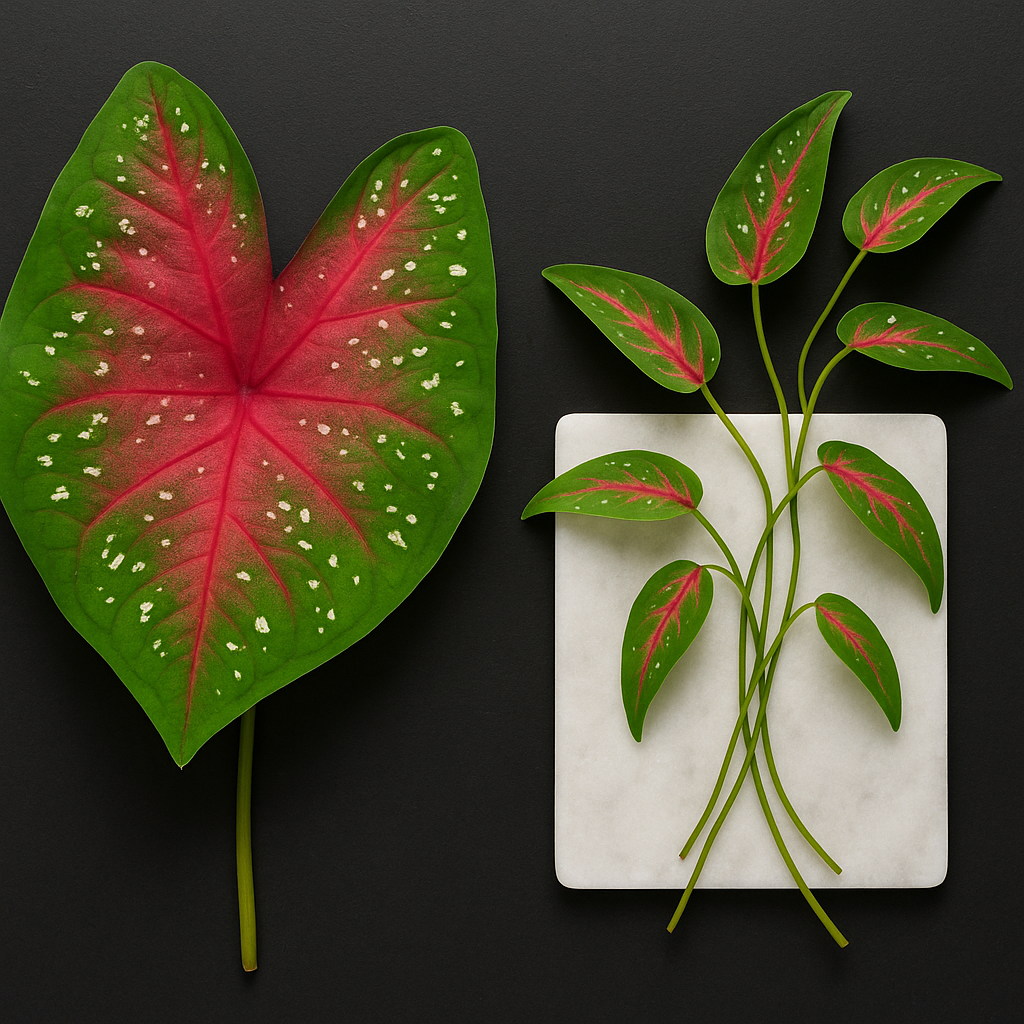
Fancy-leaf caladiums (left) grow big, dramatic hearts. Strap-leaf varieties (right) stay more compact — better for shelves and windowsills.
Caladium Care FAQ
Why is my caladium dying in winter? It's probably not dying — it's going dormant. This is normal. The leaves yellow and die back and the plant disappears until spring. Check the tuber (it should be firm) and store the pot in a cool, dry spot. Resume watering in spring.
How often should I water my caladium? During active growth: every 2-4 days depending on conditions. Check the top inch of soil — if it's dry, water. During dormancy: stop watering entirely until new growth appears in spring.
Can caladiums grow in low light? They prefer bright indirect light and will lose color and become leggy in low light. They do not do well in dark corners. "Shade tolerant" for caladiums means they handle indirect light better than most colorful houseplants, not that they survive in near-darkness.
Why are my caladium leaves curling? Usually underwatering or low humidity. Caladium leaves curl inward (like a funnel) when they're water-stressed. Increase watering frequency or humidity. If the soil is moist and the plant is still curling, check for root rot.
Are caladiums toxic to pets? Yes. Caladiums contain calcium oxalate crystals, which cause irritation and swelling of the mouth and GI tract if ingested. Keep them away from cats and dogs. Most pets won't eat them voluntarily (the leaves are irritating), but curious animals may investigate.
How do I get my caladium to come back after dormancy? In spring, move the pot to a warmer, brighter spot, water lightly, and wait. New growth typically emerges within 4-8 weeks. If the tuber is firm, it will come back. If it was stored loose, repot it in fresh mix with the eyes facing up, about 2 inches deep.
Products We Love
We use these products ourselves:
Digital Hygrometer / Moisture Meter Combo → A hygrometer + moisture meter combo is the most useful tool for caladium care. Caladiums need 60%+ humidity and consistent moisture — a combo meter lets you monitor both without guessing.
Peat-Based Potting Mix with Perlite → Well-draining, peat-based mix with perlite is the substrate caladiums need. It holds moisture but drains fast enough to protect the tuber from rot.
Shallow Wide Planter with Drainage → Caladium tubers spread horizontally. A wide, shallow pot — 8 to 12 inches across, 6 inches deep — gives roots room to grow without holding water in a deep soil column.
Terracotta Pots (Witchy/Goth Aesthetic) → Terracotta's breathability helps prevent overwatering — a real functional benefit that also happens to look the part. Etsy has plenty of witchy/goth options that fit the aesthetic.
Want plants that are actually hard to kill? Check out our 10 Easiest Houseplants guide. For more tropicals that handle shade, see our Best Low Light Plants roundup.